


A large bank balance can protect a business during a downturn, fund acquisitions and support dividends. It can also sit idle while returns deteriorate. That is why identifying cash rich companies in India requires more than sorting one balance-sheet line. Investors must combine cash, liquid investments, borrowings, operating cash flow and capital-allocation quality.
This FY2025-26 shortlist covers ten large non-financial listed companies. It is unranked because deposits and investments are classified differently, and it is not a recommendation.
How Do We Define a Cash-Rich Company?
A cash-rich company has liquid financial resources that are meaningful relative to its operating needs and financial obligations. The useful starting pool is cash and cash equivalents, current investments and highly liquid non-current investments. From this, subtract borrowings and separately assess lease liabilities, restricted balances, customer advances and other claims.
Three tests improve the definition:
- Liquidity: Can the asset be converted into cash quickly without a material loss?
- Net cash: Do liquid resources exceed interest-bearing borrowings and near-term obligations?
- Replenishment: Does the core business consistently generate operating and free cash flow?
Banks and NBFCs are excluded because cash, deposits and borrowings are integral to their operating model. Comparing their balance sheets with technology, consumer or manufacturing companies would be misleading. The strongest cash rich companies combine liquidity with recurring cash generation and disciplined reinvestment.
See what markets are pricing in
Live indices, sector moves and market breadth — the backdrop to every story we publish.
Top 10 Cash-Rich Companies in India 2026: Comparison Table
The list below is an unranked FY2025-26 research shortlist. It highlights companies frequently identified by substantial liquid resources, low conventional debt or strong cash generation. The “cash lens” states what investors should reconcile in the consolidated annual report before making comparisons.
| Company | Business | Why it enters the 2026 shortlist | Cash lens to verify |
|---|---|---|---|
| Infosys | IT services | Reported consolidated cash and investments of ₹43,075 crore at 31 March 2026 and described itself as debt-free | Cash, deposits, current and non-current investments; exclude equity holdings where appropriate |
| Tata Consultancy Services | IT services | Asset-light model, strong operating cash generation and substantial distributions | Add cash, deposits and liquid investments; distinguish earmarked balances and lease liabilities |
| HCL Technologies | IT services | Recurring service revenue and strong cash conversion support liquidity | Reconcile cash and investments with borrowings, acquisitions and dividends |
| Wipro | IT services | Large global operations and a liquid investment portfolio | Separate current investments, deposits and cash from restricted balances |
| ITC | Consumer, hotels, paper and agri businesses | Strong operating cash flow and historically conservative funding | Compare cash accumulation with dividends, capex and working-capital needs |
| Coal India | Mining | Large operating cash generation and regular shareholder distributions | Check consolidated cash, bank balances, investments and mine-closure obligations |
| Hindustan Zinc | Metals and mining | High-margin operations can generate substantial cash across favourable cycles | Subtract borrowings and examine commodity-cycle sensitivity and group distributions |
| Bajaj Auto | Two-wheelers | Strong balance sheet and treasury investments supported by cash generation | Separate strategic investments from readily realisable treasury assets |
| Hero MotoCorp | Two-wheelers | Historically low leverage and liquid resources around a mature core business | Review capex, subsidiaries, investments and changes in dealer working capital |
| Maruti Suzuki India | Passenger vehicles | Scale and operating cash flow can support a significant liquidity buffer | Compare liquid assets with committed plant capex and supplier obligations |
These are examples of cash rich stocks in India, not the ten companies with the largest raw cash balance in every database. Infosys illustrates the classification problem: its FY2025-26 consolidated cash and investments were ₹43,075 crore, while cash and cash equivalents alone were ₹22,201 crore. A screen using only the latter would omit ₹20,874 crore of other reported investments.
Use the Wright Research stocks platform to examine each company's current financial statements and valuation. The appropriate shortlist changes when liquidity is distributed or deployed.
Cash Balance vs Operating Cash Flow vs Free Cash Flow
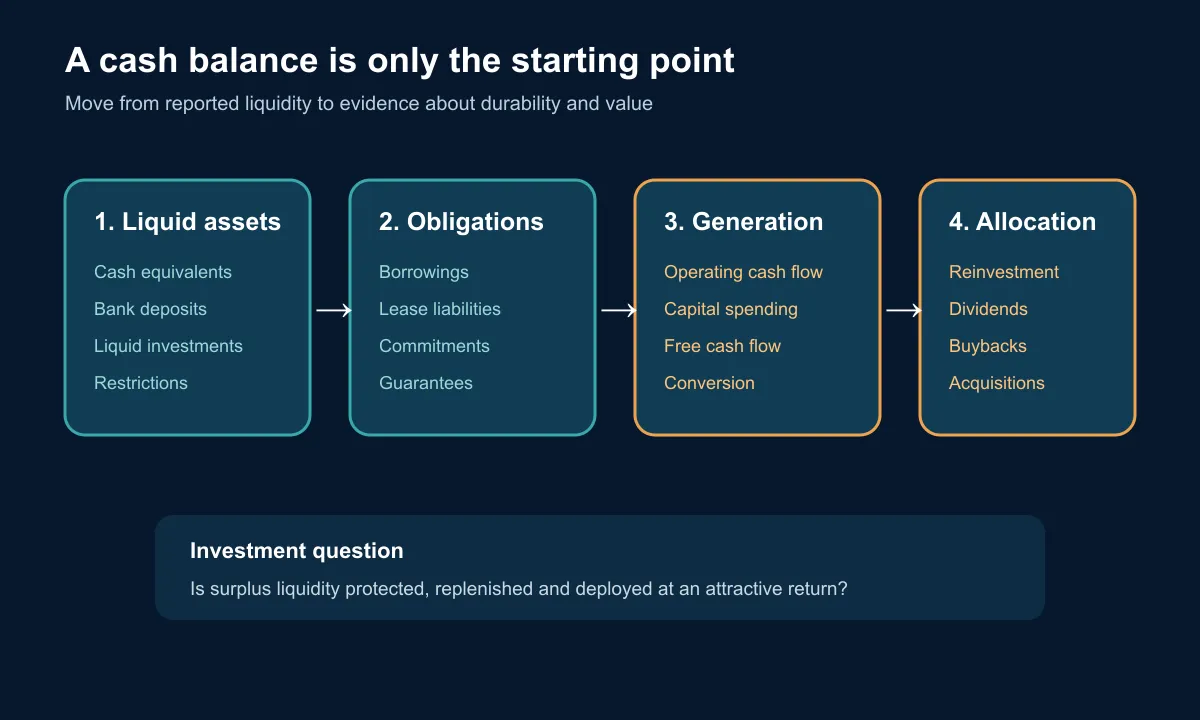
Cash balance is a point-in-time stock. Operating cash flow is the cash generated during a period after working-capital movements. Free cash flow usually means operating cash flow less capital expenditure, although company definitions can differ. Each answers a different question.
A company may show ₹10,000 crore of cash after issuing debt even though operations consume cash. Another may hold only a modest balance because it returns surplus cash each year while producing strong free cash flow. The second business can be financially healthier despite reporting less cash on the measurement date.
For companies with high cash reserves, calculate at least five years of operating cash flow, capital expenditure and free cash flow. Compare cumulative free cash flow with cumulative profit. Persistent profit without cash conversion may indicate rising receivables, inventory build-up or aggressive revenue recognition.
Seasonality matters. A consumer company may collect cash before a festival season; an engineering company may receive customer advances; a mining company may make large tax or royalty payments after year-end. Avoid treating one quarter as a normal run rate.
Net Cash Position: Subtracting Borrowings and Obligations
The simplest equation is:
Net cash = cash and liquid investments − interest-bearing borrowings
This is only a starting point. Some investments may be strategic, unlisted, restricted or difficult to sell. Lease liabilities, supplier-finance arrangements, pension deficits, guarantees and committed acquisitions can also reduce financial flexibility. Customer advances may be cash on the balance sheet but require future delivery.
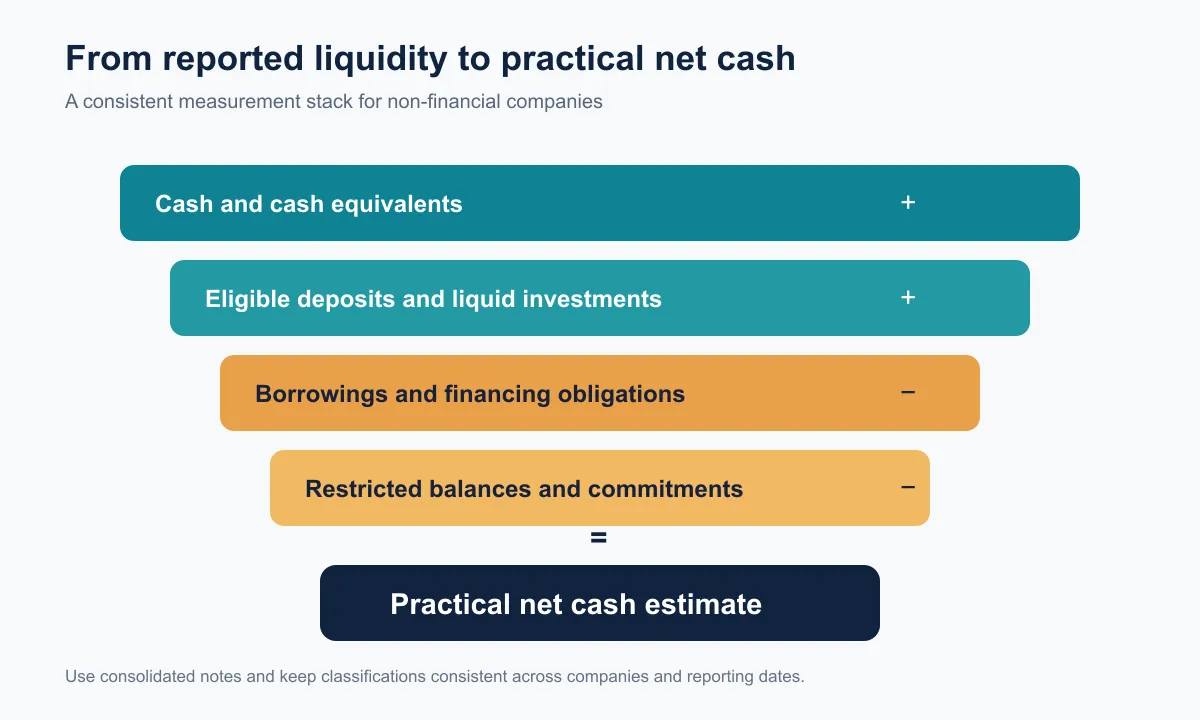
Use consolidated accounts so cash in subsidiaries and group debt appear together. Then check whether balances are freely transferable across jurisdictions. A parent may report access to dividends from a subsidiary only after local regulatory, tax and solvency requirements are met.
Among cash rich stocks, a company with ₹20,000 crore of liquid assets and ₹5,000 crore of debt is different from one holding the same assets with no borrowings. Net cash per share and enterprise value can help, but both depend on correctly classifying liquid investments.
Cash-Generation Quality: Conversion, Seasonality and Working Capital
Cash conversion tests whether accounting earnings become money. Common measures include operating cash flow divided by EBITDA, operating cash flow divided by net profit and free cash flow divided by net profit. Review several years because tax timing, provisions and working capital can distort one period.
Receivable days, inventory days and payable days explain the conversion. Fast revenue growth can temporarily consume cash, while delayed supplier payments can flatter operating cash flow. Negative working capital is valuable when customers pay before suppliers, but risky if it depends on slowing payments.
For cash rich companies in India, inspect the cash-flow statement alongside balance-sheet notes. The Wright Research guide on how to read an annual report helps connect cash movements with accounting disclosures. Also reconcile “other financial assets,” bank deposits and treasury investments rather than assuming every current asset is cash-like.
Get research like this in your inbox
The week’s research that mattered, in five minutes. Joined by 2L+ investors.
How Cash-Rich Companies Allocate Surplus Funds
Management can reinvest in capacity, research, distribution or acquisitions; repay debt; pay dividends; buy back shares; or retain liquidity. The best choice depends on expected return, valuation and risk. Retaining cash for a committed factory can be sensible, while holding the same amount without a plan can depress returns.
Evaluate acquisition discipline. Cash provides optionality, but it can encourage management to overpay or expand outside its competence. Compare the purchase price, strategic logic, post-deal returns and impairment history. For buybacks, ask whether shares were repurchased below a reasonable estimate of intrinsic value.
The best cash rich companies state a capital-allocation framework and demonstrate it through the cycle. Infosys, for example, completed an ₹18,000 crore buyback during FY2025-26 while still reporting substantial liquidity. That fact is more informative than the closing cash balance alone.
When Large Cash Reserves Can Signal Poor Capital Allocation
Surplus cash earns low returns when held in deposits or short-duration securities. If the operating business also lacks attractive reinvestment opportunities, return on equity can decline. Investors should ask why the company retains the balance and whether shareholders receive an appropriate return.
Warning signs include repeated promises of acquisitions that never occur, treasury assets growing faster than the business, low payout despite weak reinvestment returns, loans to related parties and unexplained investments in group entities. Foreign cash may also be subject to repatriation costs or restrictions.
Valuation matters. A seemingly cheap company can remain cheap when excess cash is controlled by management with a poor allocation record. Conversely, distributing every rupee can leave a cyclical business exposed during a downturn. The objective is an efficient buffer, not the highest possible balance.
Metrics to Compare Beyond Cash Balances
Use a compact dashboard:
| Metric | Calculation or evidence | What it reveals |
|---|---|---|
| Net cash | Liquid resources minus borrowings | Balance-sheet protection |
| Net cash per share | Net cash divided by diluted shares | Scale relative to ownership unit |
| Free cash flow | Operating cash flow minus capex | Cash available after reinvestment |
| Cash conversion | Operating cash flow divided by net profit | Earnings quality |
| Return on capital | Operating profit after tax relative to invested capital | Whether the core business creates value |
| Payout and buyback yield | Dividends plus buybacks relative to market value | Cash returned to shareholders |
| Acquisition returns | Post-deal profit and cash flow versus purchase price | Capital-allocation discipline |
Apply fundamental analysis before considering cash rich stocks in India. A liquid balance sheet cannot repair a structurally declining business, weak governance or an excessive purchase price.
Data Methodology and How Often the List Is Updated
The screen uses FY2025-26 consolidated disclosures available by 4 November 2026 and excludes banks, insurers and NBFCs. It considers cash, bank balances and liquid investments, then reviews borrowings, restrictions and cash generation. This keeps comparisons among cash rich companies in India consistent.
Refresh the list after every annual report and check material quarterly changes. Dividends, buybacks, acquisitions, debt repayment and capex can change net cash quickly. Preserve the reporting date and do not mix standalone data for one company with consolidated data for another.
This approach makes comparisons between cash rich companies in India more defensible. It also prevents cash rich stocks in India from being selected solely because one screener includes strategic investments or restricted deposits as cash.
Is your portfolio built for what’s coming?
Get a free AI-powered review of your holdings — risk, overlap and quality in minutes.
FAQ
Are fixed deposits and short-term investments included in cash equivalents?
Only when they meet the accounting definition, including high liquidity and an insignificant risk of value changes. Other deposits and short-term investments may still be liquid resources but appear in separate balance-sheet lines.
Why can cash reserves at banks and NBFCs differ from those of non-financial companies?
Cash, deposits and borrowings are operating assets and liabilities for financial institutions. Their liquidity must be analysed through regulatory ratios, asset quality and funding structure, not a non-financial net-cash screen.
Why might a cash-rich company retain surplus cash instead of paying dividends?
It may fund working capital, capex, acquisitions, contingencies or regulatory needs. Investors should compare the stated purpose with actual deployment and the return earned on retained capital.
Does a reported cash balance include cash held by subsidiaries?
Consolidated statements generally include controlled subsidiaries, subject to consolidation adjustments. That does not mean every balance can be transferred freely to the parent, so review restrictions, jurisdictions and minority interests.
The strongest cash rich companies in India do more than accumulate liquidity. They generate cash repeatedly, maintain a robust net position and allocate surplus capital at attractive risk-adjusted returns.
For education only, not investment advice. Financial data and classifications change with new disclosures. Consult a SEBI-registered investment adviser where appropriate.


