


In our last rebalance, we informed the subscribers that we are upgrading our models to include “earnings momentum”. This raised a lot of curiosity! So in this post we will try to explain what earnings momentum is and why we are adding it to our portfolios.

Earning momentum refers to the recent trend in a company's earnings. If a company has positive earning momentum, it means that its earnings have been increasing over a period of time. It is not only related to growth in the companies profitability but also to the performance of a company’s results against the expectations. Earnings momentum can be an essential factor for investors to consider when evaluating a company as a potential investment, as it can provide insight into its financial health and future performance.
Earnings Momentum Definition
Earnings Momentum refers to the trend of a company's earnings performance over a specific period, typically measured on a quarterly or annual basis. It is an essential concept in financial analysis and investment decision-making, as it provides valuable insights into a company's growth potential and financial strength. Positive earnings momentum indicates that a company's earnings are consistently increasing, while negative earnings momentum suggests declining earnings over time.
Investors and analysts often use earnings momentum as a key metric to assess a company's financial health and future prospects. A company with strong and consistent positive earnings momentum is generally viewed as a sign of a well-managed, thriving business with the potential for sustained growth. On the other hand, negative earnings momentum may raise concerns about the company's ability to remain profitable and competitive in the market.
See what markets are pricing in
Live indices, sector moves and market breadth — the backdrop to every story we publish.
How is earnings momentum calculated?

Stocks with earnings momentum or growth stocks are stocks of companies that are expected to grow at a faster rate than the overall market. When analysing growth stocks, it's essential to consider the company's past performance and future growth potential. Here are a few key things to consider:
Revenue and Earnings Growth:Look for companies with a solid revenue and earnings growth history. This can be a good indicator of the company's future growth potential.
Profit Margins:Higher profit margins indicate that a company is more efficient at generating profits and has more room to grow.
Valuation:Growth stocks are often more expensive than value stocks, so it's important to ensure the company's valuation is reasonable, given its growth prospects.
Earnings surprise:Another way to measure earning momentum is to calculate the earnings surprise, which is the difference between a company's actual earnings and the earnings that analysts expected. A positive earnings surprise indicates that the company's earnings exceeded expectations, which can signify strong earning momentum.

Understanding EPS Momentum
EPS Momentum, specifically, focuses on the trend of a company's Earnings Per Share (EPS) over time. EPS is a crucial financial metric that measures a company's profitability by dividing its net earnings by the number of outstanding shares. It reflects the portion of a company's profit that is allocated to each share, giving investors an idea of the earnings generated on a per-share basis.
EPS Momentum provides valuable insights into how a company's profitability is evolving. A consistent increase in EPS over several quarters or years indicates positive earnings momentum and portrays a financially healthy and growing business. Conversely, declining EPS over time signals negative earnings momentum, which may raise concerns about the company's financial performance and future prospects.
How EPS Momentum is Calculated
Calculating EPS Momentum is relatively straightforward. It involves comparing the EPS of a company over consecutive periods, such as quarters or years, and observing the trend:
Gather EPS Data: Collect the EPS figures for the company's financial reports over the desired time frame.
Compute Change in EPS: Calculate the percentage change in EPS between each period. For example, to determine the EPS momentum for quarterly data, subtract the EPS of the previous quarter from the EPS of the current quarter and divide the result by the EPS of the previous quarter. Multiply the outcome by 100 to express it as a percentage.
Analyze the Trend: Examine the calculated percentage changes to discern the pattern of earnings momentum. A consistent increase in percentage change signifies positive earnings momentum, while a series of decreasing values indicates negative earnings momentum.
How does one estimate earnings?
This is the big question! Many analysts will incorporate top-down factors such as economic growth rates, currencies and other macroeconomic factors that influence corporate growth. They use market research reports to get a sense of underlying growth trends. To understand the dynamics of the companies they cover, good analysts will speak to customers, suppliers and competitors. Finally, the companies themselves offer earnings guidance that analysts build into the models.
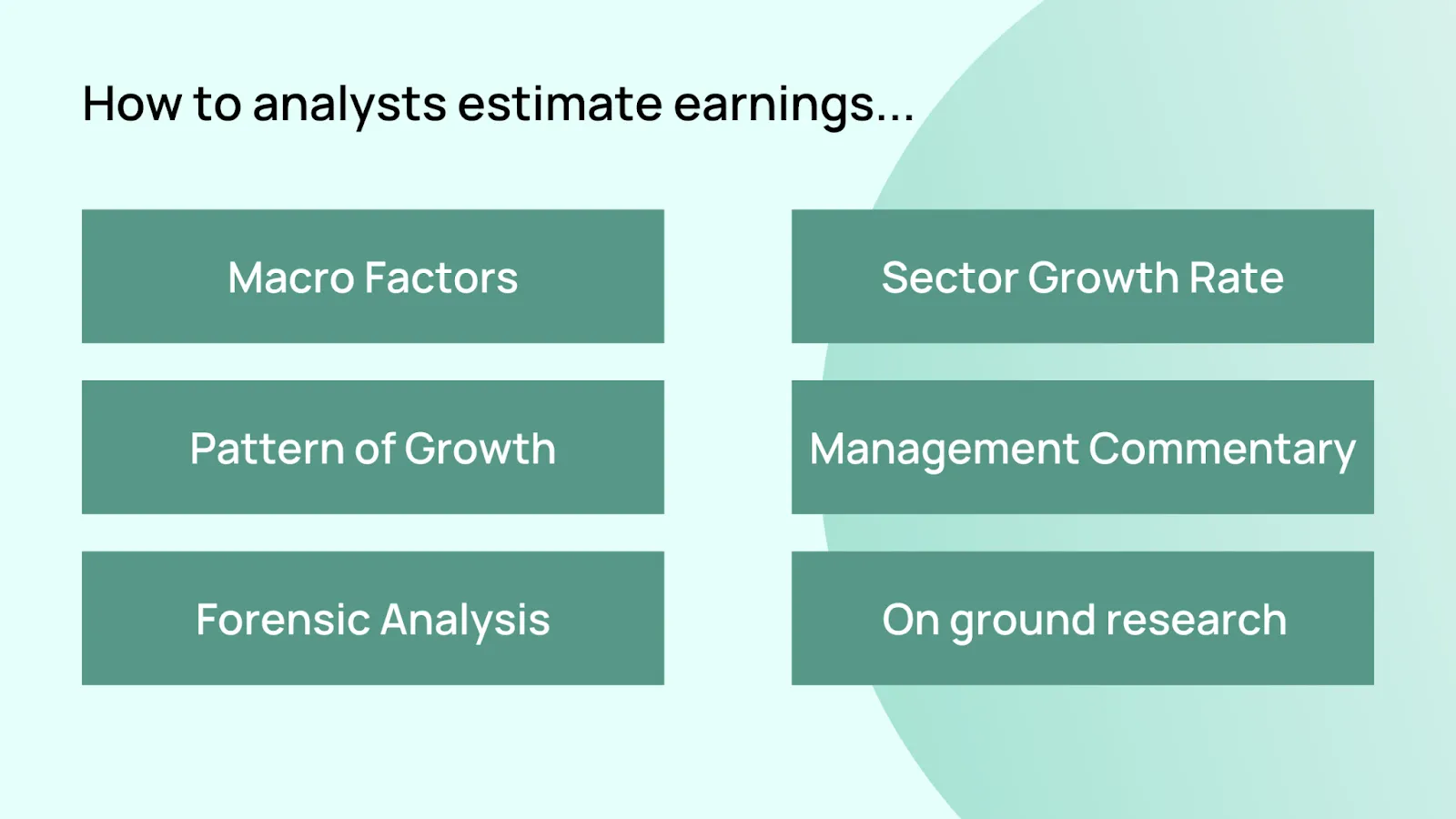
To predict revenues, analysts estimate sales volume growth and evaluate the prices companies can charge for the products. On the cost side, analysts look at expected changes in the costs of running the business. Costs include wages, materials used in production, marketing and sales costs, interest on loans, etc.
How are estimates useful?

Earning estimates can be a helpful tool for investors to help them make informed decisions about where to invest their money. Earnings estimates are forecasts of a company's future earnings based on factors such as its financial performance, industry trends, and economic conditions.
There are several ways that investors can use earning estimates to guide their investment decisions:
Compare earning estimates to a company's actual earnings: By comparing a company's actual earnings to the earnings estimates made by analysts, investors can get a sense of the company's financial performance and whether it is meeting expectations.
Look for companies with positive earnings estimate revisions: If analysts are consistently revising their earning estimates for a company upwards, it could be a sign that the company's financial performance is improving and that it may be a good investment opportunity.
Consider the company's industry and sector: It can be helpful to compare a company's earning estimates to those of its peers in the same industry or sector and the overall market. This can give investors a sense of how the company is performing relative to its competitors and the market.
Get research like this in your inbox
The week’s research that mattered, in five minutes. Joined by 2L+ investors.
Benefits and Risks of Incorporating Earnings Momentum
Benefits
Growth Assessment: Earnings momentum allows investors to assess a company's growth trajectory and financial health over time. Positive momentum can indicate a growing business with increasing profitability.
Investment Decision-making: EPS momentum is a valuable tool for investors when making investment decisions. Companies with positive earnings momentum may be seen as attractive investment opportunities, while negative momentum may signal potential risks.
Identifying Trends: By analyzing EPS momentum, investors can identify trends in a company's financial performance, helping them make informed decisions about their investment strategies.
Risks
Short-term Focus: Relying solely on short-term earnings momentum may lead investors to overlook the long-term fundamentals and sustainability of a company.
Market Sentiment: EPS momentum can be influenced by external factors such as market sentiment, which may not accurately reflect a company's underlying performance.
Cyclical Nature: Some industries experience cyclical patterns that can impact earnings momentum. Investors must consider the industry-specific factors when interpreting earnings momentum data.
Incorporating earnings momentum into investment analysis provides valuable insights into a company's financial performance and growth potential. However, it is essential for investors to consider this metric in conjunction with other fundamental and qualitative factors to make well-rounded and informed investment decisions.
How is earning momentum different from price momentum?
Earning and price momentum are two different concepts that can be used to evaluate a company's or security's performance.
Earning momentum refers to the trend in a company's earnings over a period of time. If a company has positive earning momentum, its earnings have been increasing.
On the other hand, price momentum refers to the trend in the price of a security over time. If security has positive price momentum, its price has been increasing.
While earning momentum and price momentum are related, they are not the same thing. A company's earnings can influence its stock price, but other factors such as market conditions, industry trends, and investor sentiment can also impact the price of a security.
How has the performance of earnings momentum been in 2022?
Earnings momentum has outperformed price momentum as it has been a tough market in 2022, where identifying stocks with actual value and earning potential has been most important.
Per our estimates, the top earning momentum strategy has beaten a price momentum strategy by a margin last year. This is also quite apparent based on the performance of Nifty Growth Index.

Which stocks are expected to have earnings momentum in 2023?
Here’s how the allocations fors earnings momentum strategy looks like. Banks seems to have the highest weightage in the earnings momentum strategy followed by energy, industrials, metals and financials.
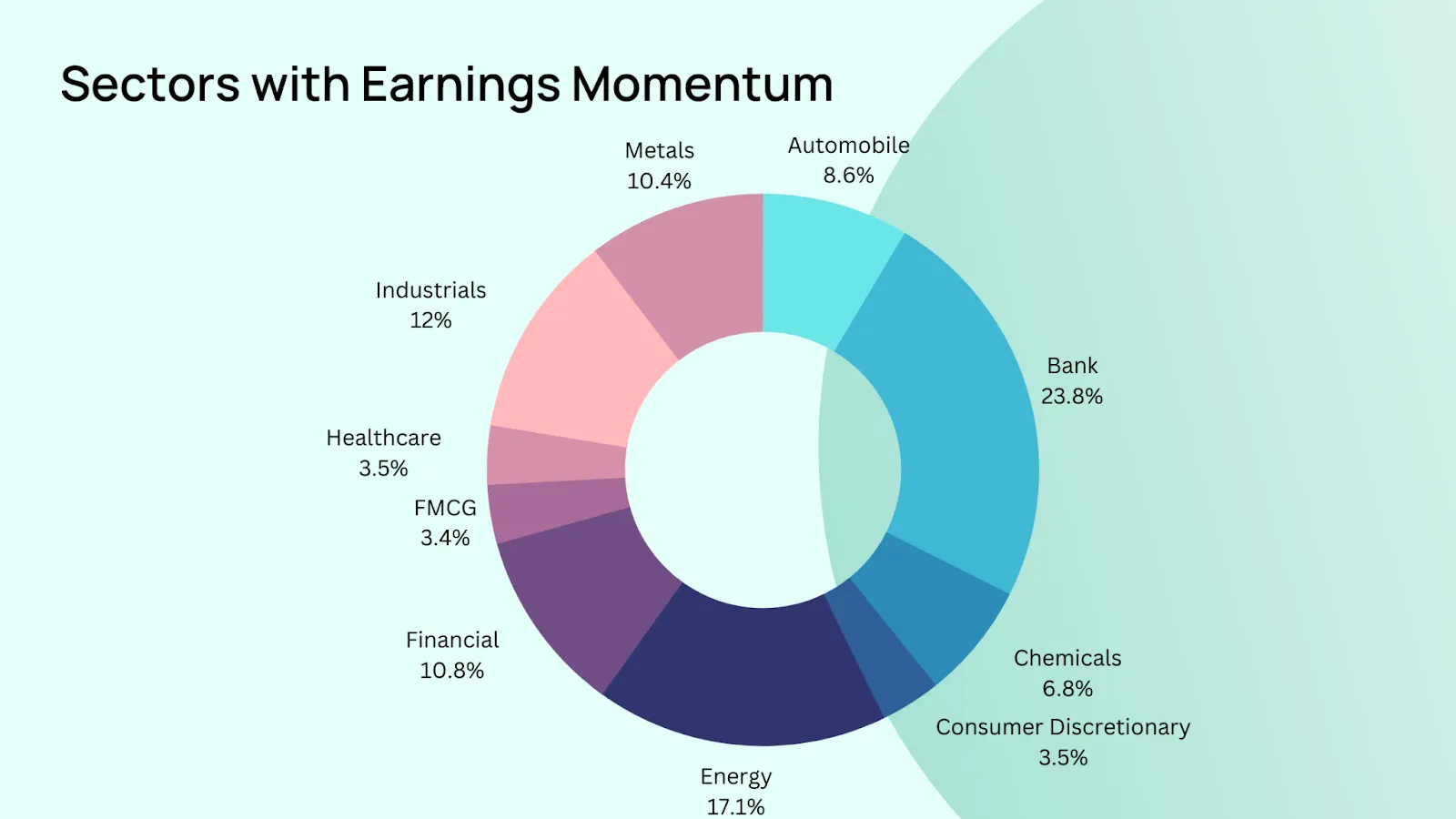
With the budget coming in the beginning of 2023, the sectors that the government is looking to focus on - manufacturing, capital goods, defence, sustainability, railways, public sector banks are already seeing fresh investments. We expect these sectors to continue to be in the spotlight.
How can we invest in earnings momentum with Wright?
With the last rebalance, we have now included earnings momentum to be a part of our Momentum, Multi-Factor and Smallcaps strategies along with Price Momentum and other factors. There have been further improvements in the New India and Innovation stratgies as well.
You can invest in our research on Earnings Momentum using the Wright Momentum strategy.
Wright ⚡️ Momentum by Wright Research.
Track the factors behind this research
Momentum, value, quality and low-vol — updated factor performance for Indian markets.
FAQs
What is the relationship between earnings momentum and earnings management?
Earnings momentum refers to the trend of a company's earnings over time, while earnings management involves manipulating financial results to achieve certain objectives. Earnings management can impact earnings momentum by distorting the genuine trend of a company's earnings.
How does earnings management affect earnings momentum?
Earnings management can artificially boost or suppress a company's reported earnings, leading to a temporary spike or dip in earnings momentum. This can mislead investors and distort their perception of the company's financial health.
What is the earnings momentum factor, and how does it impact investing strategies?
The earnings momentum factor is a factor used in quantitative investment strategies. It focuses on investing in companies with strong positive earnings momentum. By targeting companies with consistent earnings growth, investors aim to capitalize on the potential for future price appreciation.
How does earnings momentum contribute to revenue growth?
Earnings momentum and revenue growth are closely interlinked. Companies that consistently report positive earnings momentum often exhibit sustained revenue growth. This is because, typically, a company's earnings are derived from its revenues. Therefore, as revenues increase, so do earnings, assuming the company maintains control over its expenses. The continued growth of both revenues and earnings often signals a successful business strategy and efficient operations, attracting more investors and potentially driving up the stock price.
Are there any real-life examples of successful earnings momentum strategies?
Yes, there are several real-life examples of successful earnings momentum strategies. Many institutional investors and hedge funds use earnings momentum as part of their investment strategies. For instance, the famous Fidelity Contrafund, managed by Will Danoff, has often incorporated earnings momentum into its strategy. The fund looks for companies that are likely to beat earnings estimates and have positive earnings surprises, reflecting strong earnings momentum. Tech giants like Apple and Microsoft are often cited as companies that have demonstrated consistent earnings momentum over the years, contributing to their market success and attractive returns for investors. Also, Wright Momentum incorporates earnings momentum in it’s strategies helping investors in the Indian market.


