


The Indian stock market, one of the oldest in Asia, has a rich history that dates back to the 19th century. The evolution of the stock market in India is intertwined with the country's colonial past and its eventual journey to independence in 1947.
Birth of the Indian Stock Market
The roots of the Indian stock market can be traced back to the early 19th century when the country was under British colonial rule. The growth of the stock market in India was closely linked to the development of trade, commerce, and industry under British influence.
Early 19th Century: The Precursor to Stock Trading
The beginning of organized stock trading in India can be traced to the 1830s in Mumbai, which was rapidly emerging as a major commercial hub due to its strategic location and the presence of the British East India Company. The need for capital to fund large-scale infrastructure projects, such as the construction of railways and the establishment of textile mills, led to the introduction of joint-stock companies. These companies needed to raise capital from the public, leading to the early forms of stock trading.
1850s: Formalization of the Stock Market
The first recorded instance of organized trading in shares can be dated to the 1850s. A group of brokers began trading under a banyan tree in front of the Town Hall in Bombay. This informal group of brokers would later become the foundation of India's first stock exchange.
1875: Establishment of the Bombay Stock Exchange (BSE)
The year 1875 marked a significant milestone in the history of the Indian stock market with the establishment of the Native Share and Stock Brokers' Association, which later became the Bombay Stock Exchange. The BSE is the oldest stock exchange in Asia and was formed by a group of 22 brokers who would meet under the banyan tree to trade shares. The BSE played a crucial role in the development of the Indian capital markets by providing a platform for the trading of securities and formalizing the process of stock trading.
Late 19th Century
By the late 19th century, the Indian stock market had begun to grow rapidly, driven by the expansion of the railways, the establishment of cotton mills, and the booming trade in opium and textiles. The period saw the emergence of other stock exchanges in major cities such as Ahmedabad and Calcutta (now Kolkata), further strengthening the market infrastructure.
Check the macro backdrop
GDP, inflation, rates and more — India’s key economic indicators in one dashboard.
Indian Stock Market Finding Its Voice in 20th Century
World War I and the Post-War Period
World War I (1914-1918) had a considerable impact on the Indian economy and the stock market. The war led to increased government spending and the need for war bonds, which were traded on the stock exchanges. However, the post-war period brought economic difficulties, including inflation and a decline in trade, which affected the stock market.
1920s: The Boom and the Bust
The 1920s witnessed a boom in the Indian stock market, driven by the global economic prosperity of the Roaring Twenties. However, this period was also characterized by speculation and the formation of stock market bubbles. The crash of the Bombay stock market in 1929, coinciding with the Wall Street Crash in the United States, led to a severe downturn in the Indian economy and stock market.
1930s: The Great Depression and Recovery
The Great Depression of the 1930s had a profound impact on the Indian economy and the stock market. The global economic slowdown led to a decline in demand for Indian goods, a fall in prices, and a contraction in economic activity. The stock market experienced a prolonged period of downturn during this time.
However, the Indian economy and the stock market began to recover in the late 1930s, aided by the growth of industries such as textiles, jute, and tea. The onset of World War II in 1939 brought new challenges, but also opportunities, as the demand for war-related goods and services increased.
1940s & the Impact of World War II
World War II (1939-1945) had a mixed impact on the Indian stock market. On one hand, the war led to increased government spending and the issuance of war bonds, which were traded on the stock exchanges. On the other hand, the war caused disruptions in trade and production, leading to economic challenges.
1940s also saw the rise of new industries in India, including steel, cement, and chemicals, which contributed to the growth of the stock market. The industrialization of India, supported by the British government and Indian entrepreneurs, led to the emergence of new companies and the listing of their shares on the stock exchanges.
Indian Independence from British Rule
Bombay Plan and Economic Nationalism
During the 1940s, Indian industrialists and economists began to advocate for economic nationalism and self-reliance. The Bombay Plan, formulated in 1944 by a group of leading industrialists, outlined a vision for India's post-independence economy, emphasizing the need for industrialization and government intervention in the economy. This plan had a significant impact on the stock market, as it highlighted the importance of capital markets in financing industrial growth.
August 15, 1947: India Gains Independence
1956: Formalization of Stock Trading
India passed the Securities Contracts Regulation Act in 1956, which formalized stock trading. This act provided a legal framework for the regulation of stock exchanges, securities contracts, and the protection of investors, further strengthening the foundation of the Indian stock market.
1964: Introduction of Mutual Funds
The newly-created Unit Trust of India (UTI) launched India’s first mutual fund scheme, the US 64, in 1964. The scheme became highly popular, raising Rs 6,400 crore by 1988, and established UTI as a major player in the Indian financial market.
1977: The Rise of Reliance Industries
Dhirubhai Ambani’s Reliance Industries, with interests in textiles and petrochemicals, listed on the stock exchange in 1977. The IPO garnered huge interest from retail investors, kickstarting the ‘cult of equity’ in India, and marked the beginning of a new era for Indian entrepreneurship and the stock market.
1986: Launch of BSE SENSEX
On January 1, 1986, BSE introduced the SENSEX, a 30-share index that became the benchmark for the Indian stock market. With a base year of 1978-79 and a base value of 100, the SENSEX provided a barometer of market performance and became the most widely tracked index in India.
Challenges and Transformations in the Late 20th Century
1988: Establishment of SEBI
The late 1980s were marked by a lack of transparency and undependable clearing and settlement systems, which underscored the need for a financial market regulator. As a result, the Securities and Exchange Board of India (SEBI) was established in 1988. However, it was not until 1992 that SEBI was granted statutory power, enabling it to regulate the securities market effectively.
1992: Formation of the National Stock Exchange (NSE)
In 1992, the National Stock Exchange of India Limited (NSE) was established. This period also saw a sharp spike in interest in the stock market, driven by a bull market led by Harshad Mehta. The NSE was created to bring greater transparency and efficiency to the market, and it introduced a modern, fully automated screen-based electronic trading system in 1994, which revolutionized trading in India.
1994: Launch of Nifty 50 Index
On April 22, 1994, the NSE launched the Nifty 50 index, a benchmark Indian stock market index representing the weighted average of 50 of the largest Indian companies listed on the NSE. Initially, the Nifty 50 was calculated based on the full market capitalization methodology, but from June 26, 2009, the computation shifted to a free-float methodology. The base period for the Nifty 50 index is November 3, 1995, with a base value set at 1,000.
Get research like this in your inbox
The week’s research that mattered, in five minutes. Joined by 2L+ investors.
Major Events That Shaped the Indian ShareMarket
1. The 1991 Economic Liberalization
The 1991 economic liberalization marked a watershed moment in India’s economic history. Faced with a severe balance of payments crisis, the Indian government, under Prime Minister P.V. Narasimha Rao and Finance Minister Dr. Manmohan Singh, initiated sweeping economic reforms. These reforms included de-licensing industries, reducing tariffs, and opening the economy to foreign investment.
Impact on theShareMarket:
The liberalization opened the Indian stock market to foreign institutional investors (FIIs) for the first time, bringing in substantial foreign capital.
It led to a rapid increase in market capitalization and liquidity, making the Indian stock market more attractive to global investors.
The reforms laid the foundation for a more modern, competitive, and transparent financial system, propelling the Indian stock market towards globalization.
2. The Establishment of SEBI (1988) and Its Empowerment (1992)
The Securities and Exchange Board of India (SEBI) was established in 1988 to protect investor interests and promote the development and regulation of the securities market. However, SEBI was not granted statutory powers until 1992, following the Harshad Mehta scam, which highlighted the need for a stronger regulatory framework.
Impact on theShareMarket:
SEBI’s empowerment marked the beginning of a new era of regulatory oversight in the Indian stock market, enhancing investor confidence.
The introduction of rules regarding insider trading, disclosure norms, and market transparency helped curb malpractices and boosted the integrity of the market.
SEBI’s role in ensuring fair trading practices and protecting retail investors has been pivotal in the market’s evolution.
3. The 1992 Harshad Mehta Scam
The 1992 stock market scam, orchestrated by stockbroker Harshad Mehta, exposed significant loopholes in the Indian banking system and stock market. Mehta manipulated stock prices using money obtained fraudulently from banks.
Impact on theShareMarket:
The scam led to a massive market crash, wiping out investor wealth and shaking confidence in the financial system.
It resulted in the restructuring of SEBI, granting it more powers to regulate the stock market effectively.
The scam underscored the importance of transparency and stringent regulation in the financial markets, leading to the modernization of trading systems and procedures.
4. The Dot-Com Bubble Burst (2000)
The late 1990s saw a surge in technology stocks globally, including in India. The hype around internet-based companies led to inflated stock prices. However, when the bubble burst in 2000, stock markets around the world, including India, experienced significant downturns.
Impact on theShareMarket:
The burst of the dot-com bubble led to a steep decline in the value of tech stocks in India, causing a broader market correction.
It highlighted the risks of speculative investing and the importance of sound business fundamentals.
The market downturn pushed investors and regulators to focus on sustainable growth and proper valuation of companies.
5. The 2008 Global Financial Crisis
The global financial crisis of 2008, triggered by the collapse of Lehman Brothers and the subprime mortgage crisis in the United States, sent shockwaves through global markets, including India.
Impact on theShareMarket:
The Indian stock market experienced one of its sharpest declines, with the SENSEX falling by more than 50% from its peak in January 2008.
The crisis led to increased volatility and highlighted the interconnectedness of global financial markets.
In response, Indian regulatory bodies, including SEBI and the Reserve Bank of India (RBI), strengthened risk management practices and regulatory frameworks, helping the market recover more robustly.
6. The Demonetization Drive (2016)
On November 8, 2016, the Indian government announced the demonetization of ₹500 and ₹1,000 currency notes in an effort to curb black money, counterfeiting, and tax evasion. This move had widespread implications across the economy, including the stock market.
Impact on the Share Market:
The stock market witnessed significant volatility in the immediate aftermath of the announcement, with sectors like real estate, banking, and consumer goods experiencing sharp declines.
Over time, the market stabilized as the transition to a less-cash economy began to show positive effects, such as increased digital transactions and better tax compliance.
The long-term impact was mixed, with certain sectors benefiting from increased formalization of the economy, while others struggled with the liquidity crunch.
7. The Introduction of Goods and Services Tax (GST) (2017)
The implementation of the Goods and Services Tax (GST) on July 1, 2017, was a landmark reform aimed at creating a unified indirect tax structure across India. It replaced a multitude of state and central taxes with a single tax regime.
Impact on theShareMarket:
The GST brought about greater ease of doing business and improved tax compliance, which was positively received by the markets.
Companies in sectors such as logistics, manufacturing, and consumer goods saw long-term benefits from the streamlined tax structure.
Despite initial challenges and market corrections, the overall sentiment remained positive as GST was expected to boost economic growth and corporate earnings.
8. The COVID-19 Pandemic (2020-2022)
The outbreak of COVID-19 in early 2020 led to unprecedented disruptions in global economies, including India. The pandemic-induced lockdowns and economic slowdown had a profound impact on the Indian stock market.
Impact on theShareMarket:
The stock market witnessed one of the steepest declines in history in March 2020, with the SENSEX dropping by nearly 40% from its pre-pandemic highs.
However, the market showed remarkable resilience, rebounding strongly by the end of 2020, driven by massive government stimulus, monetary easing by the RBI, and optimism around vaccine developments.
The pandemic accelerated the adoption of digital technologies in trading and investing, with a surge in retail participation in the stock market.
Major Regulatory Improvements by SEBI in the Last 10 years
Here are the major regulatory improvements undertaken by SEBI for the stock markets in the last 10 years:
SEBI introduced regulations for REITs and InvITs, providing a framework for these investment vehicles and allowing investors to participate in real estate and infrastructure projects.
Implementation of the Securities and Exchange Board of India regulations standardized disclosure requirements and corporate governance norms for listed entities, enhancing transparency and protecting investor interests.
Introduction of the Goods and Services Tax (GST) was a government initiative, SEBI adjusted the regulatory framework to accommodate changes, ensuring smooth transitions for market participants.
Mandatory Dematerialization of Shares for Transfer (2018) was mandated by SEBI to transfer of shares of listed companies must be in dematerialized form, reducing fraud and simplifying the transfer process.
Framework for Commodity Derivatives Market (2015-2016) was merged by SEBI for Forward Markets Commission (FMC) with itself and brought the commodity derivatives market under its purview, introducing regulatory frameworks for these markets.
SEBI strengthened regulations on insider trading, defining insider trading more comprehensively and increasing penalties for violations to protect market integrity.
Introduction of Mutual Fund Reclassification Norms (2017): SEBI mandated the reclassification of mutual fund schemes to ensure clarity and reduce overlap, helping investors make more informed decisions.
Framework for Enhanced Monitoring and Reporting of Foreign Portfolio Investors (FPIs) (2018): SEBI introduced new norms for FPIs, including enhanced monitoring, to improve transparency and reduce the risk of market manipulation.
Introduction of the Regulatory Sandbox (2019): SEBI launched a regulatory sandbox to allow market participants to test new financial products and services in a controlled environment, promoting innovation while ensuring investor protection.
Implementation of Margin Requirements for Derivatives Trading (2020): SEBI tightened margin requirements for derivatives trading, aiming to reduce speculative trading and enhance market stability.
Enhanced Corporate Governance Norms for Listed Companies (2018): SEBI implemented stricter corporate governance norms, including rules on board composition, audit committees, and related party transactions, to enhance accountability and transparency.
Introduction of the Stewardship Code for Mutual Funds and Institutional Investors (2020): SEBI mandated that mutual funds and other institutional investors adopt a stewardship code, ensuring they actively engage with investee companies to protect investor interests.
Framework for Risk-Based Supervision of Market Intermediaries (2019): SEBI introduced a risk-based supervision framework for intermediaries like brokers and portfolio managers, focusing regulatory attention on areas with higher risk.
Regulations for Social Stock Exchange (2020): SEBI proposed a framework for a Social Stock Exchange to list social enterprises and voluntary organizations, allowing them to raise funds through the capital markets.
Settlement Date Changes by SEBI
T+2 to T+1 Settlement: Indian exchanges shifted from a T+2 to T+1 settlement cycle starting January 2023, initiated in phases from January 2022.
- Optional T+0 settlement: a beta version started on 28 March 2024 for select stocks, and SEBI extended it to the top 500 stocks in December 2024. It runs alongside the T+1 cycle.
Nifty 50 Performance from 1990s till 2024
The Nifty 50 closing value shows a consistent upward trend over the years, reflecting the long-term growth of the Indian stock market. This growth is especially notable from the early 2000s onwards, where the index experiences significant increases, particularly around the periods leading up to and following economic reforms and technological advancements.
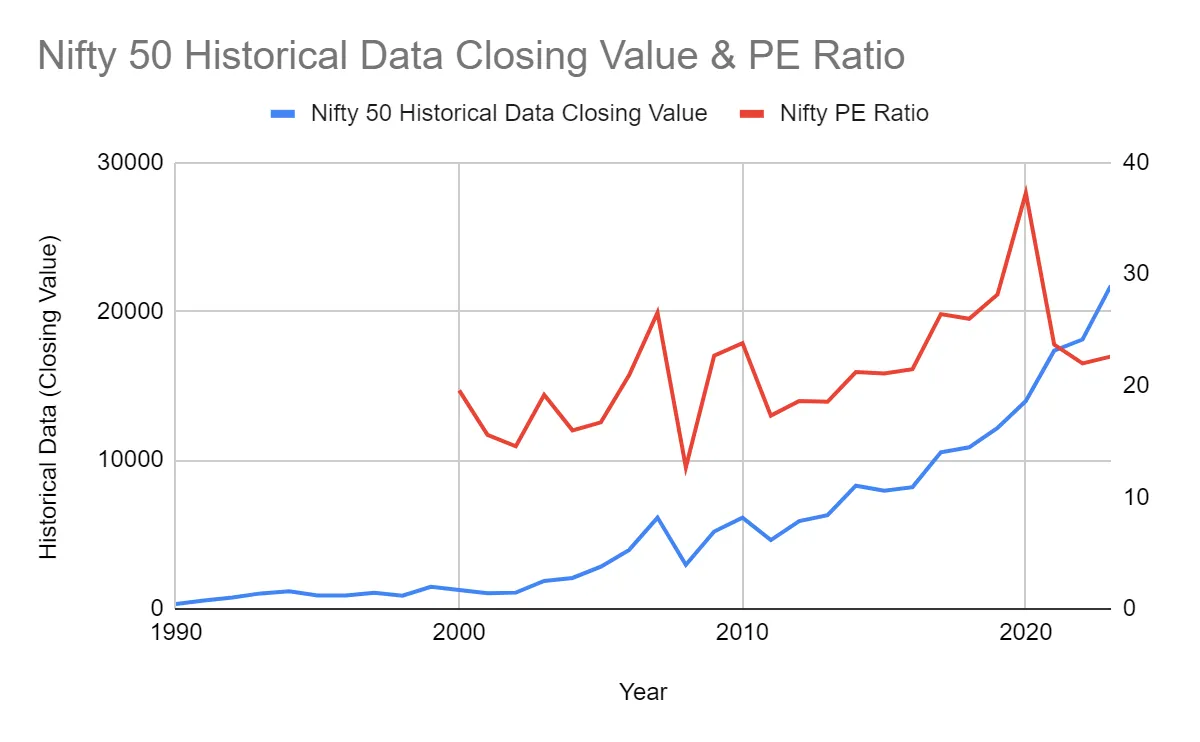
In contrast, the Nifty PE ratio displays more volatility, with noticeable spikes and drops at various points in time. These fluctuations suggest periods of market overvaluation or corrections. For instance, there are prominent peaks around 2008 and 2020, coinciding with global financial events like the financial crisis and the COVID-19 pandemic, respectively. Despite these fluctuations, the general trend shows that while the market has grown in value, it has also seen periods of significant revaluation, impacting investor sentiment and market stability. Overall, the Indian stock markets have shown a strong growth trajectory from 1990 while also emphasizing the accompanying market volatility. The data suggests that the market has been a good long-term investment.
Large caps or small caps: who is winning?
Nifty, midcap and smallcap returns from one day to ten years, with the spread and valuation by segment.
The Indian Stock Market, 2024 to 2026
Figures are from exchange, AMFI, depository, SEBI and press reports, as of 23 November 2026 unless stated.
Market Size
BSE-listed market capitalisation first crossed Rs 400 lakh crore on 8 April 2024 and US$5 trillion in May 2024. India's total market capitalisation crossed Rs 500 lakh crore on 6 November 2026, and was about US$5.42 trillion on 13 November 2026, which made India the fifth-largest equity market with a 3.37% share of global market capitalisation.
Key Market Events
| Date | Event |
|---|---|
| 4 June 2024 | Lok Sabha results day: the Sensex closed 4,390 points (5.7%) lower, and about Rs 31 lakh crore of market capitalisation was lost in the session |
| October 2024 | Hyundai Motor India IPO raised Rs 27,870 crore |
| 2025 | Foreign portfolio investors were net sellers of Rs 1.58 lakh crore of equities, a record for a calendar year, while domestic institutions were net buyers of roughly Rs 7 to 7.7 lakh crore depending on the cut-off used |
| October 2025 | Tata Capital's Rs 15,512 crore IPO, the largest of 2025 |
| 2 January 2026 | Sensex record close of 85,762; the Nifty 50 reached a record above 26,300 in the first week of January |
| March 2026 | The worst month since the Covid period, with a fall of over 11%: the Sensex closed at 71,947.55 and the Nifty at 22,331.40 on 30 March. Reports cited Middle East tensions, high crude prices, a weaker rupee and foreign outflows |
| September 2026 | NSE's own IPO opened on 17 September at a final price of Rs 1,785, with listing on 24 September |
| 28 October 2026 | Jio Platforms listed at Rs 1,358, a 21.36% premium to its issue price, after an IPO of about Rs 30,200 crore |
| 20 November 2026 | Sensex closed at 83,919.71 and Nifty at 25,800.60; the Nifty was up about 11.9% in November so far but still below its January 2026 high |
Investor Participation
NSDL had 4.77 crore demat accounts in October 2026, and the industry total passed 21 crore in late 2025. NSE reported 13 crore unique registered investors in April 2026, up from 10 crore in August 2024. Monthly SIP contributions were Rs 32,160 crore in October 2026, just below the record Rs 32,490 crore of September 2026, across about 10 crore SIP accounts (AMFI).
IPO fundraising was a record in FY26: about Rs 1.8 lakh crore across 219 listings, according to NSE data.
Regulation and Taxes
- Tuhin Kanta Pandey took charge as SEBI chairperson on 1 March 2025.
- SEBI's F&O framework of 1 October 2024 introduced six measures, including a higher minimum contract value for index derivatives, weekly expiry on one benchmark index per exchange, and upfront collection of option premium. It took effect from November 2024, and lot sizes were revised in Nov-Dec 2024 (for example, Nifty from 25 to 75).
- Budget 2024 (July 2024) raised short-term capital gains tax on listed equity from 15% to 20% and long-term from 10% to 12.5%, with the exemption raised to Rs 1.25 lakh.
- Budget 2026-27 (1 February 2026) raised STT on futures from 0.02% to 0.05% and on options premium from 0.10% to 0.15%, and left capital gains rates unchanged.
- SEBI notified the Portfolio Managers Regulations 2026 on 7 October 2026, effective 1 April 2027, replacing the 2020 regulations; they ban upfront fees.
Past market levels are not an indication of future results.


