


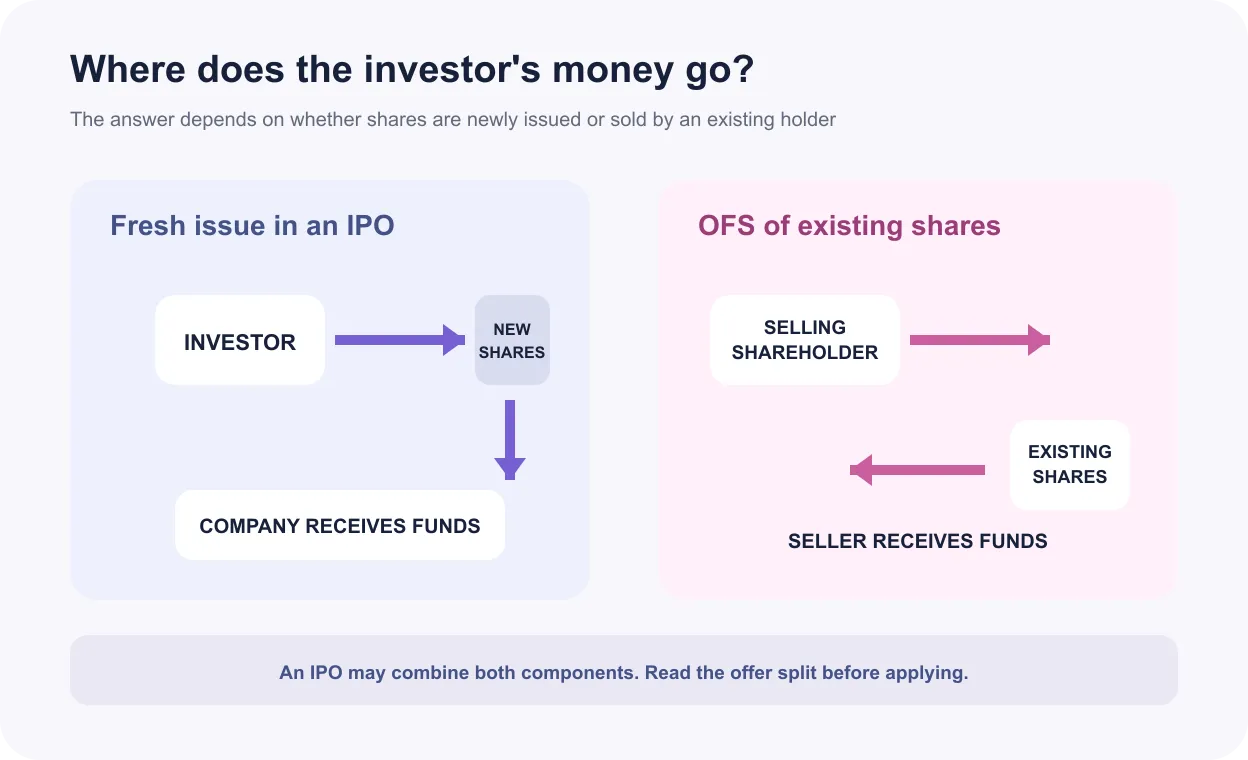
An IPO and an OFS can both place shares in investors' demat accounts, but the capital flow can be very different. In a fresh issue, the company creates shares and receives the proceeds. In an offer for sale, an existing shareholder sells shares and receives the proceeds.
The difference between IPO and OFS also depends on context. An IPO is a company's first public offering and can combine a fresh issue with an OFS component. The exchange OFS mechanism, meanwhile, is a separate bidding window for existing shares of an eligible listed company.
Investors evaluating IPO vs OFS should identify what is being sold, who receives the money, whether the share count changes and which application process applies. The labels alone say nothing about valuation or future returns.
The difference between IPO and OFS becomes clear only after separating primary capital from a secondary transfer. That distinction should be checked before reviewing subscription demand.
What Is an IPO?
IPO meaning is Initial Public Offering. It is the process through which an unlisted company first offers equity shares to public investors and seeks listing on a recognised stock exchange. The offer is governed by an offer document that describes the business, risks, financial statements, use of proceeds and issue structure.
An IPO may be a fresh issue, an offer for sale by existing shareholders, or a combination. SEBI's own processing terminology distinguishes IPO (Fresh), IPO (OFS), and IPO (Fresh + OFS). Investors must therefore read the composition rather than assume every IPO funds the company.
For a fresh component, the company issues additional shares and receives funds for the stated objects of the offer, subject to expenses. This can finance expansion, reduce debt, fund working capital or serve another disclosed purpose. The new shares can dilute existing shareholders' percentage ownership.
Understanding IPO meaning also requires attention to price. In a book-built issue, investors bid within the price band or use the cut-off option where permitted. Allotment depends on category demand and the final issue price. Listing gains are possible but never assured.
In practical terms, IPO meaning covers the company's first public offer and proposed listing, not every later sale of its listed shares.
See what markets are pricing in
Live indices, sector moves and market breadth — the backdrop to every story we publish.
What Is an OFS (Offer for Sale)?
OFS meaning is a sale of existing shares by a current shareholder. In an IPO prospectus, an OFS component lets promoters, early investors or other selling shareholders exit partly or fully. The company does not receive those sale proceeds.
OFS meaning in the stock-exchange mechanism is more specific. NSE explains that the mechanism facilitates promoters or eligible non-promoter shareholders of listed companies in selling shares through a separate exchange window. Investors place bids through registered trading members.
Retail investors may submit a price bid or, when the offer provides it, choose the cut-off route. A floor price sets the minimum acceptable bid level, but allocation still depends on the valid bids, discovered price and offer terms. Some sellers may offer a retail discount.
The exchange OFS is not a normal secondary-market purchase. Investors can submit buy bids during the offer window but cannot use the OFS window to sell. Funds or margins are collected under the applicable exchange process, and unallotted amounts are released.
For retail readers, OFS meaning should always be interpreted from the offer notice because dates, floor price, allocation method and discounts are transaction-specific.
IPO vs OFS: Key Differences
The most useful IPO vs OFS comparison separates a first-time public issue from an exchange sale by a listed shareholder. It also distinguishes the OFS component inside an IPO from the exchange OFS mechanism.
| Feature | IPO | Exchange OFS |
|---|---|---|
| Company status | Unlisted company seeking first listing | Eligible listed company |
| Shares offered | Fresh shares, existing shares, or both | Existing shares |
| Who receives funds | Company for fresh issue; seller for OFS part | Selling shareholder |
| Share count | Increases if fresh shares are issued | Normally unchanged |
| Core document | Prospectus and issue documents | Exchange offer notice |
| Application route | ASBA or permitted UPI route | Bid through registered broker |
| Trading status | Trading starts after allotment and listing | Shares are already listed |
The difference between IPO and OFS is not simply “new company versus old company.” An IPO can include existing-share sales, while the exchange OFS deals in shares of an already listed company. Read the offer type and proceeds section.
Another difference between IPO and OFS is the disclosure package: an IPO relies on a detailed prospectus, while an exchange OFS is announced through a focused seller and exchange notice.
Get research like this in your inbox
The week’s research that mattered, in five minutes. Joined by 2L+ investors.
Fresh Issue vs OFS: How They Differ
Fresh issue vs OFS is fundamentally creation versus transfer. A fresh issue creates new shares. An OFS transfers already issued shares from the seller to successful applicants. Only the fresh component brings new primary capital into the company.
Consider a company with 100 shares outstanding. If it issues 25 new shares, the total becomes 125. A holder with 10 shares moves from 10% ownership to 8%, assuming no other changes. If a shareholder instead sells 25 existing shares through an OFS, total shares remain 100.
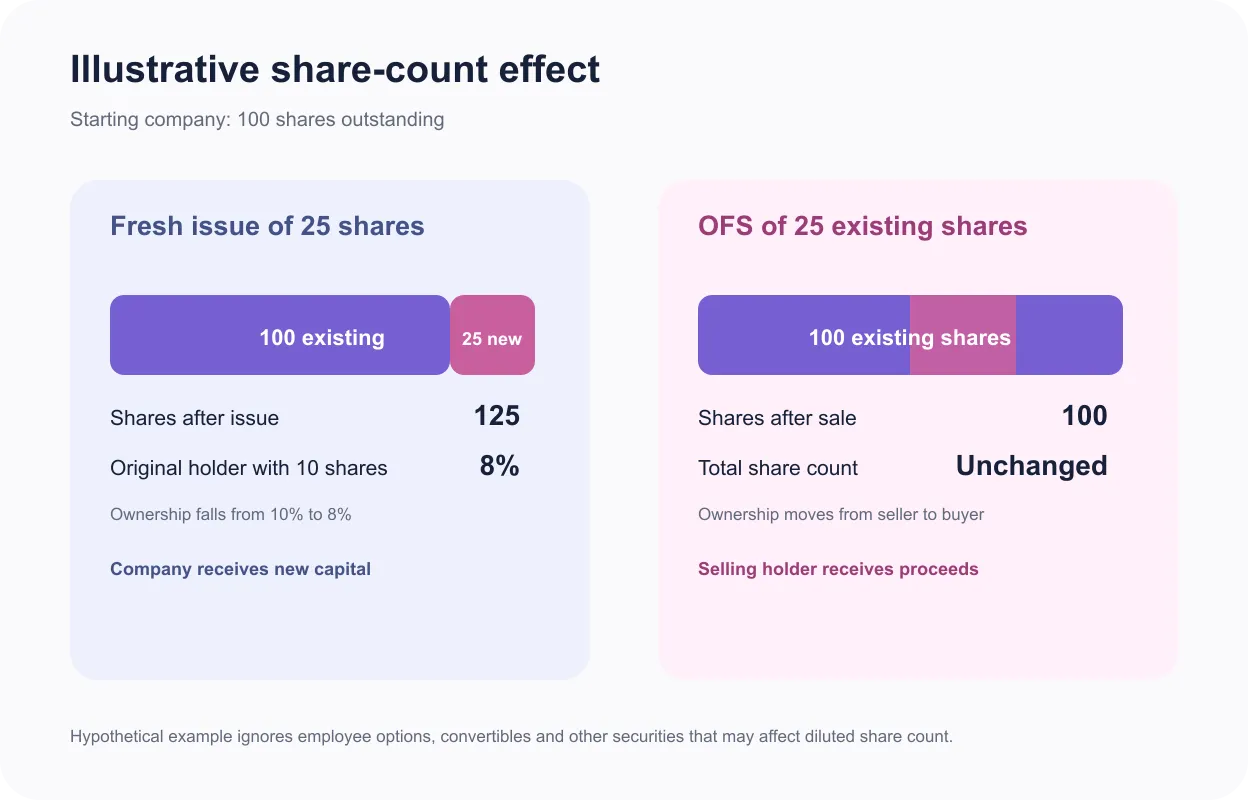
The fresh issue vs OFS split also affects how investors assess the offer. For fresh capital, examine whether the proposed use can improve earnings capacity or balance-sheet strength. For an OFS, understand who is selling, how much ownership remains and the stated rationale.
Neither structure is automatically superior. A fresh issue can dilute ownership but finance productive growth. An OFS can improve public float without diluting the share count, yet a large exit may warrant closer reading. Valuation and governance remain central.
How to Apply for an IPO or OFS
For an IPO, review the red herring prospectus, price band, lot size, issue dates and category rules. Apply through ASBA in a supported bank account or the permitted UPI process offered by intermediaries. Funds remain blocked until allocation and are debited only for allotted shares.
For an exchange OFS, read the exchange announcement and seller notice. Check the floor price, retail bidding day, reservation, possible discount, bid rules and settlement schedule. Place the bid through a broker that supports the OFS segment and maintain the required funds.
The offer for sale vs IPO application screen can appear similar, but deadlines and allocation logic differ. In either case, confirm the PAN, demat and bank details before submitting. A cut-off bid improves price eligibility under applicable rules but does not guarantee allotment.
Do not borrow solely to chase listing gains or an announced discount. Compare the offer price with business quality, financial risks, listed peers and the post-offer capital structure. Oversubscription is a demand signal, not proof of long-term value.
Which Is Better for Investors: IPO or OFS?
There is no universal winner in IPO vs OFS. The better opportunity is the one with an understandable business, reasonable valuation, credible disclosures, adequate liquidity and an offer structure that supports the investor's objective.
For an IPO, check revenue quality, cash flow, debt, related-party transactions, promoter record, key risks and how much of the issue is fresh capital. A large OFS component is not automatically negative, but the identity and post-offer stake of selling shareholders deserve attention.
For an exchange OFS, compare the floor price and potential retail discount with the prevailing market price without assuming the discount is free profit. The market price can fall, bids may receive partial allocation and short offer windows demand preparation.
When comparing offer for sale vs IPO , focus on proceeds and ownership. The difference between IPO and OFS matters because it changes whether investor money supports the company or provides liquidity to a seller.
The final difference between IPO and OFS is timing. IPO applications run within the public-issue timetable, while an exchange OFS uses the shorter trading-window process stated in its notice.
A disciplined checklist is straightforward: identify fresh issue vs OFS proportions, trace proceeds, assess dilution, examine the seller, compare valuation and read the risk factors. Then size the application so an adverse listing or post-offer move does not disrupt the portfolio.
Is your portfolio built for what’s coming?
Get a free AI-powered review of your holdings — risk, overlap and quality in minutes.
FAQ
What is the difference between IPO and OFS?
An IPO is the first public offering of shares by an unlisted company and may contain newly issued shares, existing shares sold by shareholders, or both. The stock-exchange OFS mechanism is generally used to sell existing shares of an eligible listed company.
What does OFS mean in the stock market?
OFS means offer for sale. In the exchange mechanism, eligible promoters or large shareholders sell existing listed shares through a separate bidding window.
What are the advantages and risks of investing through an OFS?
An OFS provides access to listed shares through a transparent exchange window and may include a retail discount. Risks include adverse price movement, limited issue time, allocation uncertainty and weak liquidity after purchase.
How is an OFS different from a fresh issue?
A fresh issue creates new shares and sends proceeds to the company, increasing shares outstanding. An OFS transfers existing shares and sends proceeds to the selling shareholder.
Can retail investors apply for OFS?
Yes. Eligible retail investors can bid through a registered broker during the retail bidding window, subject to the offer notice, applicable limits and available allocation.
What is the full form of OFS?
OFS stands for Offer for Sale.
What is the meaning of IPO?
IPO stands for Initial Public Offering, the process through which an unlisted company first offers its shares to the public and seeks stock-exchange listing.


