


India’s battery energy storage system market has moved beyond pilot projects. The policy requirement is large, tender activity is accelerating and battery costs have fallen sharply. Yet capacity announcements alone do not make a viable infrastructure market. The central question in 2026 is whether projects can earn predictable revenue, secure financing and operate safely over their contracted life.
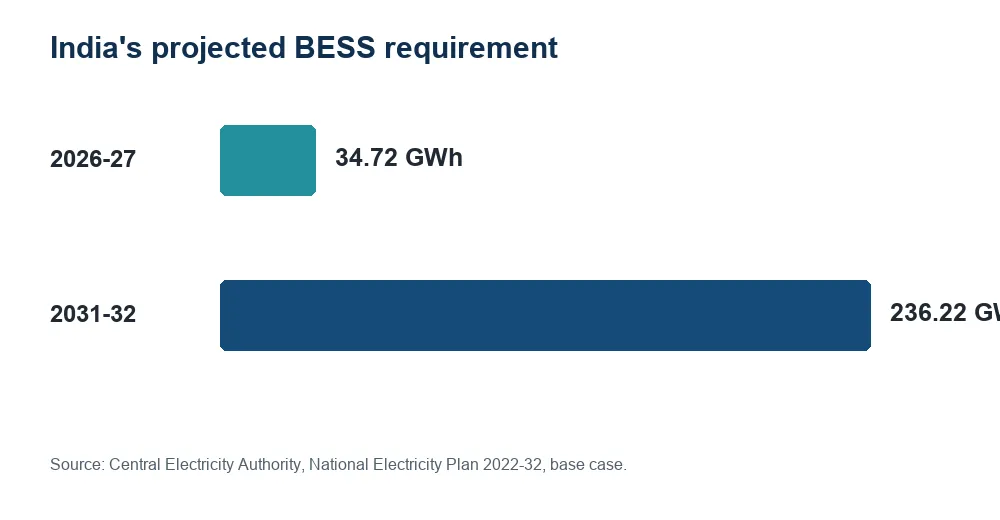
The Central Electricity Authority’s National Electricity Plan projects a base-case BESS requirement of 8.68 GW and 34.72 GWh in 2026-27, rising to 47.24 GW and 236.22 GWh in 2031-32. A July 2026 government release put the associated investment requirement at about ₹3.49 lakh crore. Those figures establish the scale of the build-out. They do not guarantee attractive returns for every developer, equipment supplier or investor.
This article examines India’s BESS opportunity through grid need, project architecture, revenue, policy support, supply-chain exposure and bankability. It separates official requirements from estimates in the supplied BESS deep-dive report.
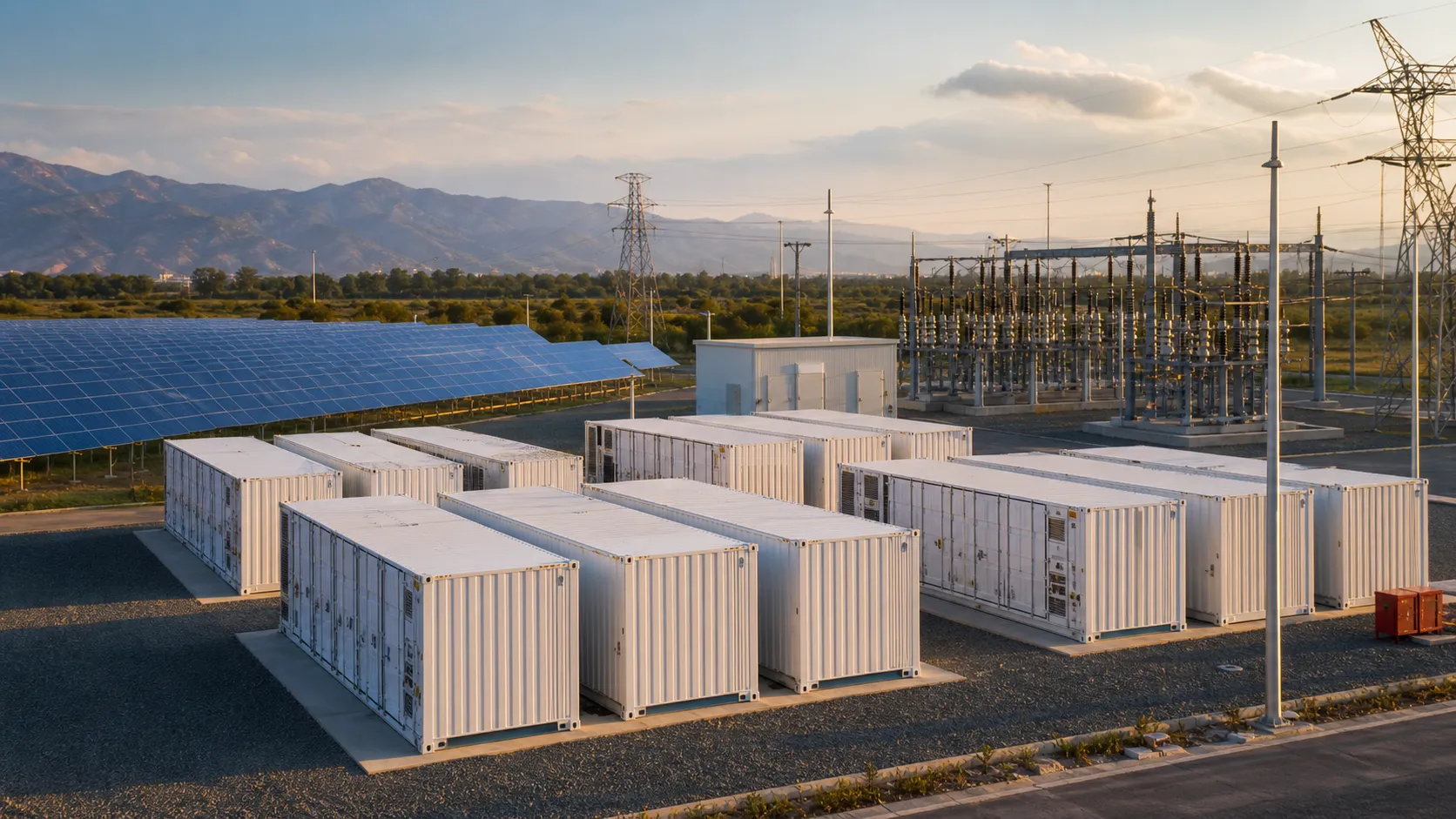
Why does India need battery energy storage now?
India needs BESS because renewable generation and electricity demand peak at different times. Solar output is strongest during the day, while residential and commercial demand often rises after sunset. Batteries can absorb surplus electricity, discharge during peak periods and respond rapidly to grid instructions.
Storage performs more than energy shifting. It can provide frequency response, voltage support, congestion relief, reserve capacity and black-start capability. These services become more valuable as variable solar and wind form a larger share of generation. The International Energy Agency describes batteries as an increasingly important source of short-term energy shifting and ancillary services in power systems.
The scale gap is substantial. The National Electricity Plan’s 34.72 GWh requirement for 2026-27 expands nearly sevenfold by 2031-32. The precise requirement can change with demand, renewable additions, pumped-storage development and transmission availability. It should therefore be read as a planning case rather than a guaranteed procurement schedule.
See what markets are pricing in
Live indices, sector moves and market breadth — the backdrop to every story we publish.
What does a bankable BESS project contain?
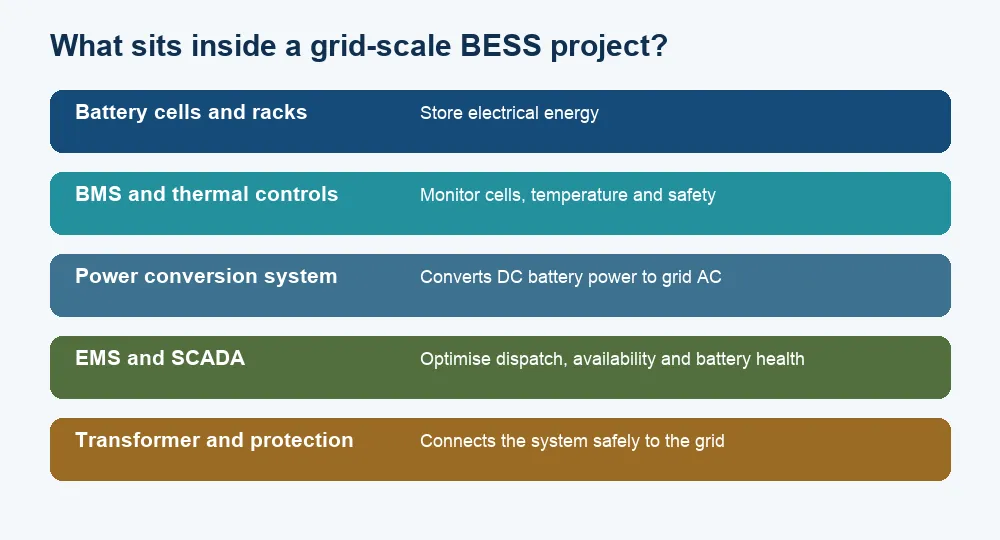
A BESS project is an integrated power asset, not a container filled with battery cells. Its performance depends on cells, modules, racks, battery-management systems, power-conversion systems, thermal management, fire protection, energy-management software, transformers and grid controls working together.
Power capacity and energy capacity answer different questions. MW measures how quickly the system can charge or discharge. MWh measures how much energy it stores. A 100 MW/200 MWh project can discharge at rated power for two hours. Duration influences the use case, equipment sizing, degradation profile and revenue model.
Lithium iron phosphate, or LFP, is widely used for stationary storage because energy density is less critical than safety, cycle life and cost. The IEA reported that LFP represented 80% of new battery storage in 2023. Chemistry is only one part of performance. Software dispatch, cooling, warranty terms, augmentation planning and emergency response can determine whether contracted availability is achieved.
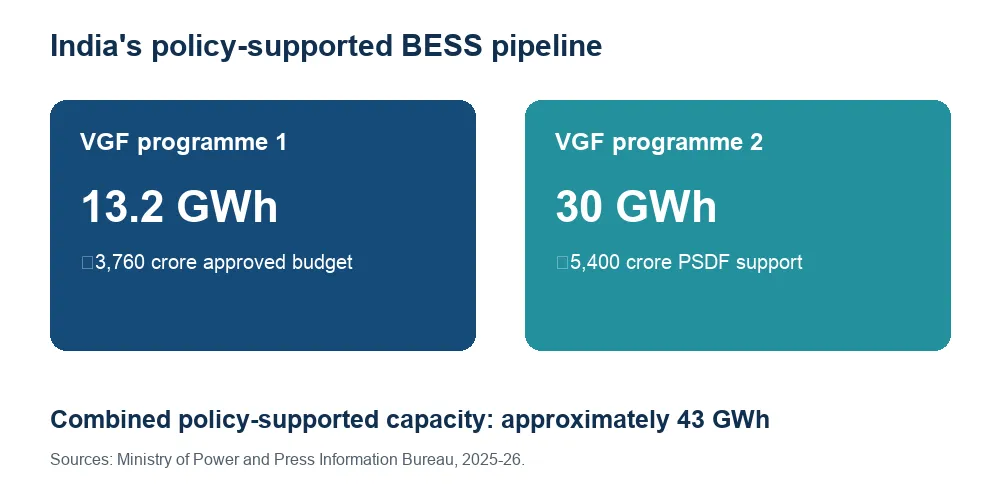
How large is India’s policy-supported BESS pipeline?
The government is using planning targets, procurement rules, transmission waivers and viability gap funding to accelerate deployment. In April 2025, the Ministry of Power said the first VGF scheme had expanded from 4 GWh to 13.2 GWh while retaining its ₹3,760 crore budget. Falling costs reduced support to ₹46 lakh per MWh or 30% of project capital cost, whichever was lower.
A second VGF programme approved in June 2025 supports 30 GWh with ₹5,400 crore from the Power System Development Fund. Government statements in 2025 and 2026 therefore describe roughly 43 GWh of BESS under the two support programmes. These programmes help bridge the difference between project cost and the tariff an offtaker can bear.
VGF is useful, but it does not remove execution risk. Projects still need land, grid connectivity, equipment procurement, financial closure, commissioning and reliable payment. The first scheme’s 2024-25 expenditure was nil because projects had not achieved financial closure, according to the April 2025 parliamentary reply. Funding approval and cash disbursement must be tracked separately.
Get research like this in your inbox
The week’s research that mattered, in five minutes. Joined by 2L+ investors.
Where do BESS projects earn revenue?
BESS revenue can come from capacity payments, energy arbitrage, ancillary services, renewable firming and behind-the-meter savings. A contracted capacity payment can improve predictability because the project is paid for availability. Merchant arbitrage depends on the spread between charging and discharging prices after efficiency losses, degradation and market fees.
The supplied report estimates that India’s midday-to-evening price spread widened substantially through 2025. That is a useful market signal, but the report’s 2025 prices and profitability calculations are estimates rather than audited project results. Arbitrage spreads can narrow as storage deployment grows, market rules change or more flexible generation enters.
Revenue stacking can improve asset use, but a project cannot assume that every service is simultaneously available. Dispatch obligations may conflict. Market access rules can change. Lenders will usually assign different confidence levels to contracted, regulated and merchant income.
| Revenue source | Commercial basis | Main diligence question |
|---|---|---|
| Capacity payment | Fixed payment for available MW | Is the offtaker creditworthy and the availability test achievable? |
| Energy arbitrage | Buy or charge low, discharge high | Does the spread survive efficiency loss and degradation? |
| Ancillary services | Payment for rapid grid response | Is the market deep enough and can revenues be stacked? |
| Renewable firming | Contracted delivery profile | Who bears forecast error and charging-energy risk? |
| C&I peak management | Avoided demand and peak-energy charges | Are tariffs stable and site load patterns predictable? |
The right metric is risk-adjusted cash flow, not the lowest tender tariff. A low bid can win capacity and still fail to cover equipment replacement, financing costs or payment delays.
What can undermine BESS project economics?
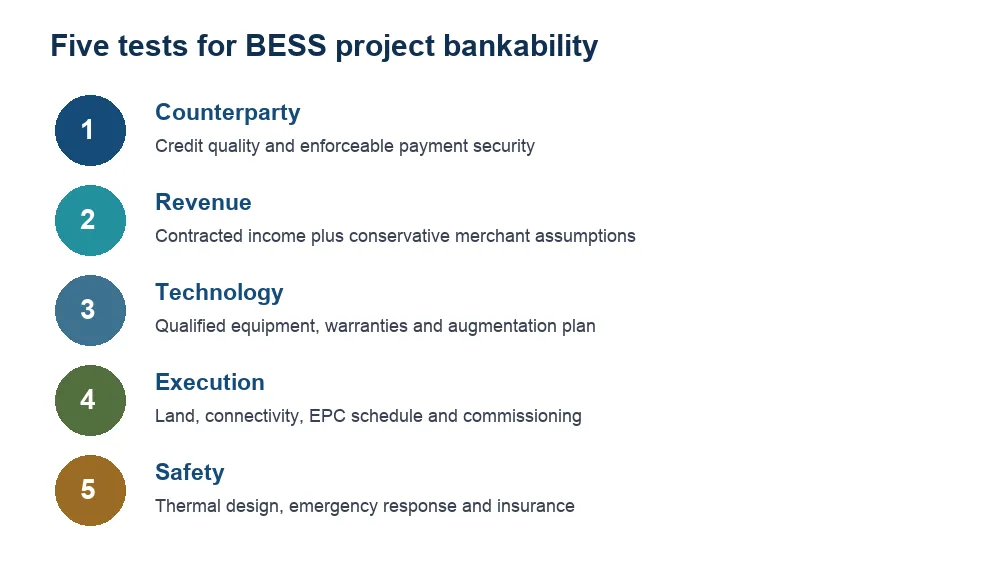
Counterparty quality is a primary risk. Many projects ultimately depend on electricity distribution companies. Payment delays increase working-capital needs and can prevent financial closure. Centralised procurement, escrow arrangements, letters of credit and government guarantees can improve the risk profile, but their enforceability matters more than their presence in a term sheet.
Aggressive bidding is another concern. The supplied report highlights rapid tariff compression and argues that some tenders may be below its estimated viability benchmark. Tender formats differ, so ₹/kWh and ₹ lakh/MW/month bids should not be compared without adjusting for duration, cycles, charging energy, VGF, degradation obligations and contract length.
Supply concentration also matters. The IEA estimates that China holds nearly 85% of global battery cell production capacity. India can localise enclosures, EPC, controls, integration and services sooner than it can establish a complete cell-material chain. Currency movement, trade restrictions and shipping disruption therefore remain material project risks.
Safety and degradation complete the risk map. Thermal incidents can stop operations and damage market confidence. Heat can accelerate degradation. Contracts need clear performance guarantees, augmentation responsibilities, insurance terms and end-of-life arrangements.
Where can value accrue across India’s BESS ecosystem?
Value can accrue at several layers, but the economics differ. Cell manufacturing offers scale and strategic importance, alongside high capital intensity and global price competition. System integrators combine equipment, controls and warranties, but they carry interface and performance risk. Power-conversion, thermal-management and safety suppliers can build specialised positions if their products qualify across multiple projects.
Software can create value through dispatch optimisation, state-of-charge estimation, degradation management and participation in power markets. Its defensibility depends on operating data, integration depth and demonstrated savings. EPC contractors benefit from project activity, although low margins and liquidated damages can limit returns.
Asset owners receive the contracted or merchant cash flows and carry financing, availability and counterparty risk. For investors, announced order books should be reconciled with project stage, margin, cash collection and contingent liabilities. A company with a large pipeline but weak payment protection may be less attractive than a smaller supplier with qualified products and diversified customers.
The BESS opportunity is therefore real, policy-supported and necessary for India’s grid. Bankability remains selective. Strong projects will combine credible offtakers, enforceable payment security, conservative degradation assumptions, dependable integration and more than one viable revenue stream.
Investors should also distinguish between a structural market requirement and a company-level investment case. Grid demand can expand while individual projects earn weak returns or suppliers compete away their margins. Evidence of financial closure, commissioned capacity, receivables collection, warranty provisioning and repeat orders is more useful than a headline pipeline. The strongest operators will show that technical availability converts into collected cash flow without depending on permanently wide merchant spreads.
Contract design is the bridge between technical performance and financeability. Investors should examine who supplies charging energy, how round-trip losses are treated, what happens when the grid cannot accept discharge and whether availability penalties reflect battery degradation. They should also test refinancing assumptions and the timing of augmentation spending. These details can change cash flow even when two projects have the same headline MW, duration and tariff. Transparent reporting on operating availability, realised cycles, efficiency and cash collection would make comparisons across developers substantially more reliable.
Follow this sector’s live moves
Sector-level performance across Indian markets, updated through the day.
What are the key FAQs about BESS in India?
What is the difference between MW and MWh in BESS?
MW measures power, or the rate at which a battery charges and discharges. MWh measures stored energy. Dividing MWh by MW gives the rated discharge duration in hours.
How much BESS does India require?
The CEA’s National Electricity Plan projects 8.68 GW/34.72 GWh in 2026-27 and 47.24 GW/236.22 GWh in 2031-32 under its base case. Actual deployment can differ as grid conditions and other flexibility resources change.
What is viability gap funding for BESS?
VGF is government capital support intended to make early projects affordable for procurers while preserving developer returns. India has announced support programmes covering roughly 43 GWh across two schemes.
Is battery arbitrage enough to finance a project?
Merchant arbitrage alone can be volatile. Bankable projects often combine contracted capacity revenue, payment security and other permitted services, while stress-testing price-spread compression.
What is the largest risk for Indian BESS projects?
There is no single risk across every project, but counterparty payment, aggressive tariffs, imported equipment exposure, degradation and safety are recurring concerns.


