


Long-term goals change as their deadline approaches. A portfolio that can tolerate substantial equity volatility 20 years before retirement may need a different balance with only two years remaining. SEBI's new life cycle category turns that idea into a regulated mutual fund structure with a predefined path for reducing risk.
This article explains the final framework introduced in February 2026, how its asset-allocation ranges work and what investors should examine before treating automation as a substitute for planning.
What Is a Life Cycle Fund?
The simplest life cycle fund meaning is an open-ended, target-date mutual fund that follows a predetermined glide path. It invests across permitted asset classes and gradually changes the allocation as the target year approaches. The target might represent retirement, education or another long-term financial goal.
Under the Indian framework, a life cycle mutual fund may hold equity, debt, infrastructure investment trusts (InvITs), exchange-traded commodity derivatives (ETCDs), and gold or silver ETFs within prescribed ranges. The target date does not promise a particular corpus or return. It identifies the time horizon around which the portfolio's risk mix evolves.
SEBI permits tenures from 5 to 30 years in multiples of five. A mutual fund may have no more than six such schemes open for subscription at one time. Investors can explore the broader mutual fund platform before comparing a target-date solution with conventional equity, debt and hybrid funds.
Run the numbers on your next investment
Project returns on a lumpsum or SIP with our free calculators.
Why SEBI Introduced the Category
The February 2026 categorisation circular added life cycle funds as a distinct mutual fund group. SEBI describes them as open-ended schemes with predetermined maturity and a glide path for goal-based investing. The regulator's annual report says the category is intended to promote goal-based, long-term investing aligned with an investor's life stage or target date.
The life cycle fund SEBI framework standardises key features that might otherwise differ sharply across products. It defines eligible tenures, allocation bands, naming, disclosure and what may happen close to maturity. Standardisation can improve comparison and “true-to-label” behaviour, although it cannot eliminate investment risk.
The design also addresses a practical behaviour problem. Many investors start with a suitable allocation but fail to rebalance, or reduce equity only after a market fall. A stated path creates a disciplined mechanism that does not depend on a fresh decision every year.
How the Glide Path Works
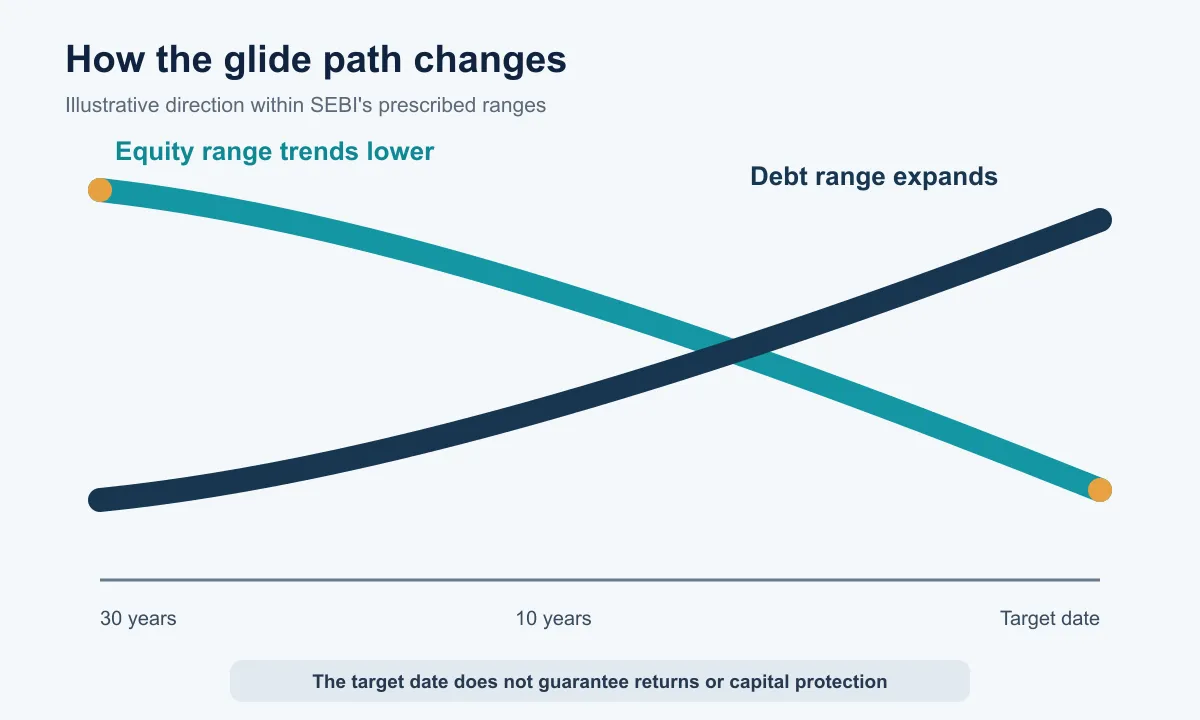
A glide path is the schedule by which the permitted asset mix changes as years to maturity decline. Far from the target date, the equity band can be high. As the goal approaches, the maximum equity allocation falls and the permissible debt range expands.
For a 30-year life cycle fund, the final SEBI framework specifies these broad bands:
| Years to maturity | Equity | Debt | Gold/silver ETFs, ETCDs and InvITs |
|---|---|---|---|
| 15–30 years | 65%–95% | 5%–25% | 0%–10% |
| 10–15 years | 65%–80% | 5%–25% | 0%–10% |
| 5–10 years | 50%–65% | 5%–25% | 0%–10% |
| 3–5 years | 35%–50% | 25%–50% | 0%–10% |
| 1–3 years | 20%–35% | 25%–65% | 0%–10% |
| Less than 1 year | 5%–20% | 25%–65% | 0%–10% |
The ranges are guardrails, not a single mechanical allocation. The scheme information document should explain how the manager moves within them, what fills any residual allocation and how often the portfolio is rebalanced.
Life Cycle Funds vs Target-Date Funds
“Target-date fund” is the widely used global term for a portfolio labelled by an intended year and managed along a glide path. In India, the regulated category is called Life Cycle Funds. In practice, the two concepts overlap substantially.
| Feature | SEBI life cycle category | Generic target-date concept |
|---|---|---|
| Time anchor | Predetermined maturity | Target retirement or goal year |
| Allocation change | Glide path within SEBI bands | Provider-designed glide path |
| Permitted assets | Defined by Indian rules | Depends on jurisdiction and product |
| Structure | Open-ended mutual fund | Often a mutual fund or fund of funds |
| Outcome | Not guaranteed | Not guaranteed |
The label alone is insufficient. Two schemes with the same target year can hold different equity levels, debt duration, credit risk or commodity exposure. Compare the actual path and portfolio rather than assuming all target-date products behave alike.
How Asset Allocation Changes With Age or Goal
Allocation changes according to time remaining, not an investor's age in isolation. A 40-year-old saving for a home in five years has a different horizon from a 40-year-old saving for retirement in twenty years. Choose a target year that matches when withdrawals are expected to begin.
The path commonly moves from growth assets toward stabilising assets. Early equity exposure seeks long-term capital growth but brings drawdown risk. Debt can reduce volatility and support nearer withdrawals, although it still carries interest-rate and credit risk. Gold, silver, InvITs or commodity instruments may add diversification, but each introduces its own behaviour and costs.
A life cycle mutual fund may simplify one goal, but a household can have several goals and outside assets. Provident fund balances, pensions, property, emergency cash and existing equity funds change the appropriate overall allocation. The fund cannot see or automatically coordinate those holdings.
Get research like this in your inbox
The week’s research that mattered, in five minutes. Joined by 2L+ investors.
Benefits of Automatic Rebalancing
The main advantage is discipline. Rebalancing systematically sells part of what has grown beyond the intended weight and adds to underweight assets. This can limit portfolio drift and reduce the temptation to chase the most recent winner.
Other potential benefits include:
- A single scheme for a defined goal and target year.
- A transparent reduction in equity ranges as maturity approaches.
- Less need for investors to execute manual switches.
- Diversification across several permitted asset classes.
- Easier monitoring than a collection of overlapping funds.
Automatic rebalancing can also reduce portfolio clutter. Wright Research's guide on how many mutual funds a portfolio needs explains why adding schemes does not always improve diversification.
Risks and Limitations
Automation is not personalisation. A standard glide path cannot fully reflect job stability, dependants, liabilities, other investments or willingness to accept losses. It may be too aggressive for one investor and too conservative for another.
Important risks include:
| Risk | Why it matters |
|---|---|
| Equity risk | Losses can occur even near the target year because equity need not fall to zero |
| Debt risk | Interest-rate changes and issuer credit quality affect returns |
| Sequence risk | A major decline near withdrawals can damage goal outcomes |
| Inflation risk | A conservative later allocation may not keep pace with rising goal costs |
| Glide-path risk | The chosen schedule may not suit the investor or future market conditions |
| Cost and tax | Expense ratios and taxable redemptions or switches can reduce net outcomes |
Target maturity is not a guarantee of capital protection. The life cycle fund SEBI rules constrain allocation ranges, but managers still make security, duration and timing decisions. Investors must also understand the tax classification applicable to the actual portfolio and prevailing law.
Who Should Consider a Life Cycle Fund?
The category may suit investors with a clear long-term goal, an identifiable target year and a preference for delegated rebalancing. It can be useful for someone who would otherwise leave a high equity allocation unchanged until the final years or repeatedly change funds based on recent performance.
It may be less suitable for investors who need a bespoke path, have irregular withdrawals, already manage asset allocation across several accounts, or want direct control over equity and debt. Investors with a short target horizon should pay close attention to the starting allocation rather than assuming the word “life cycle” means low risk.
The right question is not whether the category is universally good. It is whether one scheme's target year, path, cost and portfolio fit the investor's total financial plan.
How to Evaluate One Before Investing
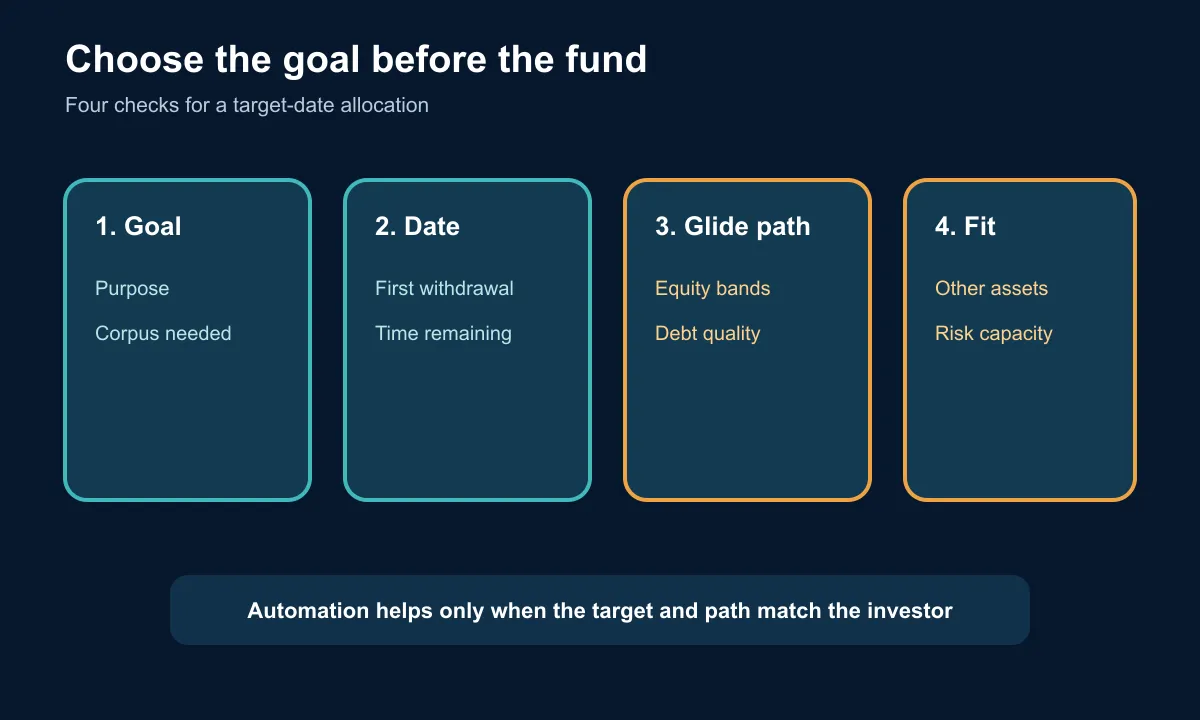
Use the following checklist before selecting a life cycle fund:
- Match the target year to the start of the expected withdrawal period.
- Read the complete glide path, including equity minimums close to maturity.
- Examine debt duration, credit quality and liquidity, not just the debt percentage.
- Understand the role of gold, silver, ETCDs and InvITs.
- Compare direct and regular plan expenses, exit load and tracking against the stated path.
- Review how the scheme handles rebalancing and market movements between bands.
- Test the scheme against other household assets and liabilities.
- Read the maturity and merger provisions in the offer document.
An adviser can help assess the entire balance sheet rather than a single product. Wright Research's advisory service can provide context where goals, risk capacity and current holdings require a more tailored allocation.
See what markets are pricing in
Live indices, sector moves and market breadth — the backdrop to every story we publish.
FAQ
Can investors redeem a life cycle fund before its target date?
Yes. SEBI defines the category as open-ended, so investors are not inherently locked in until the target date. Redemptions remain subject to the scheme's terms, including any applicable exit load, cut-off rules and tax consequences.
What happens to a life cycle fund after its target year?
The final framework allows a scheme with less than one year to maturity to be merged with the nearest-maturity life cycle scheme, with positive consent from unitholders. Investors should read the specific offer document and communications because implementation can vary within the rules.
Can investors switch between life cycle funds with different target dates?
Mutual funds may permit a switch, which is operationally a redemption from one scheme and purchase into another. Exit loads and tax consequences may apply. A switch should reflect a genuine change in goal timing or risk needs, not short-term performance chasing.
Are life cycle funds suitable for education goals as well as retirement?
Potentially. The structure is goal-based, so a target year can align with education, housing or another planned expense. Suitability depends on the time horizon, required corpus, withdrawal pattern and the risk of falling short.
A life cycle mutual fund can make asset allocation more systematic, but the target date is a planning tool—not a promise. Evaluate the glide path, portfolio and total household context before investing.


