


First-time mutual fund investors often start by searching for a ranked list of funds. A return table, however, shows only what has already happened in one period. This guide explains the decision process commonly described for beginners and the facts needed to follow it. It does not rank or recommend any scheme.
Why mutual funds are widely used as a starting point
A mutual fund pools money from many investors and invests it in line with a published mandate. A single scheme can hold dozens of securities, units can usually be bought in small amounts, and open-ended schemes publish a daily NAV and have defined redemption processes. Returns are market-linked and not guaranteed: equity funds can fall sharply, and debt funds carry interest-rate and credit risk.
See what markets are pricing in
Live indices, sector moves and market breadth — the backdrop to every story we publish.
Industry snapshot
AMFI data for October 2026, as reported in the press, showed monthly SIP contributions of about Rs 32,160 crore across roughly 10 crore contributing SIP accounts, and total industry assets under management of Rs 83,38,858 crore at 31 October 2026. Equity schemes recorded net inflows of Rs 32,993.64 crore in the month, 13.87% lower than in September.
How schemes are classified
SEBI's revised categorisation framework (circular of 26 February 2026) governs how schemes are grouped and named, including the introduction of life cycle funds. Broadly, schemes fall into equity, debt, hybrid and other groups, such as index funds, ETFs and funds of funds. The category states what a portfolio is permitted to hold; it is not a promise about returns.
| Purpose | Category commonly examined | What it holds | Main caution |
|---|---|---|---|
| Long-term growth goal | Index or diversified equity funds | Equity shares across sectors | Can fall sharply in the short run |
| Mixed asset allocation | Hybrid funds | Combination of equity, debt and sometimes gold | Equity share still creates volatility |
| Short-term parking | Liquid and ultra-short duration funds | Short-maturity debt instruments | Not equivalent to a bank deposit |
Sectoral, thematic, small-cap and concentrated schemes carry a narrower or more volatile exposure and are generally described by regulators and AMCs as higher-risk categories.
Items listed in scheme documents
The scheme information document, factsheet and key information memorandum disclose the items below. Comparisons are most meaningful between funds in the same category.
- Investment objective, benchmark and asset-allocation range.
- Riskometer: a risk label published for each scheme and updated monthly.
- Direct versus regular plan: direct plans have lower expenses because no distribution commission is paid.
- Expense ratio and exit load.
- Portfolio concentration and turnover.
- Fund manager tenure.
- Rolling returns and drawdowns against the benchmark, which show more than a single trailing return.
SIP and lump sum: how they work
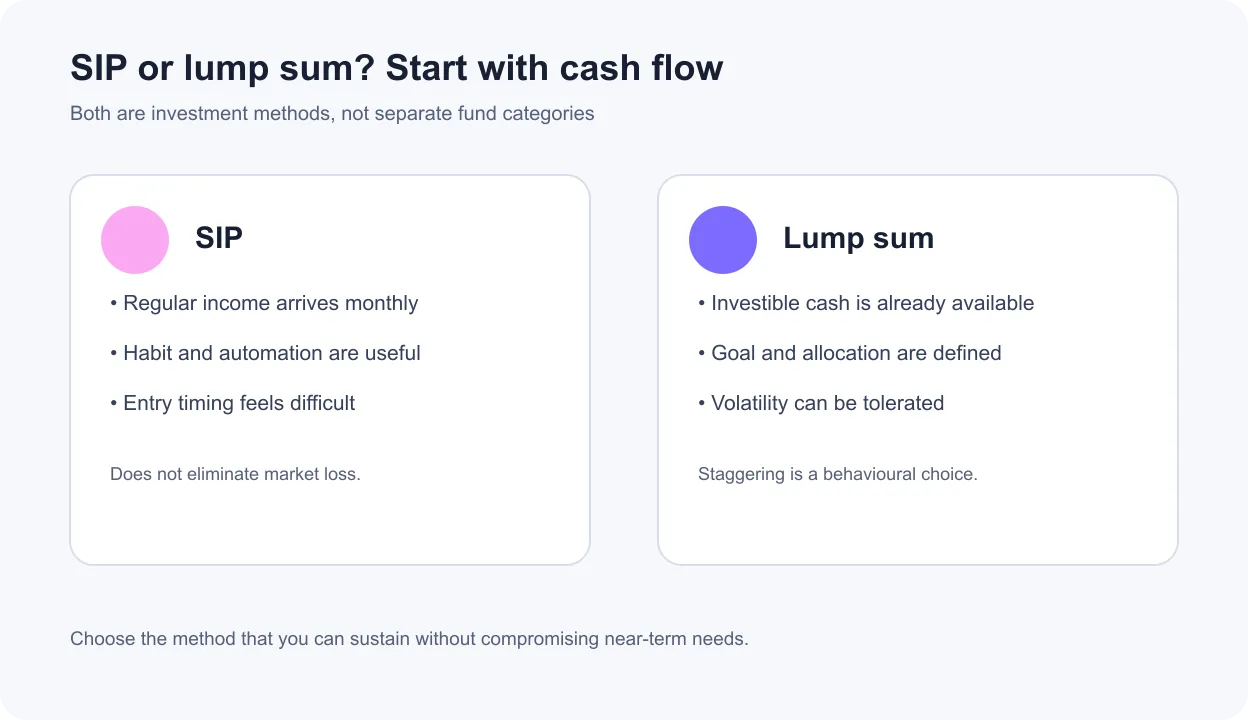
A systematic investment plan (SIP) invests a fixed amount at scheduled intervals, which spreads purchase dates across market levels. A lump sum invests the whole amount at once. Rupee-cost averaging neither prevents losses nor ensures higher returns, and which method produces a better outcome depends on how markets move after the investment date. They are funding methods, not fund categories.
Get research like this in your inbox
The week’s research that mattered, in five minutes. Joined by 2L+ investors.
How the amount is usually worked out
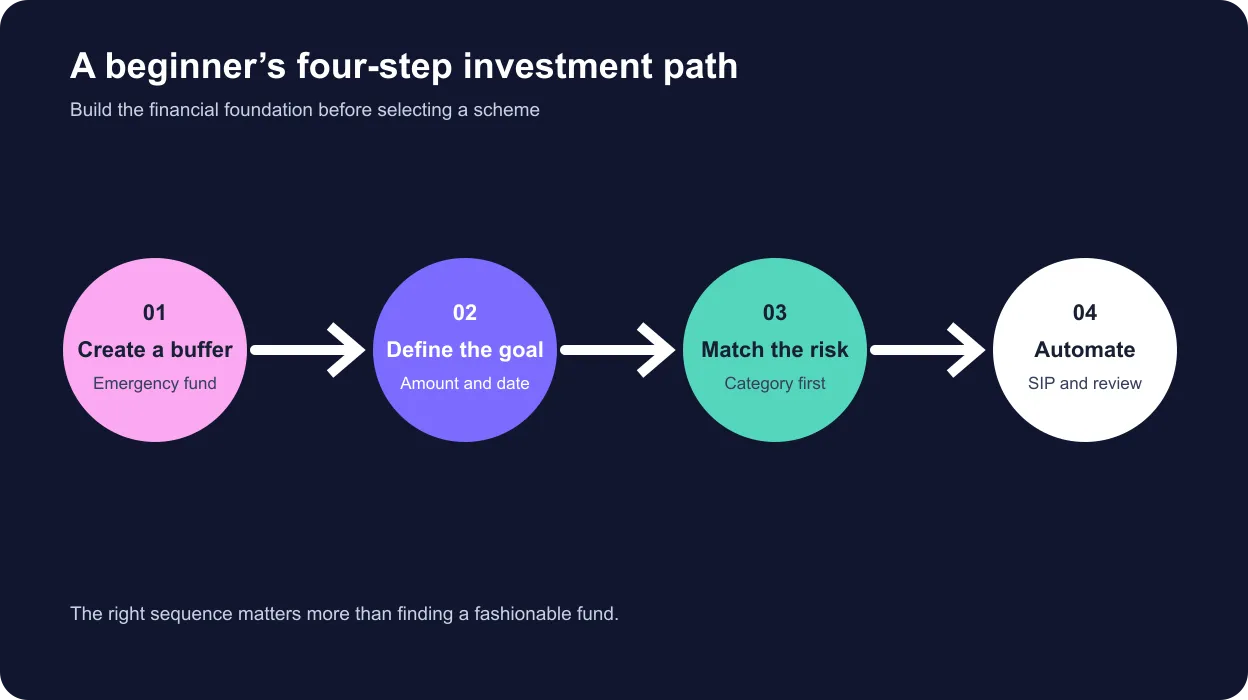
There is no universal figure. Planning frameworks typically begin with emergency liquidity and any high-cost debt, then estimate the target amount, the time available and an assumed return, and calculate the periodic contribution. SIP amounts can be stepped up as income changes. Missed instalments and early redemptions reduce what a plan delivers, whichever scheme is used.
Common mistakes described in investor-education material
- Selecting a scheme from last year's return table.
- Holding several funds with overlapping portfolios.
- Overlooking costs.
- Treating debt funds as guaranteed.
- Using volatile equity for money needed in the near term.
- Switching after every weak quarter instead of defining review criteria in advance, such as a mandate change or a change in the goal.
The mechanics of starting
Investing requires completing KYC, which is a one-time process common across the industry. The investor then chooses a category, reads the scheme documents and decides between a direct and a regular plan. Options such as growth or IDCW, nomination and the SIP mandate or payment are set at purchase, and the confirmation is retained. Investors can review holdings periodically against their goal.
Frequently asked questions
What does "best mutual fund" mean?
There is no single definition. Rankings change with the period measured and the category compared, so the same fund can appear at the top of one table and in the middle of another.
How much do investors commonly start with?
Many AMCs accept SIPs from as little as Rs 100 to Rs 500 per month, though the minimum differs by scheme and is listed in the scheme document.
Is SIP better than lump sum?
Neither method guarantees a better result. SIPs follow a regular cash flow, while a lump sum is used when capital is available at once.
Where can official fund data be found?
AMFI publishes NAVs, monthly industry data and scheme disclosures, and each AMC publishes factsheets and portfolios monthly. Wright Research also lists funds in its mutual funds section.
Taxation and costs in brief
Gains on mutual fund units are taxed under the Income-tax rules applicable to the type of scheme and the holding period, and the rates have changed in recent budgets. Investors should check the current rules on the Income Tax Department website or with a tax professional. Costs that affect net returns include the expense ratio, exit load and, for regular plans, the distribution commission embedded in the expense ratio. Each AMC publishes the total expense ratio of every scheme on its website, and AMFI compiles it in a common format.
Is your portfolio built for what’s coming?
Get a free AI-powered review of your holdings — risk, overlap and quality in minutes.
Sources
AMFI monthly data for October 2026 as reported by Angel One, 5paisa and Kotak Neo; SEBI circular on categorisation and rationalisation of mutual fund schemes, 26 February 2026.
This article is for educational purposes only and is not investment advice.


