


PSU bank stocks, meaning the listed shares of government-owned banks, drew attention after a multi-year clean-up of bad loans. This guide explains what changed, how the sector is typically analysed, how the Nifty PSU Bank index is constructed and what the latest quarterly filings show. Information is as at 23 November 2026. It is educational; no bank is recommended.
Why the sector gets attention
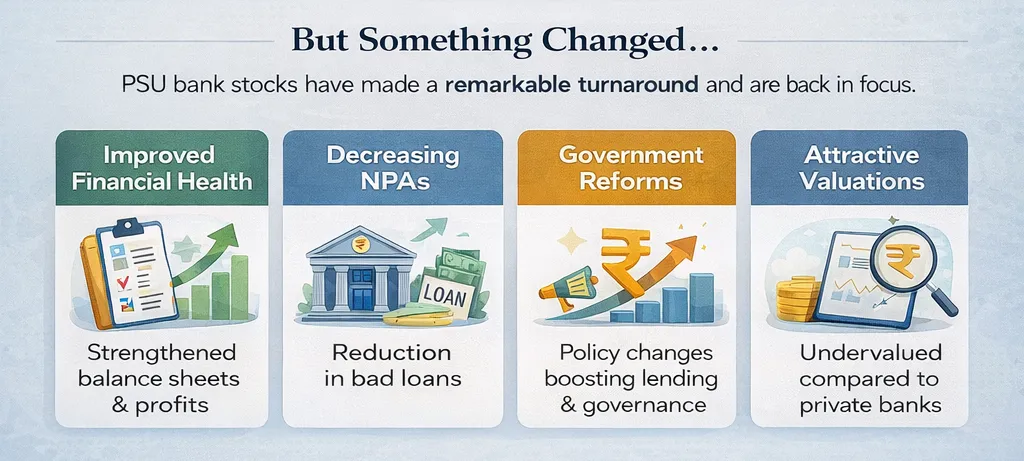
For several years PSU banks carried high stressed assets, and the government supported them with capital. Subsequent steps included resolution of stressed accounts through the Insolvency and Bankruptcy Code and higher provisioning. The most recent quarterly filings show how far asset-quality ratios have moved: SBI reported a gross NPA ratio of 1.39% for September 2026, as reported by Outlook Business, and Canara Bank 1.33%, per Free Press Journal.
See what markets are pricing in
Live indices, sector moves and market breadth — the backdrop to every story we publish.
Cheap or cheap for a reason?
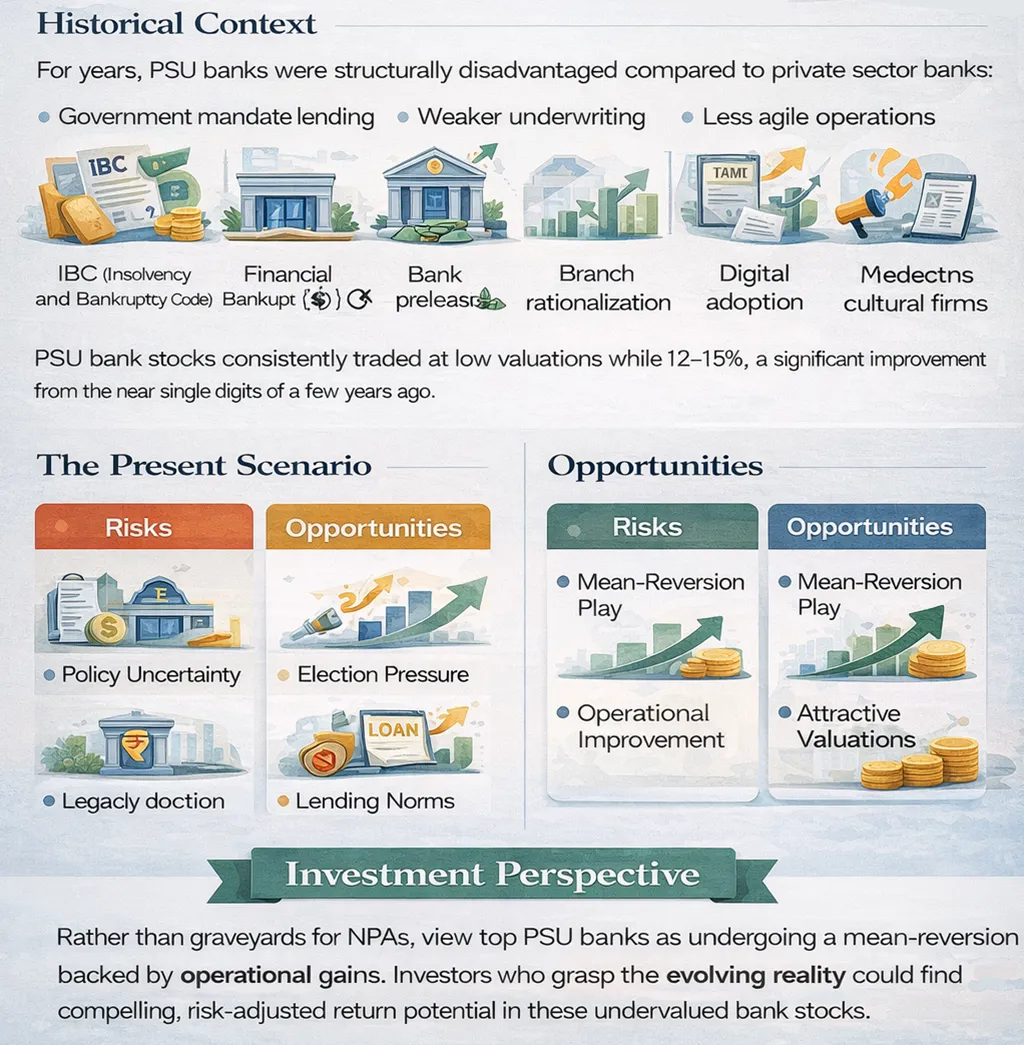
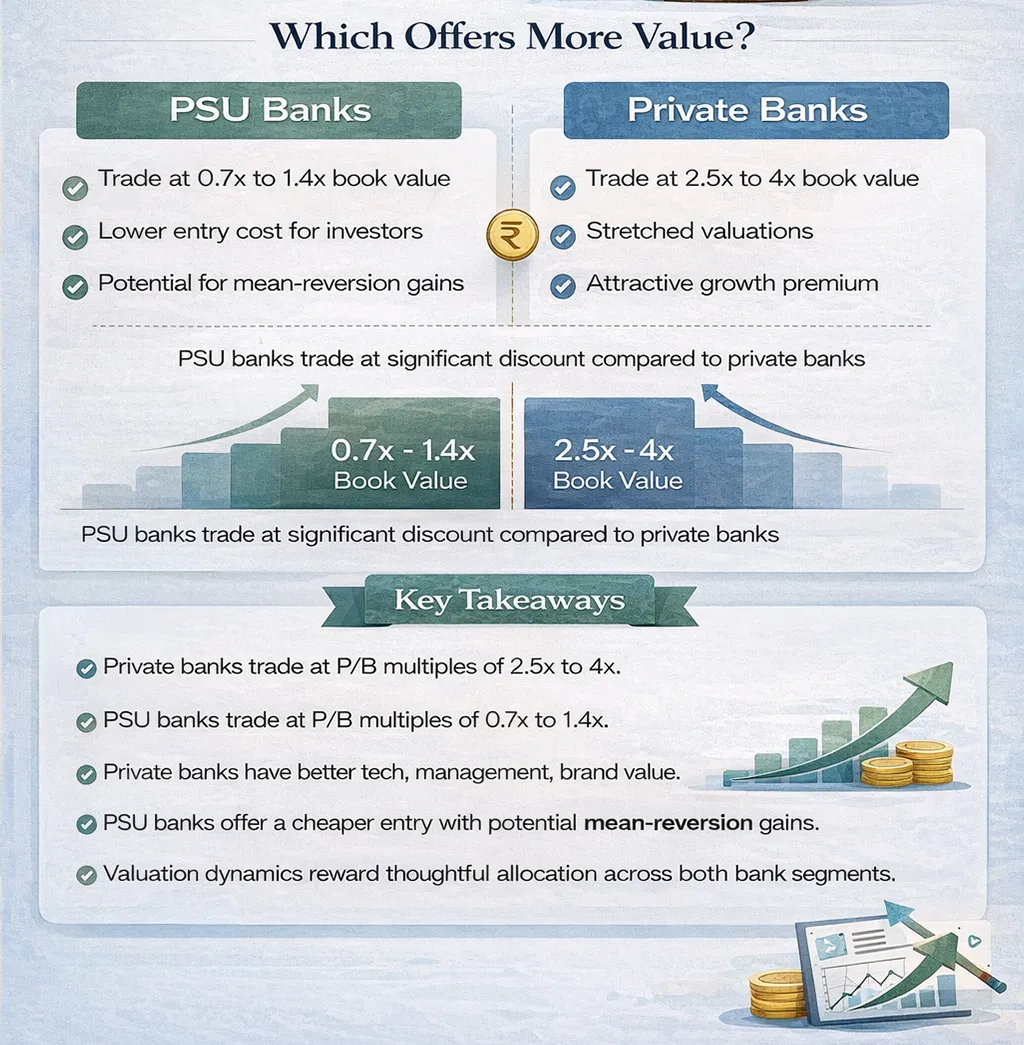
PSU banks have historically traded at lower price-to-book multiples than private banks. Analysts offer two readings of this gap. One is that it reflects structural factors: government-directed lending, slower decision making and exposure to policy. The other is that it reflects an earlier period of weak asset quality that has since improved. Which reading better fits is a matter of judgement and changes with each quarter's data. Current multiples depend on daily prices, so check the NSE or BSE for live figures rather than relying on a published snapshot.
Key metrics analysts use
| Metric | What it shows | Where to find it |
|---|---|---|
| Gross and net NPA ratio | Share of loans that are non-performing, before and after provisions | Quarterly results press release |
| Provision coverage ratio | Provisions held against gross NPAs | Investor presentation |
| Net interest margin | Spread earned on assets over funding cost | Investor presentation |
| Return on assets / equity | Profit relative to assets or shareholder funds | Annual report, presentation |
| Capital adequacy ratio | Capital against risk-weighted assets | Basel III disclosures |
| Price-to-book | Market value relative to book value per share | NSE, BSE, data vendors |
Reported Q2 FY27 data for large PSU banks
| Bank | Q2 FY27 standalone net profit | Gross NPA ratio (Sep 2026) | Net NPA ratio (Sep 2026) |
|---|---|---|---|
| State Bank of India | Rs 23,038 crore (Q2 FY26: Rs 20,160 crore) | 1.39% (1.73% a year earlier) | 0.36% (0.42%) |
| Bank of Baroda | Rs 6,532 crore (Rs 4,809 crore) | 1.78% (2.16%) | 0.37% (down 20 bps) |
| Punjab National Bank | Rs 5,532 crore (Rs 4,904 crore) | 2.55% (3.45%) | 0.25% (0.36%) |
| Union Bank of India | Rs 5,537 crore | 2.42% (3.29%) | 0.42% |
| Canara Bank | Rs 5,175 crore (Rs 4,774 crore) | 1.33% (2.35%) | 0.30% (0.54%) |
Sources: bank results for the quarter ended 30 September 2026 as reported by Outlook Business and Multibagg (SBI), PSU Connect (Bank of Baroda), Free Press Journal (PNB), PSU Connect (Union Bank) and Free Press Journal (Canara). Bank of Baroda's year-earlier net NPA is derived from the reported 20 basis-point decline. Check the exchange filing for the final audited or reviewed figures.
- SBI: profit rose about 14% on lower provisions (Rs 4,217 crore against Rs 5,400 crore a year earlier) and net interest income of Rs 49,143 crore. Reports note that the quarter also included a one-time gain from a stake sale, so growth is not purely from lending operations.
- Bank of Baroda: the bank called Rs 6,532 crore its highest-ever quarterly profit. Reports attribute a large part to an NSE stake sale and valuation gain of roughly Rs 3,600 crore, with management's operating profit excluding that effect given as about Rs 7,749 crore.
- PNB: operating profit rose 4.2% to Rs 7,532 crore and the capital adequacy ratio was 17.95%.
- Union Bank: a separate report gives consolidated profit of Rs 5,781 crore; the table uses the standalone figure.
- Canara Bank: advances grew 19.5% year on year, per PSU Connect.
In PNB's case, reports give a capital adequacy ratio of 17.95%. Earlier approximate ROE, price-to-book and recapitalisation figures that circulated for this sector are not repeated here because they could not be verified against a dated source for this update.
Get research like this in your inbox
The week’s research that mattered, in five minutes. Joined by 2L+ investors.
The Nifty PSU Bank index
The Nifty PSU Bank index tracks listed public sector banks, with 12 constituents as of April 2026, according to Upstox. It is reviewed semi-annually, and the largest bank dominates it: SBI is the heaviest constituent in every source checked, though published weights differ widely (from about 30% in April 2026 to about 62% on a market-cap-based data page on 12 November 2026), apparently because of capped versus uncapped methods. The NSE factsheet at niftyindices.com is the authoritative source for current weights. Exchange-traded products tracking such an index hold the same constituents, so their results follow the index less costs.
Shareholding rules
Separately, a minimum-public-shareholding rule requires listed companies to keep at least 25% in public hands. The deadline for public sector banks was extended to 1 August 2026. Kotak Neo reported in October 2026 that the government was considering stake sales in four smaller PSU banks (Indian Overseas Bank, Central Bank of India, UCO Bank and Punjab & Sind Bank) to bring its holding to 75% and that a further extension was expected; this is press reporting, not an official notification.
Reading the numbers
Net NPA ratios in the table are all below 0.5%, which means provisions cover most of the stressed loans on these banks' books; the gross ratio shows the size of the stress before provisioning. Net profit alone does not show efficiency, because a larger bank earns more in rupees. Ratios such as return on assets, and treatment of one-time items, make banks of different sizes comparable. Readers can also compare each bank's quarter-on-quarter and year-on-year direction, as the bracketed figures in the table allow.
Risks that analysts commonly note
- Policy: government priorities and mandated schemes can affect lending choices and margins.
- Credit cycle: a rise in stress in farm, MSME or unsecured loans would show up in NPA ratios.
- Quality of earnings: one-time gains, such as the stake-sale gains reported by SBI and Bank of Baroda this quarter, lift reported profit.
- Concentration: in the index, a single bank carries a large share of the weight.
Further reading: the Indian Banking Sector Report and Wright's article on how bank stocks are analysed. Live price pages are in the stocks section.
Is your portfolio built for what’s coming?
Get a free AI-powered review of your holdings — risk, overlap and quality in minutes.
Frequently asked questions
Which banks are PSU banks?
Banks in which the Government of India holds a majority stake. The Nifty PSU Bank index lists 12 of them.
What does gross NPA mean?
It is the proportion of a bank's loans on which payments are overdue beyond the regulatory period, before provisions are deducted. Net NPA deducts provisions.
Where can the latest numbers be checked?
Quarterly results are filed on the NSE and BSE announcement pages and in each bank's investor presentation.
This article is for educational purposes only and is not investment advice.


