


Quick answer
Listed railway-linked companies in India fall into four broad groups: financiers (for example IRFC), project executors (RVNL), service operators (IRCTC) and consultants and exporters (RITES), plus wagon makers, signalling and telecom firms. Their revenues depend heavily on government capital expenditure. The Union Budget 2026-27 set the Indian Railways capital expenditure outlay at a record ₹2,93,030 crore (PIB release, 1 February 2026). This article explains how these businesses earn money and gives dated figures from exchange filings. Inclusion of a company is not a recommendation.
See what markets are pricing in
Live indices, sector moves and market breadth — the backdrop to every story we publish.
What drives railway-linked companies
Government capital spending
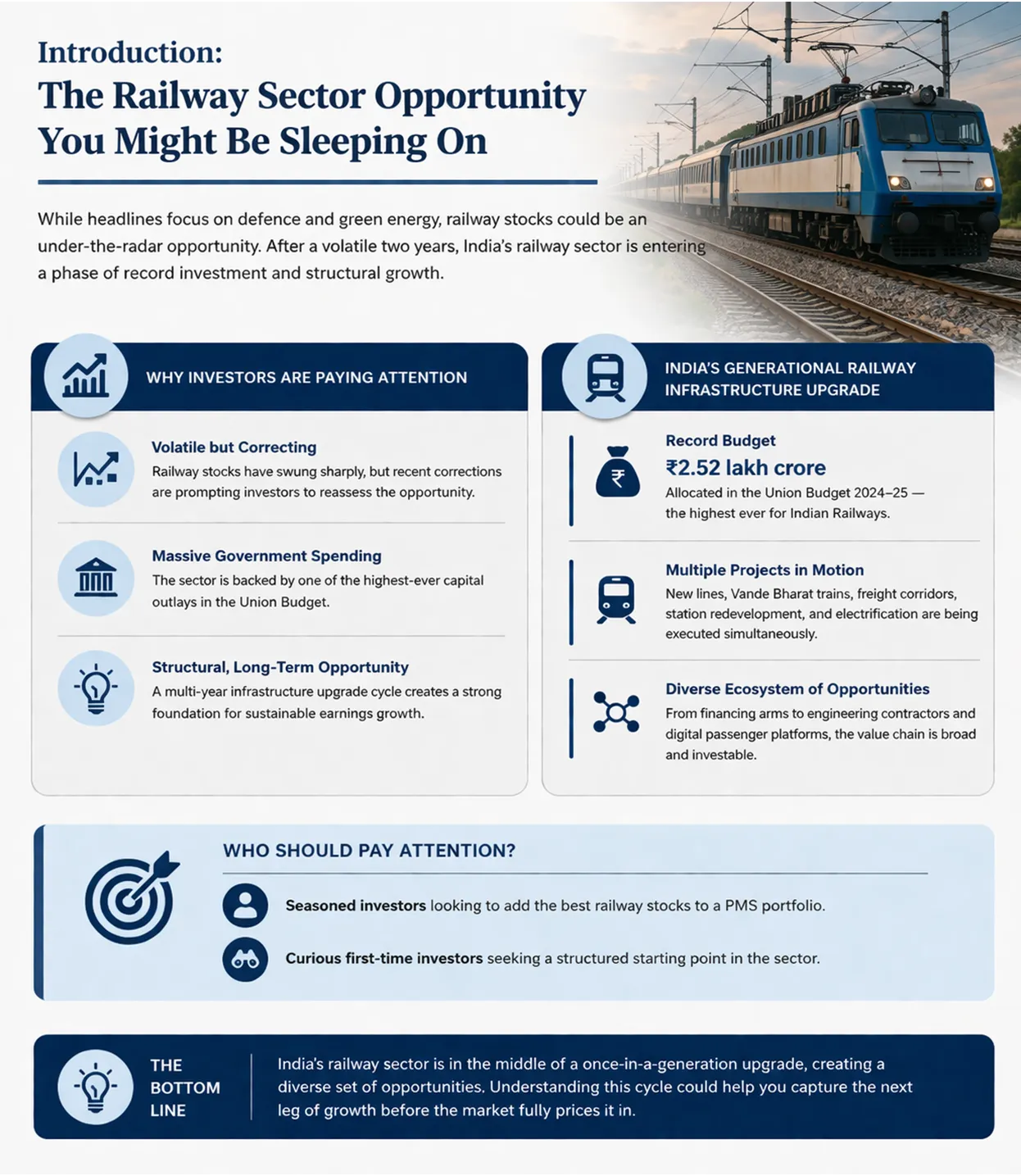
Most listed railway companies are paid out of the railway budget, directly or through Railways' borrowings. The Union Budget 2026-27 allocated ₹2,93,030 crore as planned capital expenditure for Indian Railways, according to the Press Information Bureau. Business Standard reported the government's budgetary support for railway capex at about ₹2.77 trillion, up about 9.9% from the FY26 revised estimate of ₹2.52 trillion. Different outlets split capex and total outlay differently, so the PIB release is the reference figure.
Freight corridors and network upgrades
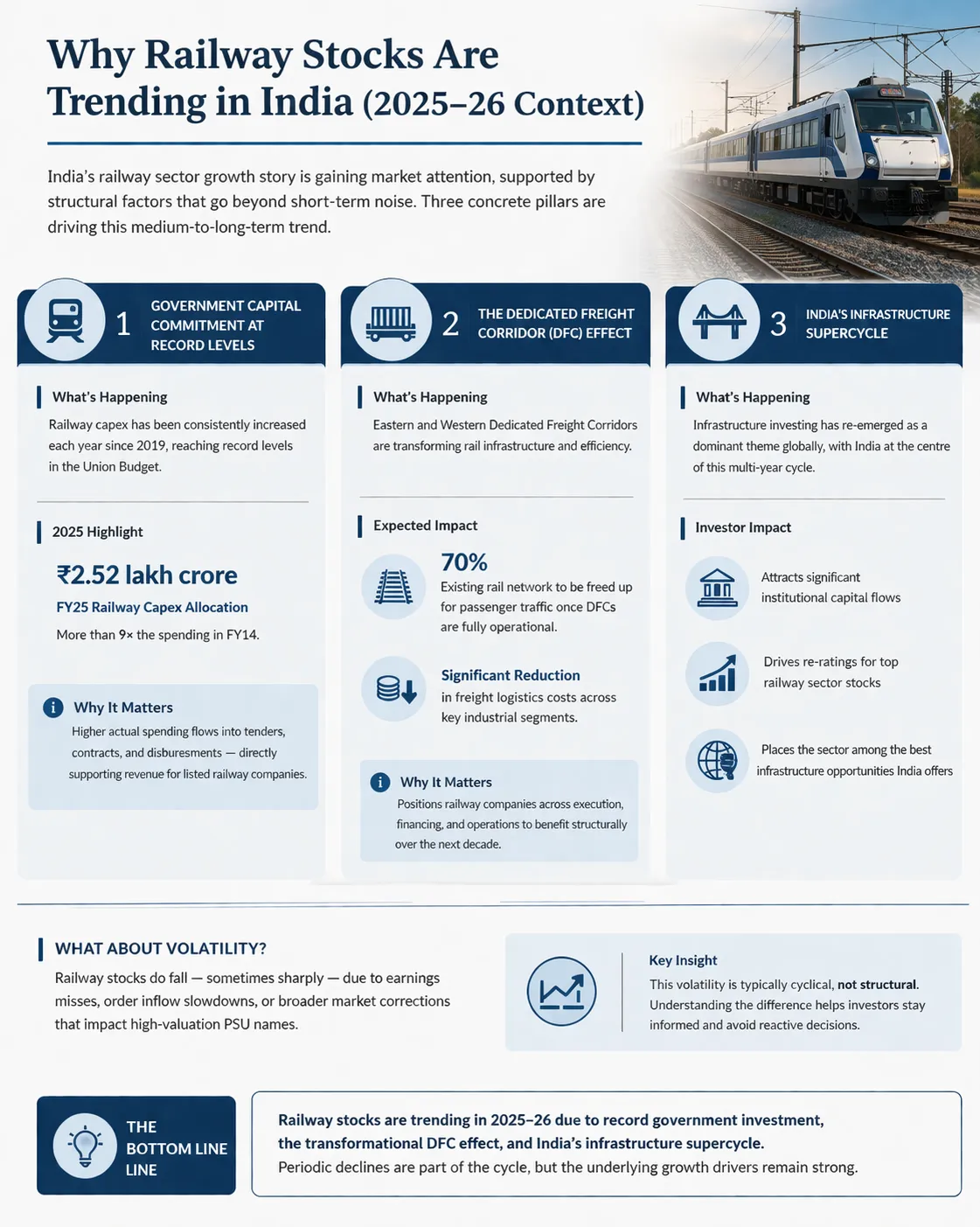
The Eastern and Western Dedicated Freight Corridors move freight onto separate tracks, which is intended to release capacity on the existing network for passenger services. Related spending covers electrification, new lines, signalling and safety systems such as Kavach, and rolling stock including Vande Bharat trains.
Private participation
Private companies take part in wagon and coach manufacturing, freight terminals, station redevelopment and signalling. A 2020 plan to run private passenger trains did not proceed as originally planned, which shows that policy timelines can shift.
How the main listed businesses make money
- IRFC is the borrowing arm of Indian Railways. It raises money from markets and lends to the Ministry of Railways, earning a spread over its funding cost. Its profit moves with the size of its loan book rather than with project execution.
- RVNL executes projects such as new lines, doubling, electrification, workshops and metro work. Revenue is recognised as work progresses, so quarters can be uneven.
- IRCTC runs online rail ticketing, catering, Rail Neer packaged water and tourism. Its income depends on passenger volumes and fees rather than on government capex.
- RITES provides railway consulting, inspection and project management, and exports rolling stock.
Other listed names include RailTel (telecom and IT on the railway fibre network), Texmaco Rail and Titagarh Rail Systems (wagons), Kernex Microsystems and HBL Engineering (signalling and Kavach-related products), and the diversified CONCOR, IRCON, Jupiter Wagons and BEML.
Get research like this in your inbox
The week’s research that mattered, in five minutes. Joined by 2L+ investors.
Dated financial snapshot
Figures are consolidated, in ₹ crore, from company filings as compiled by Screener.in on 23 November 2026. The IRFC market capitalisation is from ICICI Direct (23 November 2026). Q2 FY27 is the quarter July-September 2026.
| Company | Market cap | Q2 FY27 revenue | Q2 FY27 net profit | FY26 revenue | FY26 net profit | Trailing P/E |
|---|---|---|---|---|---|---|
| IRFC | about 1,08,455 | 7,866 | 1,958 | 27,285 | 7,009 | n/a |
| RVNL | 38,740 | 4,701 | 254 | 20,412 | 871 | 42.3 |
| IRCTC | 35,772 | 1,333 | 264 | 5,215 | 1,393 | 26.0 |
| RITES | 8,939 | 557 | 97 | 2,415 | 454 | 22.0 |
Year-on-year, IRFC's Q2 net profit was ₹1,958 crore against ₹1,777 crore in Q2 FY26, a rise of about 10%. RVNL's Q2 revenue of ₹4,701 crore compares with ₹5,123 crore a year earlier, while its net profit rose from ₹231 crore to ₹254 crore. RITES reported ₹557 crore revenue against ₹549 crore a year earlier. IRCTC's revenue rose from ₹1,146 crore to ₹1,333 crore, while net profit fell from ₹342 crore to ₹264 crore.
Order book
Reports on RVNL's Q2 FY27 investor presentation put its order book at about ₹90,099 crore as of 30 September 2026, slightly below ₹93,492 crore in the previous quarter, with the company attributing the dip to monsoon-related execution timing. IRFC is a lender and does not report an order book.
Why these shares can move sharply
- Earnings timing. Project companies recognise revenue as work is done, so profit can lag order wins.
- Order flow. A slowdown in new awards or payment delays shows up in order-book disclosures.
- Policy dependence. Budget priorities and railway tariff or fee rules affect the whole group at once.
- Valuation changes. The table shows trailing P/E ratios between about 22 and 42, so a change in market sentiment moves prices even without changes in earnings.
- Regulation. IRCTC's convenience fee and its ticketing role are set by the railway ministry.
Over the past year, the 52-week ranges reported on Screener show RVNL between ₹178 and ₹401, IRCTC between ₹435 and ₹713 and RITES between ₹175 and ₹257, illustrating how wide price swings in this group have been.
Ways people hold a theme such as this
Investors can hold individual shares, thematic exchange-traded funds or managed portfolios. Managed products differ in minimum amounts, how much the portfolio is customised and who controls trades. The infographic below summarises one comparison published earlier.
Further reading: Indian Railway Sector Report.
Is your portfolio built for what’s coming?
Get a free AI-powered review of your holdings — risk, overlap and quality in minutes.
Frequently asked questions
Which companies are in the railway sector in India?
Commonly listed names include IRFC, RVNL, IRCTC, RITES, RailTel, Texmaco Rail, Titagarh Rail Systems, Jupiter Wagons, Kernex Microsystems, HBL Engineering, IRCON, CONCOR and BEML. The NSE sector and thematic indices are one way to find the full list.
Why do railway shares rise and fall?
Prices respond to budget allocations, order announcements, quarterly results, market-wide sentiment and changes in valuation multiples. Moves in the sector are often correlated because the customer is the same.
Are railway companies infrastructure companies?
Railway-linked companies are usually classified within infrastructure or capital goods, although IRFC is a financial company and IRCTC is a services and consumer business.
Data sources: PIB (Union Budget 2026-27 railway capex release), company filings via Screener.in, ICICI Direct, and press coverage of RVNL's Q2 FY27 presentation. Figures as of 23 November 2026.
This article is for educational purposes only and is not investment advice.


