


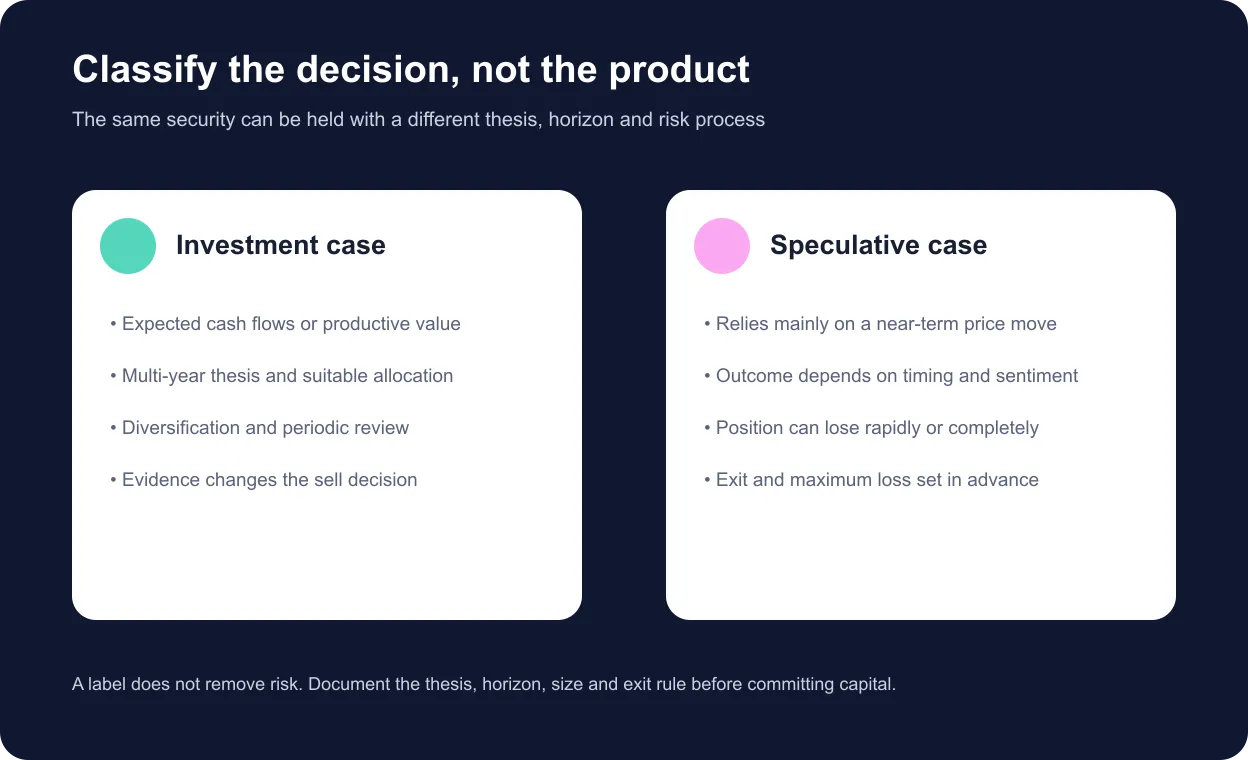
Investing and speculation both involve uncertainty, but they organise that uncertainty differently. An investment thesis usually connects price with future cash flows, productive assets or long-run earning power. A speculative thesis relies more heavily on an expected price move and the ability to exit.
The practical value of speculation vs investing is not moral labelling. It is deciding how much evidence, time, diversification and loss capacity a position requires. The same listed share can be an investment for one person and a speculative position for another because their reasons, sizing and exit rules differ.
The purpose, thesis and risk process distinguish a position more reliably than the security’s name.
Speculation vs Investing: The Big Idea
An investor expects value to develop through business profits, interest, rent or other productive cash flows. Price matters, but the underlying asset’s economics provide the analytical anchor. A speculator primarily expects a favourable change in market price, often before the fundamentals can materially change.
This distinction is a spectrum. A carefully researched growth stock may still contain speculative assumptions, while a short-duration trade may use disciplined evidence and risk control. Ask four questions: What creates the expected return? How long should it take? What could disprove the thesis? How much can the position lose?
See what markets are pricing in
Live indices, sector moves and market breadth — the backdrop to every story we publish.
What Is Investing?
Investing allocates capital to an asset with an expectation of future economic benefits. For equity, analysis may cover revenue, margins, cash flow, competitive position, governance, balance-sheet strength and valuation. For debt, the focus shifts toward contractual cash flows, credit quality, maturity and interest-rate risk.
Long term investing allows compounding to work, but time alone does not convert a weak asset into a sound one. A defensible process connects the holding to a financial goal, uses diversification and reviews whether evidence still supports the original thesis.
Successful long term investing also recognises valuation. Even a high-quality company can deliver disappointing returns if purchased at a price that assumes unrealistically strong growth. The investor accepts volatility but does not confuse every price decline with permanent loss.
What Is Speculation?
The speculation trading meaning is taking risk primarily because a price is expected to move favourably. The expected payoff may depend on news, sentiment, momentum, a macro event or a temporary market imbalance rather than long-run cash generation.
The speculation meaning in stock market discussions often implies high uncertainty and a meaningful chance of capital loss. It does not automatically mean illegal or irrational activity. Speculators can add liquidity and express views, but their outcomes are unusually sensitive to timing, transaction costs and leverage.
Understanding speculation trading meaning requires separating a forecast from a process. A forecast may be correct but mistimed; a leveraged position can be forced out before the thesis plays out. Sound speculative trading therefore needs a defined catalyst, invalidation point and maximum acceptable loss.
Speculation vs Investing: Key Differences
| Dimension | Investing | Speculation |
|---|---|---|
| Return anchor | Cash flows, earning power or productive value | Expected price change |
| Typical horizon | Usually multi-year | Often event-driven or shorter |
| Evidence | Fundamentals, valuation and goal fit | Catalyst, momentum, sentiment or market structure |
| Portfolio role | Core wealth-building allocation | Small, explicitly limited allocation |
| Exit | Thesis, valuation or goal changes | Target, catalyst, time limit or invalidation |
In a speculation vs investing comparison, the security itself is insufficient. An index ETF can be speculated in with leverage for tomorrow’s move, while a researched company may be owned for years. The decision process reveals the economic purpose.
The phrase investing vs trading answers a different question. Trading describes activity and frequency; speculation describes the source and uncertainty of the expected return. Conflating them can make a disciplined trader look reckless or a poorly researched holder look prudent.
Get research like this in your inbox
The week’s research that mattered, in five minutes. Joined by 2L+ investors.
Risk, Time Horizon and Decision-Making
Risk is not merely daily volatility. Investors face business deterioration, overvaluation, inflation and permanent capital loss. Speculators add timing, execution, liquidity and often leverage risk. The shorter the window, the less time there is for fundamental value to influence price.
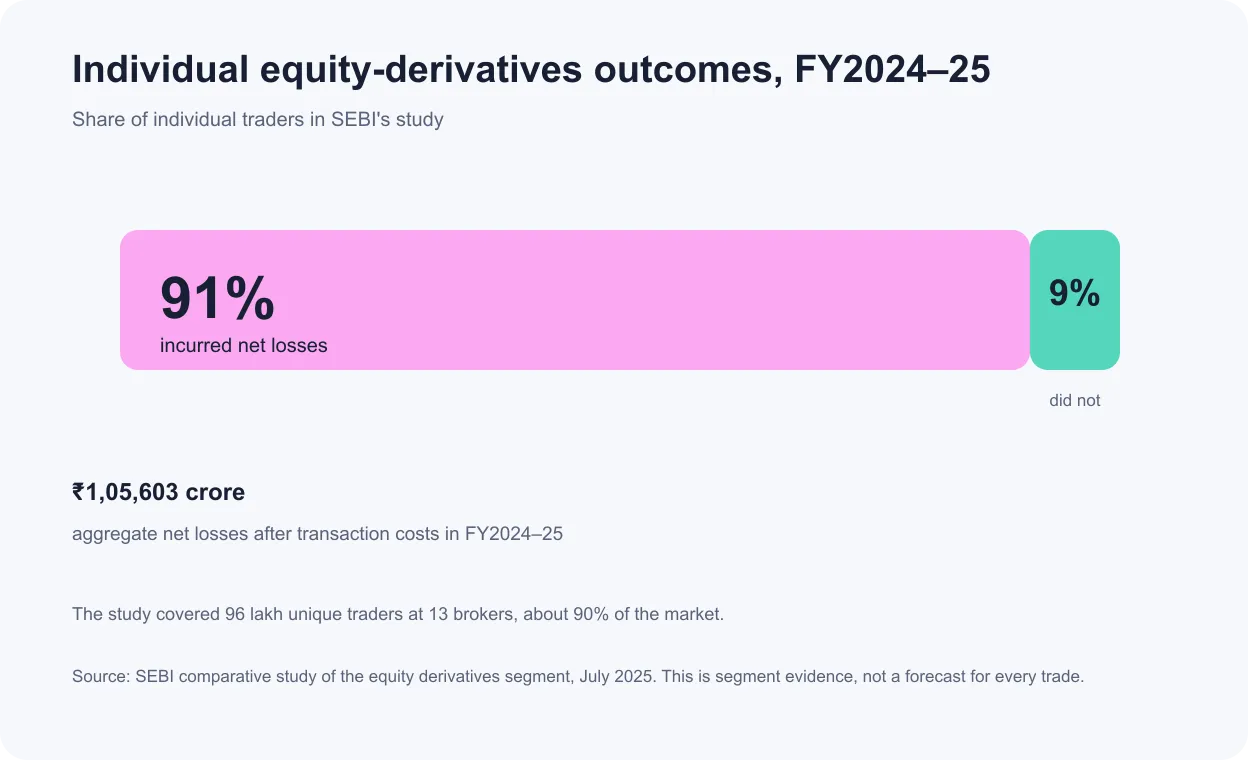
SEBI’s July 2025 study provides an important warning about leveraged equity derivatives: 91% of individual traders incurred net losses in FY2024–25, with aggregate losses of ₹1,05,603 crore after transaction costs. The finding concerns this segment, not every form of trading.
A useful speculation vs investing decision starts with loss capacity. SEBI advises matching products with objectives, risk appetite and time horizon, researching risks and diversifying. Borrowed money or leverage can make a manageable forecast error financially damaging.
Common Examples of Speculative Activity
Common speculation examples include buying after an unverified tip, chasing a sudden price spike, taking leveraged options positions around an announcement and purchasing solely because another buyer may pay more. A sound business bought without valuation or thesis can also become a speculative bet.
Highly volatile tokens, thinly traded shares, leveraged contracts and collectibles are often described as speculative assets. Yet classification depends on use. Gold may hedge a portfolio in one plan and become a leveraged short-term wager in another.
These speculation examples share dependence on uncertain market behaviour. A clear speculation meaning in stock market practice is therefore not “anything risky”; all securities carry risk. It is risk taken mainly for price appreciation without a sufficiently strong productive-value anchor.
Can Speculation Ever Have a Place in a Portfolio?
A limited allocation may suit an experienced person who understands the instrument, accepts a total loss and has already protected essential goals. It should not fund emergencies, near-term expenses or retirement needs. The relevant question is whether failure harms the financial plan.
Set a hard portfolio cap and size each position below that cap. Treat gains as uncertain, avoid replenishing losses automatically and record every trade. Speculative assets can become dangerously large after a rally, so rebalance rather than letting recent success redefine risk tolerance.
Speculation trading meaning also changes when leverage is involved: margin creates obligations beyond a simple cash purchase. Before speculative trading, understand settlement, liquidity, contract terms, transaction costs and worst-case loss. If those cannot be explained plainly, the position is not ready.
Therefore, speculative trading requires discipline before the order, not explanations after an avoidable financial loss.
How to Separate Core Investments From Speculative Bets
Use two written buckets. The core supports goals through diversified assets, suitable allocation and long term investing. The satellite bucket contains explicitly capped ideas whose loss will not interrupt the plan. Separate accounts or labels can prevent a losing trade from quietly becoming a permanent holding.
For every position, record thesis, expected return source, horizon, maximum allocation, invalidation evidence and exit rule. In investing vs trading decisions, also log costs and tax consequences. Review the core periodically; review speculative positions at the frequency their catalysts demand.
A second speculation meaning in stock market discipline is accepting uncertainty without inventing certainty. Do not average down merely to avoid admitting an error. Do not use an investment narrative to excuse a broken trade, or a price target to override deteriorating fundamentals.
The final speculation vs investing test is simple: if price stopped updating for a year, what evidence would still support ownership? Productive economics may support an investment. If the thesis collapses without a near-term buyer, catalyst or quote, treat it as speculation and size it accordingly.
That separation also clarifies investing vs trading. Long-horizon investing belongs in the core only when the asset, valuation and goal fit are sound. Such positions belong outside essential goals, with precommitted limits. The third investing vs trading lesson is that activity is not a substitute for progress.
Is your portfolio built for what’s coming?
Get a free AI-powered review of your holdings — risk, overlap and quality in minutes.
FAQ
What is speculation in the stock market?
It is taking market risk mainly to profit from an expected price change, often over a shorter horizon and with greater dependence on timing, liquidity or sentiment than on long-run cash generation.
What is the difference between speculation and investing?
Investing normally anchors a multi-year thesis to productive value, expected cash flows and portfolio goals. Speculation depends more heavily on a price movement and therefore needs explicit sizing, loss limits and exit rules.
Is speculation the same as trading?
No. Trading describes transaction activity and holding period. A trader can use a researched, repeatable process, while a long-held position can still be speculative if it lacks a defensible value thesis.
Is speculative investing risky?
Yes. Outcomes may depend on volatile prices, leverage, timing and liquidity. Losses can be rapid, and leveraged positions may lose more than the initial margin.
What are examples of speculation?
Examples include leveraged directional derivatives, buying solely on an unverified rumour, chasing a sudden price spike, or purchasing an asset only because another buyer may pay more soon.
How can investors manage speculative positions?
Use only capital that can be lost without affecting goals, cap the allocation, avoid unplanned leverage, define the maximum loss and exit conditions, and keep the position separate from the core portfolio.


