
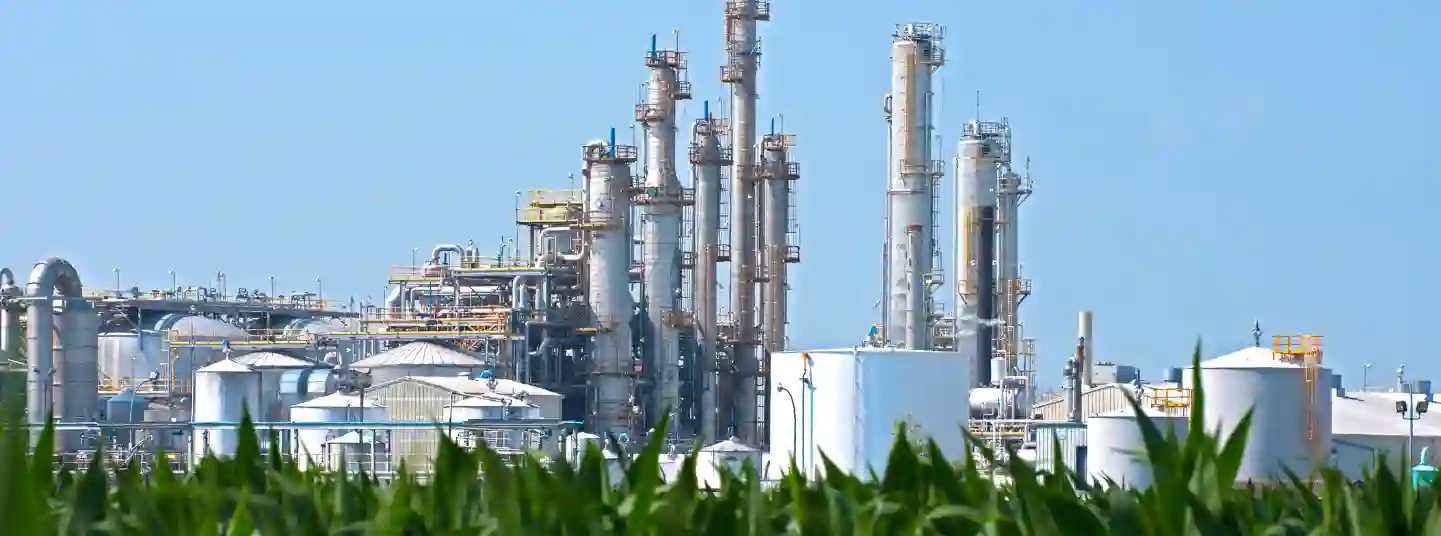
Ethanol made from sugarcane, grain and other feedstocks is blended with petrol under the Ethanol Blending Programme (EBP). This article explains how the programme works, what changed for the 2025-26 and 2026-27 ethanol supply years, how "best ethanol stocks" lists are typically built, and what listed companies reported for Q2 FY27 (July-September 2026).
How the ethanol sector works
Oil marketing companies (OMCs) buy ethanol through annual tenders for each ethanol supply year (ESY), which runs from November to October. Ethanol can be produced from sugarcane juice, sugar syrup, B-heavy and C-heavy molasses, damaged food grains, maize and rice. The government fixes procurement prices by feedstock, so a producer's margin depends on the feedstock, the tender allocation and the price set for it.
Ethanol makers fall into three groups:
- Integrated sugar companies with distilleries, such as Balrampur Chini and Triveni Engineering.
- Standalone grain distilleries, many of which use maize or rice.
- Technology and engineering suppliers that build distilleries and bio-energy plants, such as Praj Industries.
See what markets are pricing in
Live indices, sector moves and market breadth — the backdrop to every story we publish.
What changed in 2025-26 and 2026-27
- Blending level: India has reached an average blending of about 20% in petrol, a target advanced from the original 2030 deadline (Construction World and other reports; check the Ministry of Petroleum for official figures).
- ESY 2025-26 tender: OMCs sought about 1,050 crore litres. Distillers offered about 1,776 crore litres, and the sugar sector was allocated about 289 crore litres, roughly 61% of the quantity it offered, according to ISMA. The food ministry allowed mills and distilleries to produce ethanol from cane juice, syrup and B-heavy and C-heavy molasses without restriction that year.
- Prices: reported 2025-26 procurement prices were about Rs 72 per litre for maize-based ethanol, Rs 65 for cane juice and Rs 60 for B-heavy molasses (S&P Global, March 2026).
- ESY 2026-27 tender: reportedly bars ethanol from cane juice, sugar syrup and B-heavy molasses to protect sugar supply, and reduces maize ethanol procurement prices by about Rs 3 per litre, according to company commentary.
The industry has said installed capacity exceeds OMC requirements, so allocation rather than capacity is now the constraint. The sector's economics are therefore closely tied to tender rules.
How "best ethanol stocks" lists are usually built
Lists generally screen listed companies on distillery capacity, share of revenue and profit from distillery, feedstock flexibility (molasses, cane juice, grain), sugar-cycle exposure, balance-sheet leverage, and for equipment makers the order book. Earlier versions of this article listed company descriptions without current figures; where figures could not be verified, the companies were removed.
Latest reported figures
| Company | Q2 FY27 data point | Source / date |
|---|---|---|
| Balrampur Chini Mills (standalone) | Revenue Rs 1,876 crore (+12.3%); pre-tax profit Rs 144 crore (+104%); distillery revenue Rs 325 crore (-19.9%); distillery PBIT Rs 39 crore (-34.1%) | Company results coverage, Oct-Nov 2026 |
| Triveni Engineering | Alcohol sales 61,424 kilolitres (+15.8%); alcohol PBIT +53.5%; H1 alcohol production 1,08,540 kilolitres (-12.8%) | Company results coverage, Oct-Nov 2026 |
| Praj Industries (consolidated) | Revenue about Rs 849 crore (+0.9%); net profit about Rs 23 crore (+20%); order book reported at about Rs 4,460-4,590 crore | Company results coverage, Q2 FY27; order book figures differ by source |
Balrampur Chini's management attributed the weaker distillery result to ethanol procurement prices that had not been revised while cane costs rose. Praj's operating profit slipped about 6% to Rs 52 crore even as net profit rose. EID Parry, Dalmia Bharat Sugar and several other companies named in earlier versions could not be verified for Q2 FY27 and are not tabulated here.
Get research like this in your inbox
The week’s research that mattered, in five minutes. Joined by 2L+ investors.
What the numbers show
- Sugar and ethanol results at the same company can move in opposite directions: Balrampur's sugar profit more than doubled while distillery revenue fell about 20%.
- Maize-based capacity (Triveni) and molasses-based capacity (Balrampur) face different pricing and feedstock rules.
- Equipment demand (Praj) depends on new capacity orders, which are slowing as blending nears its target; the company's revenue was nearly flat.
Key variables
- Tender allocation and price: set annually by OMCs and the government.
- Feedstock: sugarcane supply, maize prices and monsoon outcomes.
- Sugar price and export policy: affects mills' diversion decisions.
- Beyond E20: industry bodies such as ISMA have asked for a roadmap beyond 20% blending; no final decision should be assumed.
- Vehicle compatibility: consumer concerns about E20 fuel and mileage have been part of public debate.
Frequently asked questions
What is the Ethanol Blending Programme?
A government programme under which oil marketing companies blend ethanol with petrol to reduce crude imports and emissions.
Which feedstocks are used?
Sugarcane juice, syrup, molasses, maize, rice and damaged grain, subject to government policy for each supply year.
Where are ethanol tender details published?
OMC tender notices and notifications by the Ministry of Consumer Affairs, Food and Public Distribution.
Companies named are factual examples with dated data. Their inclusion is not a recommendation.
Related reading: India's renewable and green energy sector and renewable energy stocks.
Is your portfolio built for what’s coming?
Get a free AI-powered review of your holdings — risk, overlap and quality in minutes.
How to read ethanol company disclosures
Integrated sugar companies report segment results for sugar, distillery, power and other activities. Distillery segment revenue and PBIT (profit before interest and tax) show the ethanol contribution separately from sugar. Volumes are reported in kilolitres, and realisation per litre depends on feedstock and the tender price. Technology suppliers report order intake and order backlog instead. Because the sugar season runs from October to September while the ethanol supply year runs from November to October, quarterly figures can show timing differences between production, sales and procurement price revisions. Primary sources are the exchange filings of each company, OMC tender notices, ISMA releases and food ministry notifications.
This article is for educational purposes only and is not investment advice.


