


Sector report: Indian Green Energy Sector Report (market size, drivers, regulation, risks and listed companies).
Quick Answer: Which Green Energy Stocks Are Listed in India?
India's listed green energy companies include green energy stocks such as Adani Green Energy (20,763 MW operational as of 30 September 2026, 50 GW target), Tata Power (renewables, EV charging and solar EPC) and NTPC Green Energy (about 11 GW). EV ecosystem names include Tata Motors (about 41% of India's passenger EV sales in October 2026, per Vahan data) and Exide Industries (6 GWh lithium-ion cell plant commissioned 23 September 2026). India's non-fossil capacity is above 300 GW against a 500 GW target for 2030. Key risks: policy dependency, interest rate sensitivity on debt-financed projects, and execution delays.
See what markets are pricing in
Live indices, sector moves and market breadth — the backdrop to every story we publish.
What Are Green Energy and Renewable Energy Stocks?
Green energy or renewable energy stocks are shares of companies that earn a meaningful part of their revenue from clean energy. That includes producing power from renewable sources, or making the equipment and infrastructure that makes clean energy possible. They fall into two broad groups:
1. Power generators produce and sell electricity from renewable sources, usually under long-term power purchase agreements.
| Category | What they do | Indian examples |
|---|---|---|
| Renewable power producers | Own and run solar and wind farms | Adani Green Energy, NTPC Green Energy, ACME Solar |
| Hydroelectric companies | Generate power from hydro projects |
2. Supporting infrastructure suppliers make the equipment and networks that clean energy depends on.
| Category | What they do | Indian examples |
|---|---|---|
| Solar equipment | Solar modules and cells | Waaree Energies, Premier Energies |
| Wind equipment | Wind turbines and components | Suzlon Energy, Inox Wind |
| Energy storage | Batteries and storage systems | Exide Industries, Amara Raja Energy & Mobility |
| Grid infrastructure | Transmission lines, substations, grid equipment | Power Grid, Hitachi Energy India |
| Green hydrogen | Electrolysers and hydrogen projects | Early stage; mainly within large groups such as Reliance Industries and Adani Enterprises |
Key difference: Generators earn steady, contract-based income but need heavy capital and carry high debt. Equipment and infrastructure suppliers depend on order flow and project demand, so their earnings can grow faster but are more cyclical.
Note: Many companies, such as Tata Power and JSW Energy, run both renewable and conventional power. Check what share of revenue actually comes from green energy before treating a stock as a renewable play.
Why Indian Investors Are Looking at Green Energy Now
If you've been tracking markets for even a few months, you've probably noticed something: green energy stocks are no longer a niche conversation. They're front and centre in every serious investor's portfolio discussion.
And for good reason. India is sitting at the intersection of two massive tailwinds: a government that has committed ₹19.7 lakh crore to the energy transition and a domestic consumption story that refuses to slow down. Electricity demand in India is expected to triple by 2050, and most of that incremental demand will be met by renewables. That scale explains why the sector draws so much investor attention.
But here's the honest problem: the sector is noisy. There are dozens of listed companies with some exposure to renewables, and separating the genuine compounders from the overhyped names is genuinely hard. This blog is an attempt to cut through that.
We'll look at the main listed green energy companies, walk through EV ecosystem names and flag the risks.
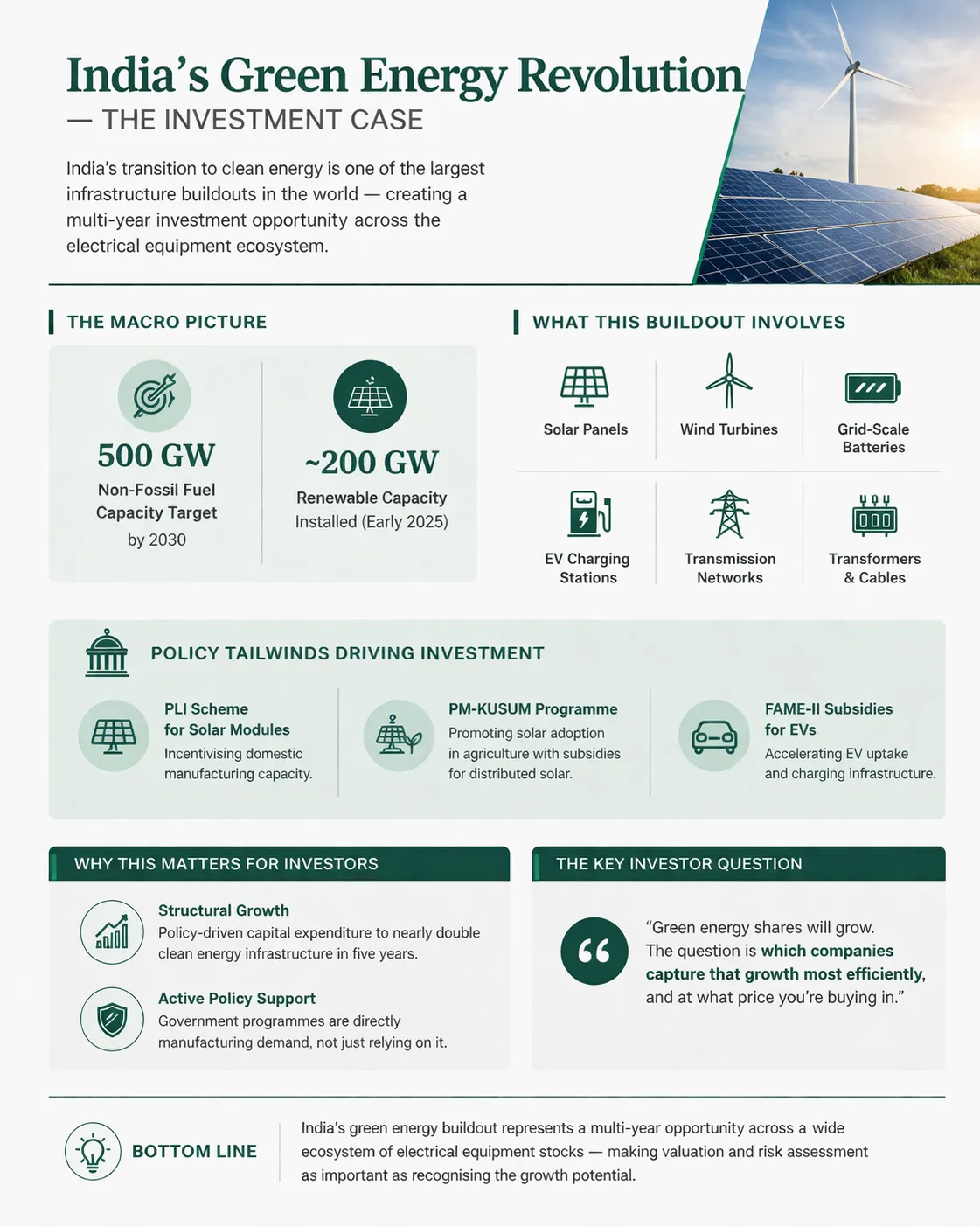
India's Green Energy Revolution: Renewable Energy Growth & Investment Case
Let's start with the macro picture, because it matters more here than in most sectors.
India has pledged 500 GW of non-fossil fuel capacity by 2030. Non-fossil capacity is now above 300 GW, so roughly 200 GW more is needed in the next four years, and that buildout involves solar panels, wind turbines, grid-scale batteries, EV charging stations, transmission networks, transformers, cables, and a whole ecosystem of electrical equipment stocks that most casual investors ignore.
The government's Production Linked Incentive (PLI) scheme for solar modules, the PM-KUSUM programme for agricultural solar, the PM E-DRIVE scheme for EVs (extended to 31 March 2028) and ALMM List-II for solar cells (in effect since 1 June 2026) are all pushing capital into this space in ways that are structurally different from a typical cyclical upturn. This isn't just about demand; there's an active policy manufacturing the demand.
Valuation matters as much as growth: the share prices of several leading names already reflect high expectations, as the P/E figures in the table below show.
Top Renewable Energy Stocks in India
1. Adani Green Energy (ADANIGREEN): India's Largest Utility-Scale Solar Stock
Adani Green Energy (ADANIGREEN) is the most prominent name when anyone talks about top green energy stocks in India. Its operational capacity was 20,763 MW as of 30 September 2026, against a stated target of 50 GW.
The business model is straightforward: long-duration power purchase agreements (PPAs) with state utilities and SECI provide revenue visibility for 20-25 years. That predictability is what justifies the premium valuation. What investors often underestimate is how much of Adani Green's competitive advantage comes from land acquisition at scale and the ability to negotiate EPC contracts at pricing that smaller players simply cannot access.
ADANIGREEN trades at a high P/E relative to its near-term earnings (see the table below), and the company carries substantial debt financing its expansion.
Metric | Adani Green Energy |
Installed Capacity (2025) | ~10.9 GW |
Target Capacity (2030) | 45 GW |
Revenue Model | Long-term PPAs |
Key Risk | Execution at scale, debt levels |
NSE Symbol | ADANIGREEN |
2. Tata Power — Diversified Clean Energy Play
Tata Power offers something different: diversification within the clean energy theme. The company has renewable generation, a rapidly growing EV charging network (Tata Power EZ Charge), and a solar EPC business (TP Solar), all under one roof.
Tata Power combines renewable generation, an EV charging network and a solar EPC business. It has more than 6,700 public charging points.
Tata Power is part of the Tata Group, which supports its access to financing.
3. NTPC Green Energy — PSU Renewable Arm
NTPC's renewable arm, NTPC Green Energy (NTPCGREEN), is already listed and has about 11 GW of capacity. NTPC Limited has a 60 GW renewable capacity target by 2032.
As a PSU, NTPC's government relationships can mean lower financing costs and easier land acquisition.
The execution pace of large PSUs can differ from market expectations.
Other Renewable Energy Stocks in India to Research
| Company | Exposure | Market Cap (₹ cr) | P/E | 1Y Return |
|---|---|---|---|---|
| JSW Energy | Power generation (thermal + renewables) | 93,918 | 40.8 | +1.7% |
| NHPC | Hydropower | 76,704 | 18.0 | −4.4% |
| SJVN | Hydro, solar, wind | 21,924 | 22.4 | −31.8% |
| IREDA | Renewable energy lender | 36,998 | 18.8 | −10.2% |
| Waaree Energies | Solar modules | 70,759 | 19.2 | −24.2% |
| Suzlon Energy | Wind turbines | 50,783 | 22.7 | −34.8% |
| Inox Wind | Wind turbines | 9,644 | 29.5 | −59.8% |
| Vikram Solar | Solar modules | 4,946 | 21.1 | −54.5% |
Market data as of 23 November 2026, from Wright Research stock pages. Past returns do not indicate future performance.
Get research like this in your inbox
The week’s research that mattered, in five minutes. Joined by 2L+ investors.
EV Ecosystem Stocks in India: OEMs, Components & Charging
1. Tata Motors EV — Market Leader
Tata Motors' share of India's passenger EV sales was about 41% in October 2026 (Vahan data). Since 1 October 2025 its passenger vehicle business has been listed separately as Tata Motors Passenger Vehicles (TMPV), following the demerger from Tata Motors Commercial Vehicles (TMCV).
Agratas Energy Storage Solutions is the group's battery cell venture; its plant is still under construction.
EV Metric | Tata Motors (India Passenger EVs) |
Market Share (Oct 2026) | ~41% |
Key Models | Nexon EV, Punch EV, Curvv EV |
Battery JV | Agratas Energy Storage |
Charging Network | Via Tata Power EZ Charge |
NSE Symbol | TMPV (passenger vehicles) |
2. Exide Industries & Battery Supply Chain
Exide Industries is India's largest lead-acid battery manufacturer and is moving into lithium-ion cells. It commissioned a 6 GWh cell plant on 23 September 2026.
Battery makers such as Exide supply the storage and power management used in EVs and in grid-scale renewable integration.
Other companies in the adjacent space include: Amara Raja Energy & Mobility (battery rival to Exide), KEI Industries (cables and wiring for renewable projects), and ABB India (power and automation for renewable infrastructure).
How to Evaluate Green Energy Stocks in India: Key Metrics
Before buying any green energy shares , there are a few metrics worth anchoring to because standard P/E analysis doesn't always apply to capital-intensive infrastructure businesses.
EV/EBITDA is more useful than P/E for renewable utilities because depreciation distorts net profit figures significantly.
Capacity under construction vs. operational tells you how much of the stock's valuation is priced on future capacity. A company with 5 GW operational but 20 GW "under development" deserves higher scepticism than its revenue multiple suggests.
PPA tariff mix matters because older PPAs were signed at higher tariffs than newer ones, which face pressure from competitive bidding.
Debt-to-equity is critical in this sector. Renewable projects are typically 70:30 debt-equity financed, which means interest rate cycles affect valuations directly.
Metric | What to Look For |
EV/EBITDA | 15–25x is reasonable for renewable utilities |
Capacity Under Construction | Closer to operational = lower execution risk |
Debt/Equity | >3x warrants scrutiny |
PPA Weighted Average Tariff | Higher = more profitable legacy assets |
Promoter Holding | Stability signal in capital-intensive businesses |
Risks of Investing in Green Energy Stocks in India
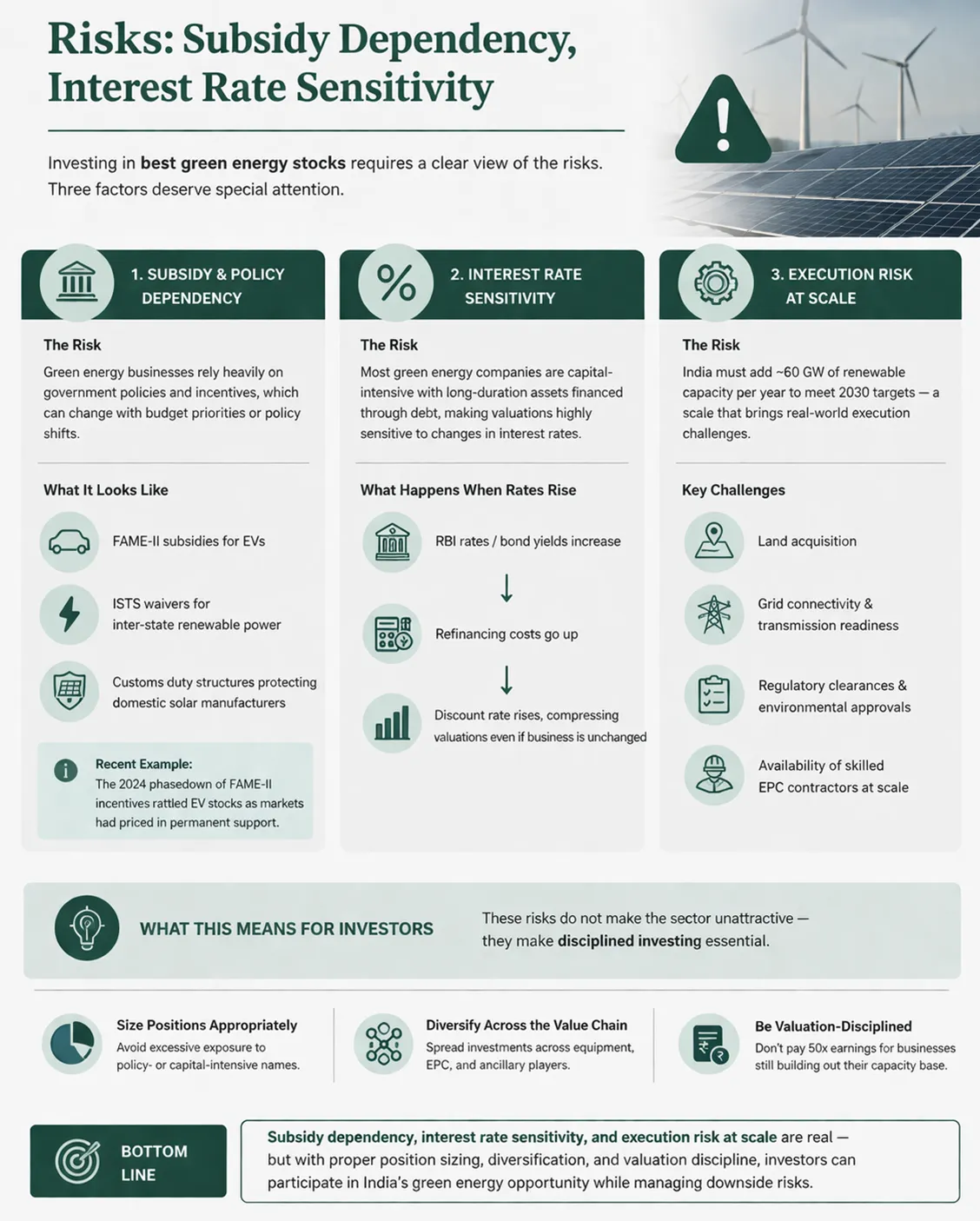
No discussion of best green energy stocks is complete without an honest look at the risks. There are three that matter most.
Subsidy and policy dependency matter: EV incentives (now PM E-DRIVE, extended to 31 March 2028), ISTS waivers for inter-state renewable power, and customs duty and ALMM rules that protect domestic solar manufacturers are all government policies, and they can be modified.
Interest rate sensitivity affects green energy sector stocks disproportionately because their business model involves long-duration assets financed with debt. When RBI rates rise or bond yields spike, two things happen: refinancing costs increase, and the discount rate used to value long-duration cash flows rises, compressing valuations even if the underlying business hasn't changed.
Execution risk at scale is underappreciated. India needs to add ~60 GW of renewable capacity per year to hit its 2030 targets. That requires land, grid connectivity, regulatory clearances, and skilled EPC contractors in volumes that have never been mobilised in this country before. Delays are not hypothetical; they're already showing up in several developers' project pipelines.
Weather Dependence, Grid Integration and Supply-Chain Risks
- Weather: Low sunlight or wind reduces generation and revenue.
- Transmission: Weak grid capacity can delay projects or leave power unused.
- Grid integration: Variable output can lead to curtailment and extra storage costs.
- Technology changes: Older equipment and plants can quickly lose competitiveness.
- Component prices: Swings in polysilicon, steel, copper and lithium prices can squeeze margins.
Companies with diversified locations, storage, secure grid access and stable supply contracts are better placed to manage these risks.
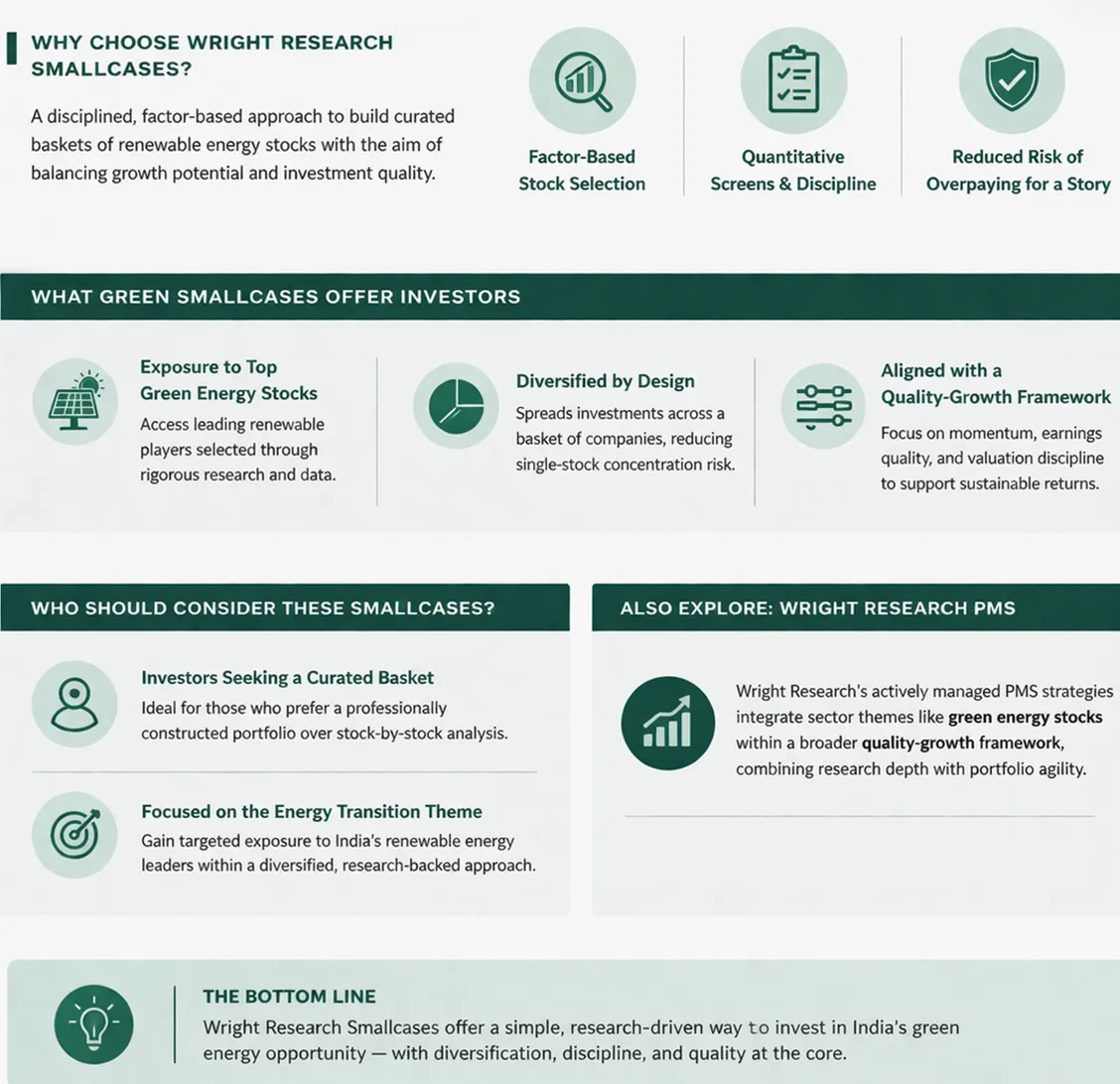
Green Smallcase Options on Wright Research
Wright Research publishes thematic Smallcase baskets, including baskets for the energy transition theme.
Details of the current baskets are on the relevant Smallcase pages.
Is your portfolio built for what’s coming?
Get a free AI-powered review of your holdings — risk, overlap and quality in minutes.
FAQs About Green Energy Stocks in India
1. Which green energy stocks are listed in India?
Widely tracked names include Adani Green Energy, Tata Power, NTPC Green Energy, NHPC and SJVN. They differ in business mix: Adani Green is a renewable developer, Tata Power combines renewables with EV charging and solar EPC, NTPC Green Energy is a PSU renewable developer, and NHPC and SJVN are hydro-led PSUs.
2. What is the difference between green energy stocks and electrical equipment stocks?
Green energy stocks refer to companies that generate or develop renewable power (solar, wind, hydro). Electrical equipment stocks and electric equipment stocks refer to manufacturers of the infrastructure enabling the energy transition, such as transformers, cables, switchgear, batteries, and EV components. Both are part of the energy transition investment thesis but operate at different points in the value chain.
3. Are green energy shares overvalued in India?
Several leading green energy shares trade at high P/E multiples relative to current earnings, as the table above shows, which reflects expectations of future capacity growth. Whether a multiple is high or low depends on assumptions about growth and discount rates.
4. What is the current green energy stock price trend?
As of 23 November 2026, seven of the eight stocks in the table above are down over one year, from −4.4% (NHPC) to −59.8% (Inox Wind); JSW Energy is +1.7%. Prices in the sector are sensitive to interest rates and policy changes.
5. How can Wright Research help me invest in renewable energy?
Wright Research publishes thematic Smallcase baskets and offers Portfolio Management Services; see the relevant product pages for details.


