


Investment books can compress decades of mistakes, experiments and market history into a few hundred pages. They cannot supply judgment automatically. The useful books are those that improve a specific decision: how to value a business, size risk, build a portfolio or follow a trading plan.
This guide organises the best investment books by reader level and purpose. Indian readers should combine timeless principles with current SEBI, NSE, NISM and company disclosures because taxes, products, settlement systems and regulations change.
How to Choose an Investment or Trading Book
Begin with the decision you want to improve. Investors may need accounting, valuation, portfolio construction or behavioural discipline. Traders may need market structure, technical analysis, position sizing or execution psychology. A famous title outside the immediate gap can become shelf decoration.
Prefer authors who explain assumptions, evidence and failure conditions. Treat promises of effortless income, secret indicators or guaranteed returns as warning signs. Some of the best stock market books openly discuss losses and uncertainty rather than presenting only successful trades.
Check the edition and market context. Older classics remain valuable for incentives and behaviour, but their tax rates, accounting examples and trading mechanics may be obsolete. Verify operational claims through primary Indian sources. SEBI Investor, NSE’s investor material and NISM education content provide free, current complements.
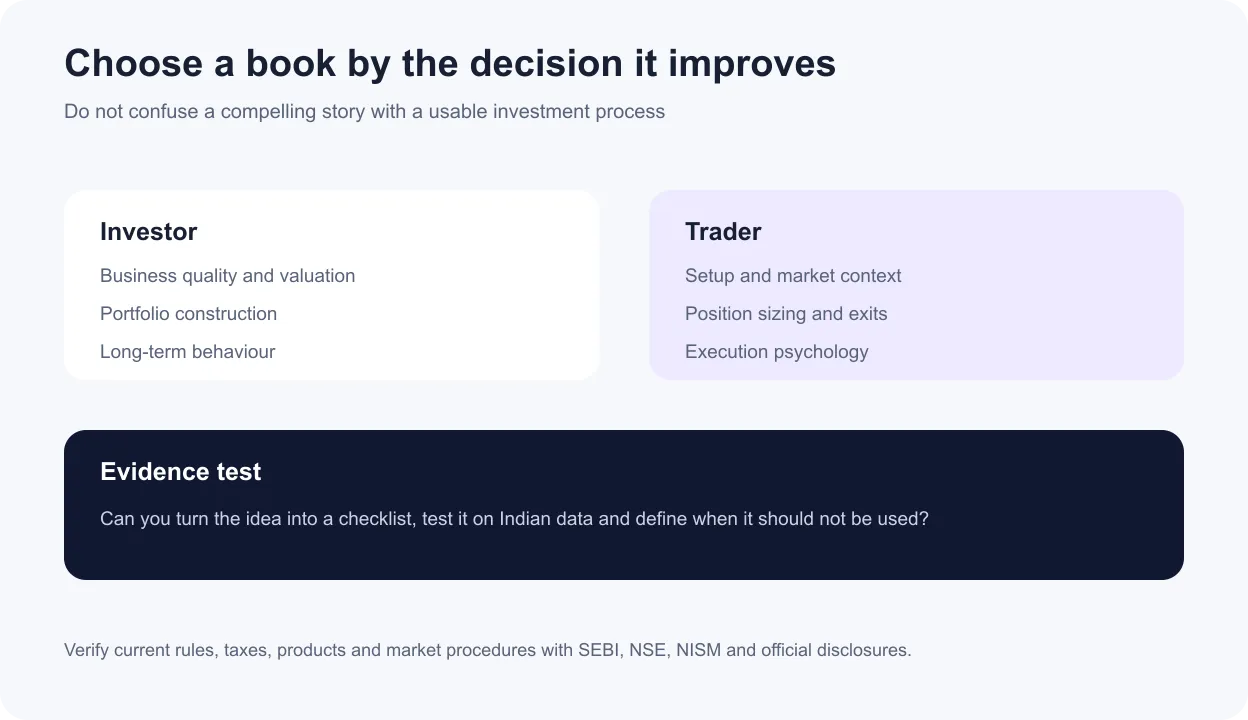
Finally, read actively. Write a one-page summary, record the rules you accept, list objections and apply one idea to an annual report or a paper trade. The best trading books are not signal services; they teach frameworks that still require testing and risk limits.
See what markets are pricing in
Live indices, sector moves and market breadth — the backdrop to every story we publish.
Best Books for Stock Market Beginners
| Book | Author | Best for | Important caveat |
|---|---|---|---|
| Let’s Talk Money | Monika Halan | Indian personal-finance foundations | Broader than stock selection |
| Stocks to Riches | Parag Parikh | Behavioural mistakes in Indian markets | Examples need current verification |
| One Up On Wall Street | Peter Lynch | Connecting everyday observation to research | Familiarity is not due diligence |
| The Little Book of Common Sense Investing | John C. Bogle | Indexing, costs and diversification | US examples need Indian translation |
| The Psychology of Money | Morgan Housel | Behaviour, compounding and expectations | Not a valuation manual |
These are practical books for stock market beginners because they build vocabulary and behaviour before complex models. Start with personal finance and market mechanics; stock selection comes after emergency reserves, insurance, time horizon and risk capacity are clear.
Among the best stock market books India readers can use, Stocks to Riches is especially relevant to local behavioural patterns. Pair it with NSE’s “Introduction to Securities Markets” material to learn accounts, intermediaries, orders and investor protections using current information.
One Up On Wall Street teaches readers to notice businesses around them, but observation is only an idea source. Verify revenue, margins, debt, governance, valuation and disclosures. The best investment books encourage investigation rather than substituting stories for analysis.
Best Books for Long-Term and Value Investors
The Intelligent Investor by Benjamin Graham remains the foundation for margin of safety, the distinction between investing and speculation, and emotional discipline. Its historical examples are old, but the central question remains current: what price provides protection if the future disappoints?
Common Stocks and Uncommon Profits by Philip Fisher shifts attention toward business quality, management and long growth runways. Read together, these two value investing books balance price discipline with qualitative research.
The Most Important Thing by Howard Marks is a concise guide to risk, cycles, second-level thinking and defensive investing. Poor Charlie’s Almanack, edited by Peter D. Kaufman, develops multidisciplinary thinking, incentives and cognitive-bias awareness. Both help readers recognise that a spreadsheet can be precise without being correct.
For a process-oriented Indian context, Coffee Can Investing by Saurabh Mukherjea, Rakshit Ranjan and Pranab Uniyal presents a long-horizon quality framework. Masterclass with Super-Investors by Vishal Mittal and Saurabh Basrar explores approaches used by Indian practitioners.
The strongest best stock market books do not produce identical portfolios. Graham may lead readers toward price and balance-sheet protection, while Fisher may justify paying more for exceptional quality. Use the disagreement to define your own circle of competence and valuation rules.
Best Books for Traders and Technical Analysis
Technical Analysis of the Financial Markets by John J. Murphy is a broad reference on trends, charts, momentum, volume and intermarket ideas. It is one of the best trading books for terminology, but a pattern description is not proof that a strategy remains profitable after costs.
Market Wizards by Jack D. Schwager uses interviews to show that successful traders can use very different methods while sharing discipline, risk control and adaptability. Reminiscences of a Stock Operator by Edwin Lefèvre offers memorable lessons about leverage, crowds and overconfidence, although it should be read as a narrative rather than a modern operating manual.
Trade Your Way to Financial Freedom by Van K. Tharp emphasises expectancy and position sizing. Trading Systems and Methods by Perry J. Kaufman is deeper and more quantitative. These best trading books become useful only when the reader writes exact entry, exit, sizing and validation rules.
Backtests should include brokerage, taxes, slippage, liquidity, corporate actions and survivorship bias. Separate the data used to design a strategy from the data used to evaluate it. Explore Wright Research’s quant glossary when a technical or statistical term needs clarification.
Get research like this in your inbox
The week’s research that mattered, in five minutes. Joined by 2L+ investors.
Best Books on Trading Psychology and Risk Management
Trading in the Zone by Mark Douglas focuses on probabilistic thinking, consistency and accepting uncertainty. The Daily Trading Coach by Brett N. Steenbarger provides structured exercises for reviewing behaviour and improving routines. These trading psychology books address execution, not market prediction.
The Psychology of Money also belongs in a trader’s library because lifestyle, ego and time horizon shape risk-taking. Against the Gods by Peter L. Bernstein provides historical context for probability and risk. Neither replaces position-level controls.
A reader should translate the best trading books into a pre-trade checklist: maximum loss, position size, invalidation point, exit method and conditions for not trading. Keep a journal that separates process quality from profit. A good trade can lose; a poorly controlled trade can win temporarily.
Psychology cannot rescue negative expectancy. Likewise, a positive backtest cannot rescue uncontrolled leverage. The best trading psychology books connect emotional discipline with measurable risk rules and an explicit stop condition.
Books Specifically Useful for Indian Investors
Indian investors benefit from books that address local household finance, governance and market history. Let’s Talk Money explains how saving, insurance and investment fit together. Stocks to Riches examines behavioural traps. Bulls, Bears and Other Beasts by Santosh Nair narrates episodes from India’s market evolution.
Coffee Can Investing and Diamonds in the Dust discuss Indian companies through quality-oriented frameworks. Masterclass with Super-Investors shows that credible Indian investors also differ in style. These are among the best stock market books India audiences can pair with annual reports and exchange filings.
No printed book stays current on every regulation. The best stock market books India readers choose should be supplemented with SEBI investor guidance, NSE educational material, NISM content and current tax resources. Check whether an author discussing derivatives, advisory services or research was describing rules that have since changed.
Indian examples also require attention to promoter ownership, related-party transactions, pledging, capital allocation and disclosure quality. Those topics make the best investment books more actionable when the concepts are applied to local filings rather than copied mechanically from US case studies.
Recommended Reading Order by Investor Experience
| Stage | Suggested books | Practical exercise |
|---|---|---|
| Foundation | Let’s Talk Money; NSE/SEBI primers | Write goals, horizon and asset allocation |
| Beginner investor | One Up On Wall Street; Common Sense Investing | Compare one company with a broad index fund |
| Business analyst | Intelligent Investor; Common Stocks and Uncommon Profits | Read five years of annual reports and value one company |
| Portfolio thinker | The Most Important Thing; Poor Charlie’s Almanack | Create risk, valuation and governance checklists |
| Trader | Murphy; Market Wizards; Trading in the Zone | Paper-test a fully specified setup and journal it |
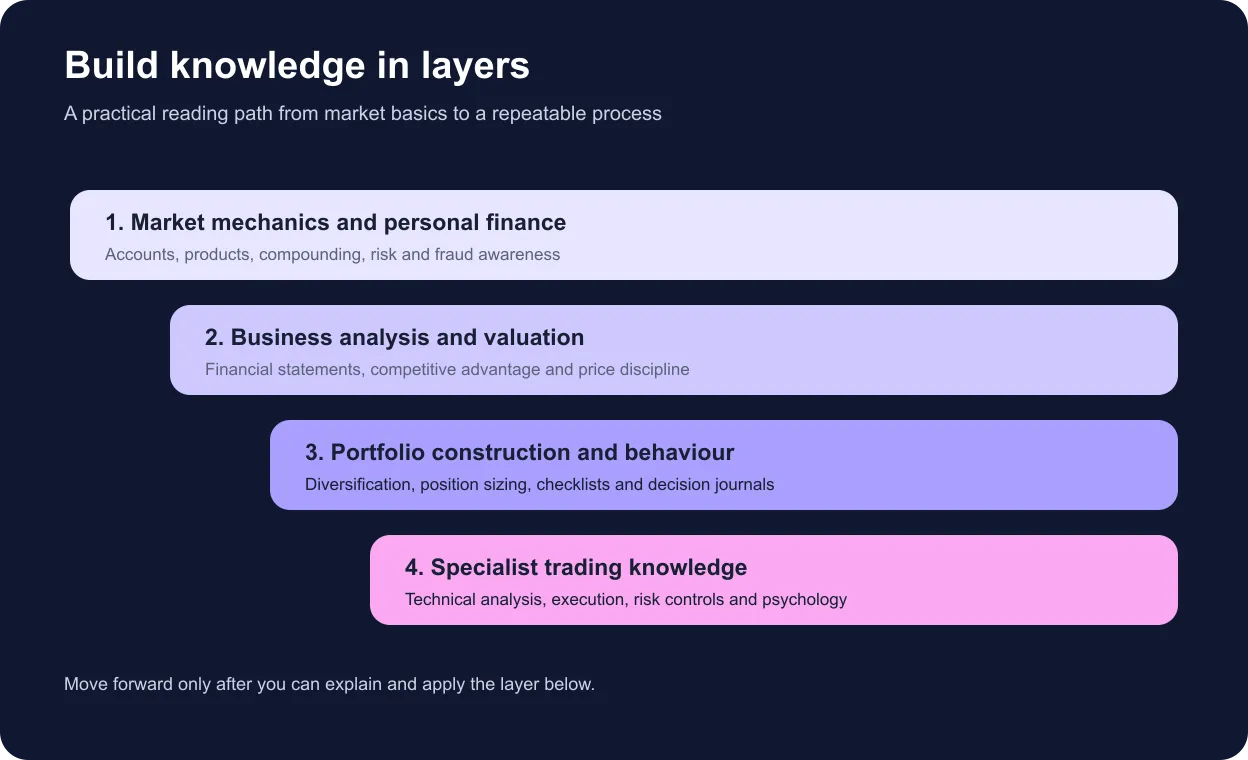
For new readers, the best books for stock market beginners should reduce avoidable errors before increasing complexity. Do not start with options tactics if you cannot yet explain order types, drawdown, diversification and the difference between price and value.
Intermediate readers can rotate between theory and application. Read one chapter, inspect a real Indian company or data series, and record what contradicted the book. Advanced readers should revisit foundational best stock market books because market experience often changes how familiar passages are understood.
Traders can add the best trading books only after defining capital at risk. Investors can add specialist sector or accounting texts after building a repeatable annual-report process. Reading order should follow skill dependencies, not bestseller rankings.
Books vs Free Resources: What Should You Use?
Books provide sustained argument, context and a coherent mental model. Free resources are better for rules, data and fast updates. A sensible learning system uses each for what it does best rather than treating them as substitutes.
SEBI Investor explains products, risks, fraud precautions and grievance channels. NSE publishes investor material and structured learning modules. NISM offers investor-education content and certification workbooks. Company filings, exchange announcements and fund documents provide primary evidence for analysis.
Use a book to learn valuation, then verify inputs in audited statements. Use a technical-analysis text to define a rule, then test it on clean data. Use the best investment books for durable frameworks and current official sources for operational facts.
Videos, newsletters and social posts can explain a difficult idea quickly, but their incentives vary. Reject recommendations that hide conflicts, promise certainty or push urgent action. The best stock market books reward rereading; trustworthy free resources allow you to inspect the source.
A compact personal curriculum beats endless collection. Choose one foundation book, one analysis book and one behaviour book. Finish the exercises before buying more. For traders, one of the best trading books plus a documented test is worth more than ten untested strategies.
Turn reading into a repeatable learning system
A useful book should change what happens before capital is committed. For every title, create a short decision sheet with four fields: the central claim, evidence supporting it, conditions under which it may fail, and one action to test. This turns the best investment books from passive inspiration into working material. If the central claim cannot be stated plainly, reread the relevant chapter before adding another source.
For company analysis, choose one listed Indian business and maintain the same case study across several books. Use Graham to estimate downside protection, Fisher to examine management and competitive strength, and Marks to think about cycle and risk. Then compare each conclusion with annual reports, investor presentations, credit-rating rationales and exchange announcements. A shared case exposes where frameworks agree, where they conflict and where the evidence is incomplete.
Create a claim ledger while reading the best stock market books India readers often encounter. Record every factual or regulatory statement that could become outdated, such as tax treatment, settlement timing, margin rules or account procedures. Add a verification link and date. This is especially important for older Indian editions and translated books because a durable lesson can sit beside an obsolete operational detail.
For quantitative or technical material, specify a hypothesis before opening a chart. Define the market, universe, timeframe, signal, holding rule, position size and benchmark. Include costs and test on data the rule did not use during development. The best stock market books can provide hypotheses, but they cannot establish that a method survives current Indian liquidity, taxes and execution conditions.
Maintain a reading journal separate from a trade journal. The reading journal records principles and questions; the trade journal records decisions, expected outcomes, rule compliance and review notes. Linking the two reveals whether new knowledge is improving behaviour or merely increasing confidence. It also prevents hindsight from rewriting the reason an investment or trade was originally taken.
Use a 30-day application cycle. Week one is reading and summarising. Week two applies the framework to filings or market data. Week three seeks contrary evidence. Week four produces a checklist revision and a short conclusion. At the end, keep, modify or reject the idea. This rhythm rewards depth, makes disagreement visible and limits the temptation to collect recommendations without testing them.
Finally, measure progress by the quality of decisions, not the number of pages completed. A beginner who can explain diversification, compare fees and avoid leverage has gained more than a reader who can quote advanced formulas without controlling risk. Build the library slowly, revisit strong titles after real experience, and retire books whose claims cannot withstand evidence.
How to evaluate what you learned
Test comprehension without looking at the book. Explain the idea to another person, identify the data it needs and describe a situation in which it could fail. If the explanation relies on the author’s reputation or a memorable anecdote, the idea is not yet operational.
Next, distinguish a principle from a parameter. Diversification and margin of safety are principles; a specific price-to-earnings threshold or moving-average length is a parameter. Principles may travel across markets, while parameters require local testing. This distinction helps Indian readers avoid importing numbers that were developed for another country, era or market structure.
Review outcomes on a fixed schedule, but judge process first. Ask whether the required evidence was collected, alternatives were considered and risk limits were followed. Short-term profit does not validate an unsupported decision, just as a loss does not automatically invalidate a sound probabilistic process.
Keep a “not learned yet” list. Accounting, derivatives, statistics and taxation are large subjects, and false fluency can be expensive. When a book reaches the edge of your competence, pause and use an official module, textbook or qualified professional before committing capital.
Is your portfolio built for what’s coming?
Get a free AI-powered review of your holdings — risk, overlap and quality in minutes.
FAQ
Which are the best investment books for beginners?
Start with Let’s Talk Money for financial foundations, One Up On Wall Street for observing businesses, and The Little Book of Common Sense Investing for diversification and costs. Add a current SEBI or NSE primer for Indian market mechanics.
What are the best stock market books for Indian investors?
A useful Indian stack combines Stocks to Riches, Coffee Can Investing, Bulls, Bears and Other Beasts, and Masterclass with Super-Investors with global classics on valuation, risk and behaviour.
Which books are best for trading psychology?
Trading in the Zone and The Daily Trading Coach focus directly on execution behaviour. Market Wizards adds practitioner interviews that show how disciplined traders approach risk and adapt their methods.
What is the best book for learning value investing?
The Intelligent Investor is the classic foundation, but beginners may find One Up On Wall Street easier first. Common Stocks and Uncommon Profits then adds a business-quality perspective.
Are global investing books useful for Indian investors?
Yes, when the lesson concerns durable principles such as valuation, incentives, risk and behaviour. Product rules, taxation, disclosures and market procedures must still be checked against current Indian sources.
Which books should a beginner read first?
Read one personal-finance foundation, one market primer, one business-analysis book and one behaviour book. Apply each with small exercises before moving to advanced valuation or trading texts.
Readers assembling a starter shelf can select books for stock market beginners , then add value investing books and the best stock market books that match their process. The goal is not to finish the longest list; it is to make fewer unsupported decisions.


