Blog home
Newsletter
News
Video
Podcast
Reading list
Wright Brief
Sign In

India’s Renewable Capacity in 2026: Progress Toward the 500 GW Goal

MNRE-sourced data: solar 171 GW, wind 59 GW, non-fossil 308 GW at 30 Sep 2026; solar about 174.5 GW by end-October 2026.

Listen to this article
Audio · ~4 min
Add as a preferred source on Google
Explore how India’s renewable energy capacity is transforming in 2025 with rapid solar and wind growth driving the nation toward cleaner power goals.

India has set a target of 500 GW of non-fossil fuel electricity capacity by 2030. This article summarises where installed renewable capacity stood in the latest data available in November 2026, based on figures from the Ministry of New and Renewable Energy (MNRE) as reported by industry publications. Figures differ slightly between outlets because of rounding, the date of the cut-off and the treatment of large hydro.

Installed capacity as at 30 September 2026

Saur Energy, citing MNRE data (published 8 October 2026), reports the following cumulative capacity as of 30 September 2026.

SourceInstalled capacity (GW)
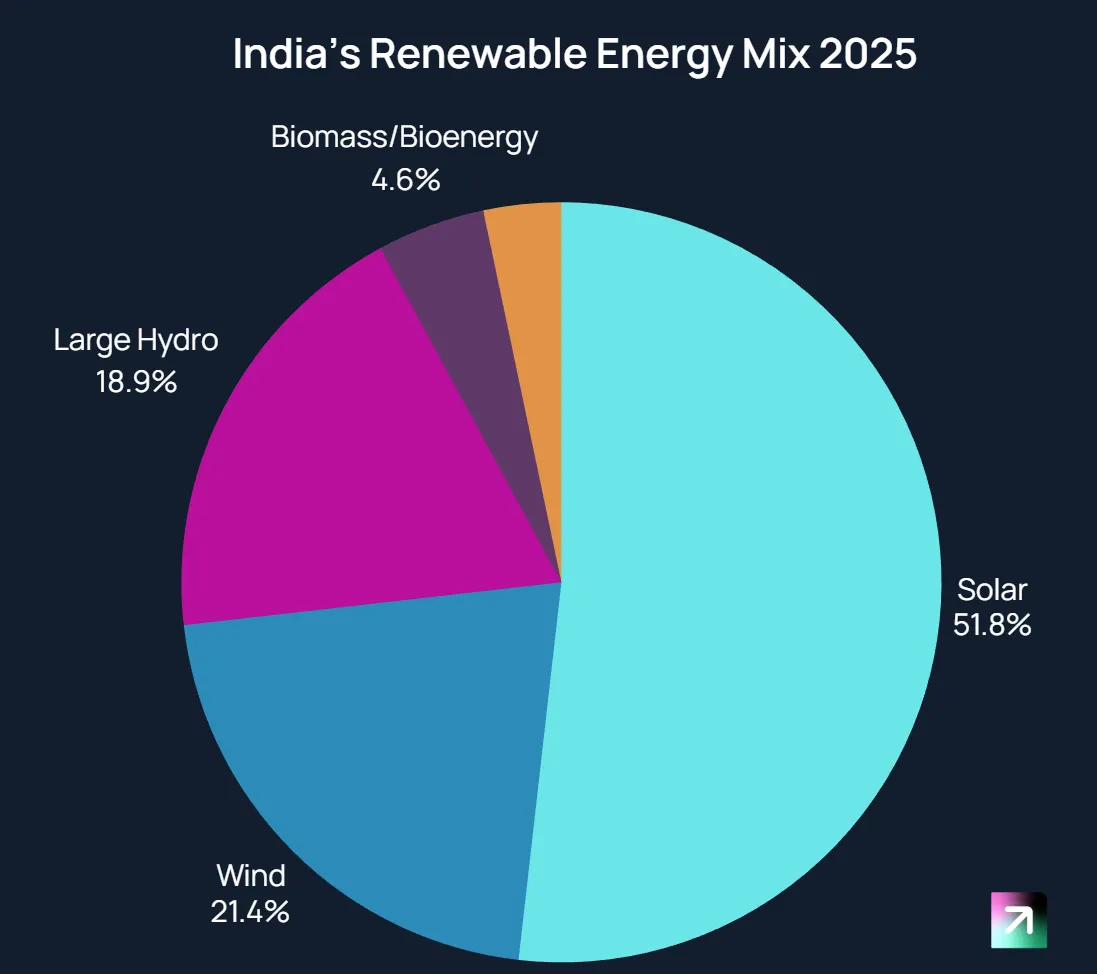
Solar171.05
Wind59.20
Large hydro (incl. 7.43 GW pumped storage)52.06
Nuclear8.78
Total renewable capacity including large hydro299.25
Renewable capacity excluding large hydro247.18
Total non-fossil capacity including nuclear308.03

Within solar, the same report gives 125.65 GW ground-mounted, 33.41 GW grid-connected rooftop, 5.36 GW hybrid and 6.63 GW off-grid. Solar is about 57% of total renewable capacity including large hydro.

Free tool

See what markets are pricing in

Live indices, sector moves and market breadth — the backdrop to every story we publish.

Open Market Tracker

Latest solar figure: end of October 2026

SolarQuarter (12 November 2026), citing MNRE, reports installed solar capacity of about 174.5 GW at the end of October 2026, with about 3.5 GW added in October and about 38.7 GW added from January to October 2026. Its category split was 127.33 GW ground-mounted, 34.97 GW rooftop, 5.62 GW hybrid and 6.63 GW off-grid. A 22 November 2026 report from now.solar rounds the total to about 175 GW.

Additions in 2026

PeriodAdditionSource
April to September 2026 (H1 FY27), all renewables24.56 GW (solar 20.79 GW, wind 3.11 GW)Saur Energy citing MNRE
January to September 2026, solarabout 35.2 GW (+19.5% year on year)JMK Research citing MNRE
January to September 2026, windabout 4.69 GW (-5.5% year on year)JMK Research citing MNRE

JMK Research (9 October 2026) also notes that utility-scale solar additions were about 12.1 GW in the first quarter, 6.9 GW in the second and 5.4 GW in the third quarter of 2026, so the pace of utility-scale additions slowed through the year while rooftop solar accounted for about a third of the January-September solar additions.

Get stock market portfolios targeting specific factors such as momentum, value etc. or specific sectors such as manufacturing, consumption and more!
Start Now
The Wright Brief · free weekly

Get research like this in your inbox

The week’s research that mattered, in five minutes. Joined by 2L+ investors.

How the 500 GW target is defined

The 500 GW goal refers to installed non-fossil capacity (solar, wind, hydro, bioenergy and nuclear) by 2030, announced by India at COP26 in 2021, alongside meeting 50% of energy requirements from renewable sources. Installed capacity is not the same as generation: solar and wind run at lower capacity utilisation than thermal or nuclear plants, so a gigawatt of solar produces fewer units of electricity per year than a gigawatt of coal-fired capacity.

Based on the figures above, non-fossil capacity of 308.03 GW at 30 September 2026 compares with the 500 GW target, leaving about 192 GW difference over the remaining period to 2030. This is a simple arithmetic comparison, not a projection.

Drivers and constraints commonly cited

  • Policy support: production-linked incentives for solar modules, the PM Surya Ghar rooftop scheme, renewable purchase obligations and transmission charge waivers for some projects.
  • Manufacturing: growth of domestic module and cell capacity reduces import dependence.
  • Grid and storage: transmission availability, curtailment risk, land and the need for storage to manage solar's daily profile are widely discussed constraints.
  • Offtake and finance: distribution company payment and power-purchase agreement signing affect project pipelines.
Drivers and constraints commonly cited

Sources and how to check the data

MNRE publishes physical progress data on mnre.gov.in and the Central Electricity Authority publishes installed capacity reports on cea.nic.in. Secondary outlets used here are Saur Energy (8 October 2026), JMK Research & Analytics (9 October 2026) and SolarQuarter (12 November 2026). We were unable to verify these figures directly on the MNRE dashboard, so exact values should be confirmed there.

Get stock market portfolios targeting specific factors such as momentum, value etc. or specific sectors such as manufacturing, consumption and more!
Start Now
Free tool

Follow this sector’s live moves

Sector-level performance across Indian markets, updated through the day.

Open the sector heatmap

Frequently asked questions

What counts toward the 500 GW goal? All non-fossil capacity, including large hydro and nuclear.

Why do totals differ between sources? Some include large hydro and some do not, and cut-off dates vary.

Is capacity the same as electricity generated? No; generation depends on capacity utilisation, weather and grid dispatch.

This article is for educational purposes only and is not investment advice.

Frequently asked questions

What is covered in India’s Renewable Capacity in 2026: Progress Toward the 500 GW Goal?

India has set a target of 500 GW of non-fossil fuel electricity capacity by 2030. This article summarises where installed renewable capacity stood in the latest data available in November 2026, based on figures from the Ministry of New and Renewable Energy (MNRE) as reported by industry publications.

What does this article say about Latest solar figure: end of October 2026?

SolarQuarter (12 November 2026), citing MNRE, reports installed solar capacity of about 174.5 GW at the end of October 2026, with about 3.5 GW added in October and about 38.7 GW added from January to October 2026. Its category split was 127.33 GW ground-mounted, 34.97 GW rooftop, 5.62 GW hybrid and 6.63 GW off-grid.

What does this article say about How the 500 GW target is defined?

The 500 GW goal refers to installed non-fossil capacity (solar, wind, hydro, bioenergy and nuclear) by 2030, announced by India at COP26 in 2021, alongside meeting 50% of energy requirements from renewable sources.

What does this article say about Drivers and constraints commonly cited?

Policy support: production-linked incentives for solar modules, the PM Surya Ghar rooftop scheme, renewable purchase obligations and transmission charge waivers for some projects; Manufacturing: growth of domestic module and cell capacity reduces import dependence.

What does this article say about Sources and how to check the data?

MNRE publishes physical progress data on mnre.gov.in and the Central Electricity Authority publishes installed capacity reports on cea.nic.in. Secondary outlets used here are Saur Energy (8 October 2026), JMK Research & Analytics (9 October 2026) and SolarQuarter (12 November 2026).

Disclaimer: Investment in securities market are subject to market risks. Read all the related documents carefully before investing. Registration granted by SEBI, membership of a SEBI recognized supervisory body (if any) and certification from NISM in no way guarantee performance of the intermediary or provide any assurance of returns to investors.

The content in these posts/articles is for informational and educational purposes only and should not be construed as professional financial advice and nor to be construed as an offer to buy/sell or the solicitation of an offer to buy/sell any security or financial products. Users must make their own investment decisions based on their specific investment objective and financial position and using such independent advisors as they believe necessary.

Wryght Research & Capital Pvt (Brand name: Wright Research) is a SEBI Registered Portfolio Manager Reg No: INP000007979 (Validity: Apr 03, 2023 – Perpetual) and a SEBI Registered Research Analyst No: INH000017295 (Validity: Jul 03, 2024 – Perpetual), with its registered office at 103, Shagun Vatika Prag Narayan Road, Lucknow, UP, 226001 India and CIN: U67100UP2019PTC123244. Past performance may or may not be sustained in future. Performance provided there in is not verified by SEBI. Investment in securities is subject to market and other risks, and there is no assurance or guarantee that the objectives of any of the strategies of the Portfolio Management Services will be achieved. Registration granted by SEBI, enlistment as RA with Exchange and certification from National Institute of Securities Markets (NISM) in no way guarantee performance of the intermediary or provide any assurance of returns to investors. Please read the Disclosure document carefully before investing. Securities quoted are for illustration only and are not recommendatory. Charts shown are for illustration only. For more information and disclosures, visit our disclosures page here.

Found this useful? Share it.
Explore related topics
About the author
Naman Agarwal
Wright Research
Wright PMS · Portfolio Management Service

Put this research to work

The same 300+ factor research engine behind this article — applied to a professionally managed portfolio, end to end.

300+
Factors tracked
2L+
Investors
₹1,200+ Cr
Invested
SEBI
Registered PMS