


A smallcase is a basket of stocks or ETFs, built around a theme or rule-based strategy by a SEBI-registered manager, which is bought in one order and held in the investor's own demat account. This article explains how the structure works, how it differs from a mutual fund, what costs apply and how it is taxed. It does not rate or recommend any particular smallcase.
What is a smallcase?
The smallcase platform, run by Smallcase Technologies, hosts model portfolios created by registered research analysts and investment advisers. Each portfolio lists its stocks, weights and the rationale for its construction. When an investor buys, the securities are credited directly to the investor's demat account through a connected broker. There is no pooled fund: the investor owns the individual shares, and no units are issued.
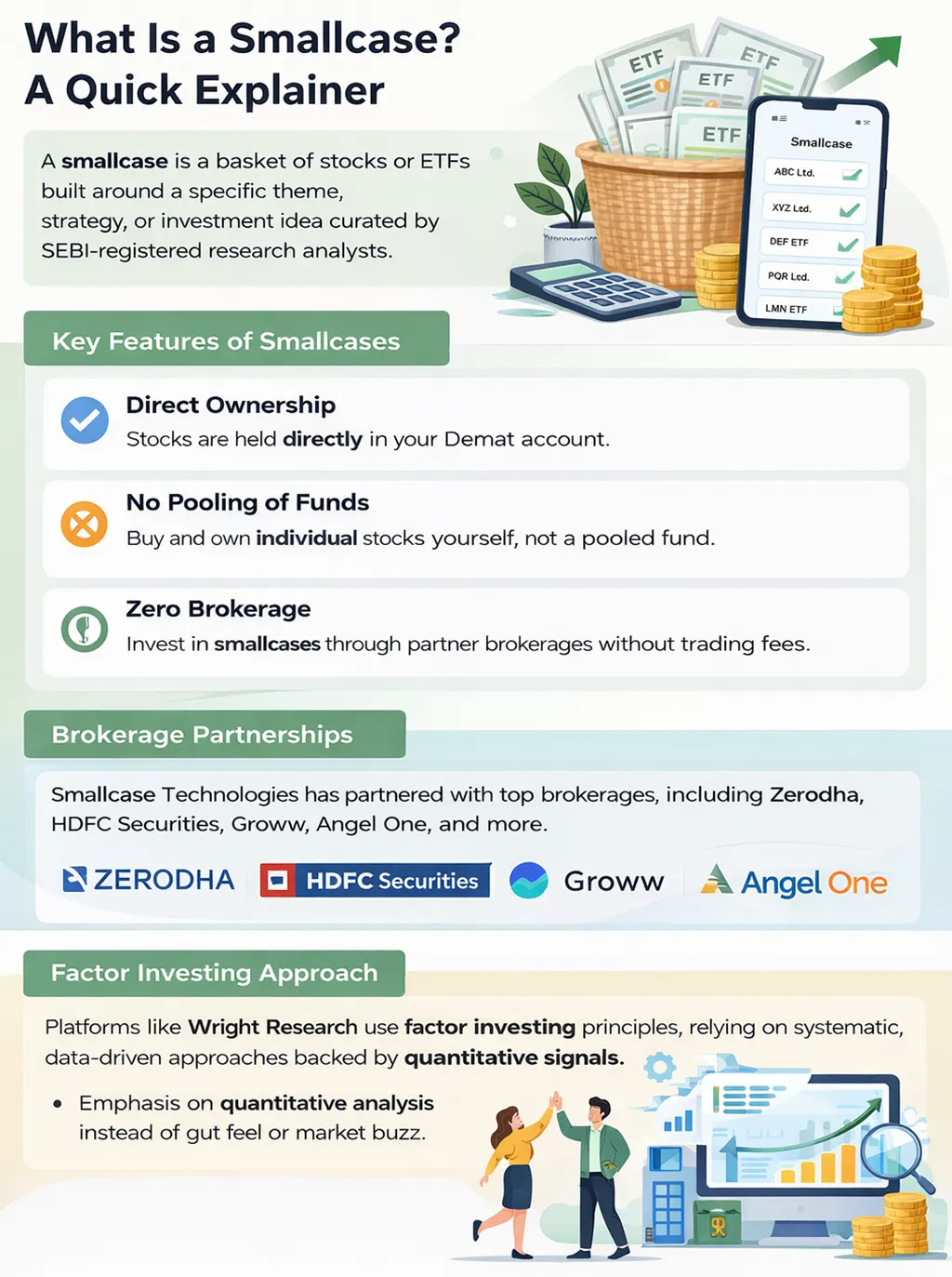
Supported brokers include Zerodha, Groww, Upstox, HDFC Securities, ICICI Securities and several others, according to smallcase's own pages. The list changes, so the current one is shown in the app.
Run the numbers on your next investment
Project returns on a lumpsum or SIP with our free calculators.
How a smallcase works
- Construction: the manager defines a universe, a selection rule and a weighting scheme. Rules can be thematic (a sector or idea), factor-based (momentum, quality, value, low volatility) or asset-allocation based.
- Purchase: the investor connects a broker and places one order. The platform converts the amount into whole-share quantities of each stock in the basket.
- Rebalancing: the manager reviews the basket on a schedule and publishes an update. The platform shows the proposed buys and sells, and the investor chooses whether to apply them. Frequency varies by manager.
- Exit: the investor can sell the whole basket or individual stocks. There is no lock-in or exit load on the platform, according to smallcase's fee page (dated 15 Jan 2026).
Common smallcase styles
Baskets on the platform are usually described by the approach used to build them. These are descriptions of methods, not statements about outcomes.
- Momentum: holds stocks with strong recent price or earnings trends and rotates them on a schedule. Momentum baskets can be concentrated and can trail the market when leadership reverses.
- Quality and low volatility: screens on profitability, balance sheet strength and price stability. These baskets are often described as defensive, though they can still fall in a broad sell-off.
- Thematic and sector: follows a single idea such as railways, electric vehicles, PSU companies or green energy. A narrow theme means less diversification.
- Asset allocation: mixes equity ETFs with gold or debt ETFs in set proportions.
Smallcase versus a mutual fund
| Feature | Smallcase | Mutual fund |
|---|---|---|
| Ownership | Individual stocks or ETFs in the investor's demat account | Units of a pooled scheme |
| Portfolio visibility | Holdings and weights visible at all times | Disclosed monthly by the AMC |
| Customisation | Investor can usually remove stocks or change quantities | Not possible |
| Tax event on rebalance | Each sale is taxed individually | Switching within the scheme does not trigger tax for the investor |
| Costs | Platform transaction fee, manager subscription (if any), broker charges | Expense ratio embedded in NAV |
| Regulation | Platform hosts SEBI-registered managers (RA or IA) | SEBI mutual fund regulations, scheme-level |
| Minimum amount | Depends on the share prices in the basket | Often from Rs 100-500 for SIPs |
Neither structure is inherently better; they differ in cost layout, control and tax mechanics. The table describes the structures, not suitability.
Get research like this in your inbox
The week’s research that mattered, in five minutes. Joined by 2L+ investors.
Costs on the platform
According to smallcase's fees page (dated 15 Jan 2026):
- A transaction fee of Rs 100 plus GST, capped at 1.5% of order value (the lower applies), is charged on Buy and Invest More orders. SIP orders carry Rs 10 plus GST, capped at 1.5%.
- Fee-based smallcases carry a subscription set by the manager and billed monthly, quarterly or annually. Free-access smallcases carry no manager fee.
- The platform states no rebalance fee and no fee on exit. Normal brokerage, STT, GST and depository charges apply on the underlying trades.
Fees can differ by broker and change with promotions, so the figures should be confirmed in the app.
Taxation
Because the investor owns the shares directly, each sale is a separate taxable transaction. For listed equity in FY 2026-27, secondary sources report that short-term gains (held up to 12 months) are taxed at 20%, and long-term gains above Rs 1.25 lakh in a financial year are taxed at 12.5%, with the rates unchanged in Union Budget 2026 (Business Standard, 1 Feb 2026). Tax-loss harvesting is possible at stock level in principle. Frequent rebalancing can create more taxable events than a pooled fund would. Individual circumstances differ, so a tax professional or the Income Tax Department notifications are the authoritative source.
How to read a smallcase's data
- Back-tested versus live results: a back-test applies today's rules to old data; a live track record shows what the basket actually delivered after launch. They are not the same.
- Benchmark and period: returns mean little without a comparison index and a start and end date.
- Drawdown and volatility: the size and duration of past falls show how bumpy the path was.
- Turnover and rebalance cost: frequent changes raise brokerage, impact cost and taxes.
- SEBI registration: registration of the manager does not guarantee performance, as the smallcase page itself notes.
See what markets are pricing in
Live indices, sector moves and market breadth — the backdrop to every story we publish.
Frequently asked questions
What is the minimum amount needed?
It depends on the basket: the investor needs enough to buy at least one share of each stock at the weights set by the manager. Minimums are shown on each smallcase's page.
Is a smallcase a mutual fund or a PMS?
Neither. It is a model portfolio executed in the investor's own demat account. A PMS is a separate regulated service with a higher minimum ticket, and mutual funds are pooled schemes.
How often are baskets rebalanced?
The manager sets the schedule, commonly monthly, quarterly or semi-annually, and publishes it with the strategy.
This article is for educational purposes only and is not investment advice.


