


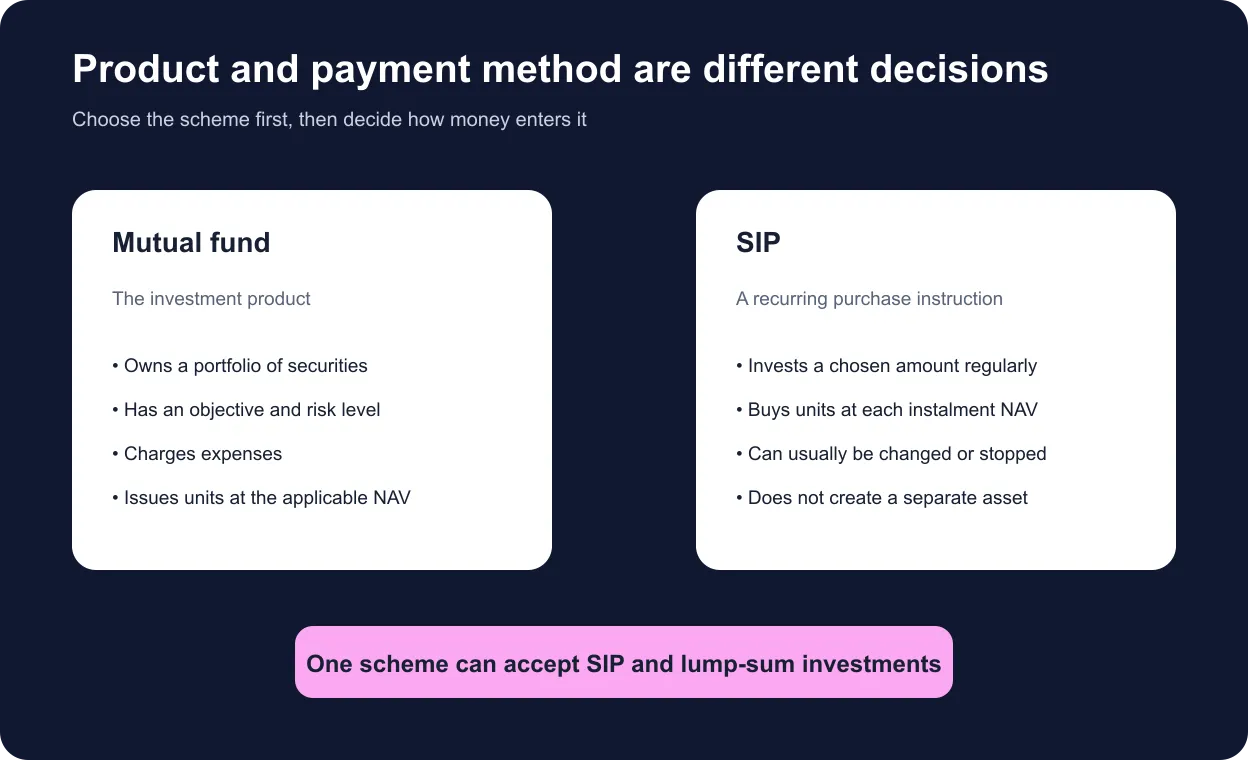
The common comparison is built on a category error. A mutual fund is an investment product that holds a portfolio of securities. A systematic investment plan, or SIP, is a recurring instruction used to buy units of that product. Investors do not have to choose one instead of the other.
Understanding sip vs mutual fund starts with two separate decisions: which scheme fits the goal, and whether to invest periodically or in one amount. A sound payment schedule cannot rescue an unsuitable fund, while a suitable fund can generally accept either route.
In short, sip vs mutual fund compares a method with a product, while SIP vs lump sum compares two methods. The difference between sip and mutual fund is categorical. Searches for mutual funds and sip difference or mutual funds and sip difference need the same distinction. The sip and mutual fund difference never determines scheme quality, so a sip vs mutual fund choice is false.
The scheme determines what you own; the contribution method determines when you buy units.
SIP vs Mutual Fund: The Core Difference
The difference between sip and mutual fund is product versus process. A scheme pools money, follows a disclosed objective and issues units whose value is represented by NAV. An SIP instructs the AMC or platform to invest a fixed amount on selected dates.
The phrase mutual funds and sip difference can mislead beginners. An investor starts an SIP in a mutual fund, not outside it. Every instalment purchases units of the same selected scheme at the applicable NAV, so the number of units varies with market prices.
Run the numbers on your next investment
Project returns on a lumpsum or SIP with our free calculators.
What Is a Mutual Fund?
A mutual fund combines money from many investors and invests it under a stated mandate. Equity funds principally own shares, debt funds hold fixed-income securities, and hybrid funds combine asset classes. Index funds and ETFs seek to track a benchmark rather than select securities actively.
When assessing the sip and mutual fund difference , remember that the fund determines asset allocation, risk, expenses, benchmark and tax treatment. These features apply whether units are purchased in one transaction or through monthly instructions.
What Is a SIP?
An SIP is a facility through which a fixed amount is invested at regular intervals, commonly monthly. AMFI notes that standard instalments can be as small as ₹500 a month, while its Chhoti SIP facility permits ₹250, although each scheme sets its applicable minimum.
For a clear difference between sip and mutual fund , think of a recurring bank instruction attached to an investment account. The instruction automates purchases; it does not guarantee returns, lock in a purchase price or transform a risky equity scheme into a low-risk product.
The practical mutual funds and sip difference also appears in account statements. The fund remains one holding, while each debit creates a separate purchase lot with its own units, NAV and holding period. Redemptions and taxes are evaluated under applicable rules.
SIP vs Mutual Fund: Side-by-Side Comparison
| Feature | Mutual fund | SIP |
|---|---|---|
| Meaning | Investment scheme holding a portfolio | Method for making recurring purchases |
| Main choice | Asset class, strategy and risk | Amount, frequency and debit date |
| Return driver | Underlying portfolio after costs | The same scheme return across staggered lots |
| Risk | Depends on scheme holdings | Does not remove scheme risk |
| Alternative | Another scheme or asset | One-time lump-sum purchase |
This table resolves the sip vs mutual fund confusion: one column describes the asset and the other describes funding frequency. Investors can hold several mutual funds, run an SIP in some, and make occasional one-time additions to others.
The difference between sip and mutual fund also matters when comparing returns. There is no universal “SIP return” separate from fund performance. Results depend on the scheme and on the NAVs at which each instalment buys units.
SIP vs Lump Sum: Do Not Confuse the Two
SIP vs lump sum is a valid comparison because both are purchase methods. A lump sum deploys available capital at once. An SIP deploys planned contributions over time. Both can buy units of exactly the same mutual-fund scheme.
Lump sum gives all capital market exposure immediately, which can help if markets rise but hurts if they fall soon after entry. SIP staggers entry points and supports rupee-cost averaging, yet money waiting outside the market may earn less if prices keep rising.
This is different from the mutual funds and sip difference , which contrasts a product with a facility. Choose based on cash availability, emergency reserves, time horizon and comfort with volatility rather than a prediction about the next market move.
Get research like this in your inbox
The week’s research that mattered, in five minutes. Joined by 2L+ investors.
How SIPs Work in Practice
After KYC, the investor selects a scheme, plan, option, amount, frequency and date, then authorises recurring debits. On each valid instalment date, the contribution is processed at the applicable NAV under cut-off and realisation rules, and units are credited to the folio.
The operational sip and mutual fund difference becomes visible when an instalment fails. A missed debit affects that scheduled purchase; it does not erase units already owned. Current scheme documents and platform terms govern retries, cancellation and the treatment of repeated failures.
AMFI reported ₹32,297 crore in SIP contributions during August 2026. The figure shows the scale of the method, not guaranteed wealth creation or returns. Between April and August 2026, monthly contributions remained above ₹30,000 crore.

Benefits and Limitations of SIP Investing
SIPs automate discipline, align well with monthly income and spread purchases across market levels. When NAV is lower, a fixed instalment buys more units; when NAV is higher, it buys fewer. This averaging reduces dependence on a single entry date.
The difference between sip and mutual fund remains crucial because averaging cannot correct poor scheme selection. A concentrated or high-risk fund remains concentrated or high risk. SIPs also do not guarantee profit, protect principal or ensure that an investor reaches a goal.
A further mutual funds and sip difference is flexibility. Investors may usually pause, stop or alter future instructions, subject to processing timelines, while previously purchased units remain invested until redeemed. Exit loads and tax rules can apply separately to each purchase lot.
When Should an Investor Use SIP or Lump Sum?
SIP often suits salaried investors building long-term goals from monthly surplus. It can also suit anyone who values automation and wants to reduce the behavioural pressure of choosing one entry day. Contribution size should remain affordable through uneven markets.
Lump sum can suit investible cash already available after emergency needs and near-term liabilities are covered. The selected scheme should match the horizon. Short-term money generally should not be pushed into volatile equity merely because an SIP seems disciplined.
The best answer to sip vs mutual fund is often “choose both dimensions”. Select an appropriate mutual fund first, then choose SIP, lump sum or a combination. The difference between sip and mutual fund is not a contest over which earns more.
For investors comparing mutual funds and sip difference , cash flow is the practical filter. Regular surplus supports a repeatable SIP. An annual bonus may support a one-time addition, staggered deployment or repayment of costly debt, depending on the broader plan.
How to Start a SIP in a Mutual Fund
Define the goal, target date and risk capacity. Maintain an emergency fund, complete KYC and shortlist schemes whose asset class and objective fit the horizon. Compare regular and direct plans, expenses, portfolio, benchmark, Riskometer and exit-load terms.
Next, select the amount and debit date, register the mandate and retain confirmation. The sip and mutual fund difference helps here: choosing ₹5,000 monthly is not complete until the investor has chosen the particular scheme and plan receiving it.
Before confirming, explain the difference between sip and mutual fund in one sentence to yourself. Then verify the mutual funds and sip difference in the transaction screen: scheme first, instalment second. This simple check can prevent choosing a convenient payment plan for the wrong portfolio.
See what markets are pricing in
Live indices, sector moves and market breadth — the backdrop to every story we publish.
FAQ
Is SIP a mutual fund?
No. A SIP is a facility for investing a chosen amount into a mutual-fund scheme at regular intervals. The scheme is the investment product; the SIP is the payment schedule used to buy its units.
What is the difference between SIP and mutual fund?
A mutual fund pools investor money in a portfolio managed according to a stated objective. A SIP is one way to purchase units of that fund periodically. A lump-sum purchase is another way.
Is SIP better than lump-sum investing?
Neither method is universally better. SIP suits regular cash flow and reduces the need to choose one entry date. Lump sum may suit money already available, provided the scheme, horizon and volatility fit the investor.
Can I invest in a mutual fund without a SIP?
Yes. Most open-ended schemes accept one-time purchases, subject to their minimum amount, cut-off time and scheme rules. Investors can also combine an initial lump sum with later SIP instalments.
Does SIP reduce investment risk?
SIP spreads purchase dates and can reduce entry-timing risk, but it cannot prevent losses. Market, credit, interest-rate, concentration and scheme-specific risks continue to depend on the selected mutual fund.
Which is better for beginners: SIP or lump sum?
A SIP can be easier for beginners with monthly income because it automates a repeatable habit. The correct scheme, emergency fund, goal, horizon and risk capacity matter more than the payment method alone.


