


India’s mutual-fund industry includes bank-backed, institution-backed and independently sponsored fund houses. Each asset management company manages schemes, research, trading, risk, compliance and investor service under the oversight structure prescribed for mutual funds.
The largest asset management companies in india manage trillions of rupees, but size alone cannot identify the right fund. Investors buy units of a specific scheme, so benchmark, portfolio, risk, cost and execution matter more than a fund house’s overall rank.
AMC size is useful context, while scheme suitability remains the investment decision.
What Is an Asset Management Company (AMC)?
An AMC is the professional investment manager appointed to operate a mutual fund’s schemes. It builds investment and research teams, executes transactions, values portfolios, publishes disclosures, manages risk and provides investor services.
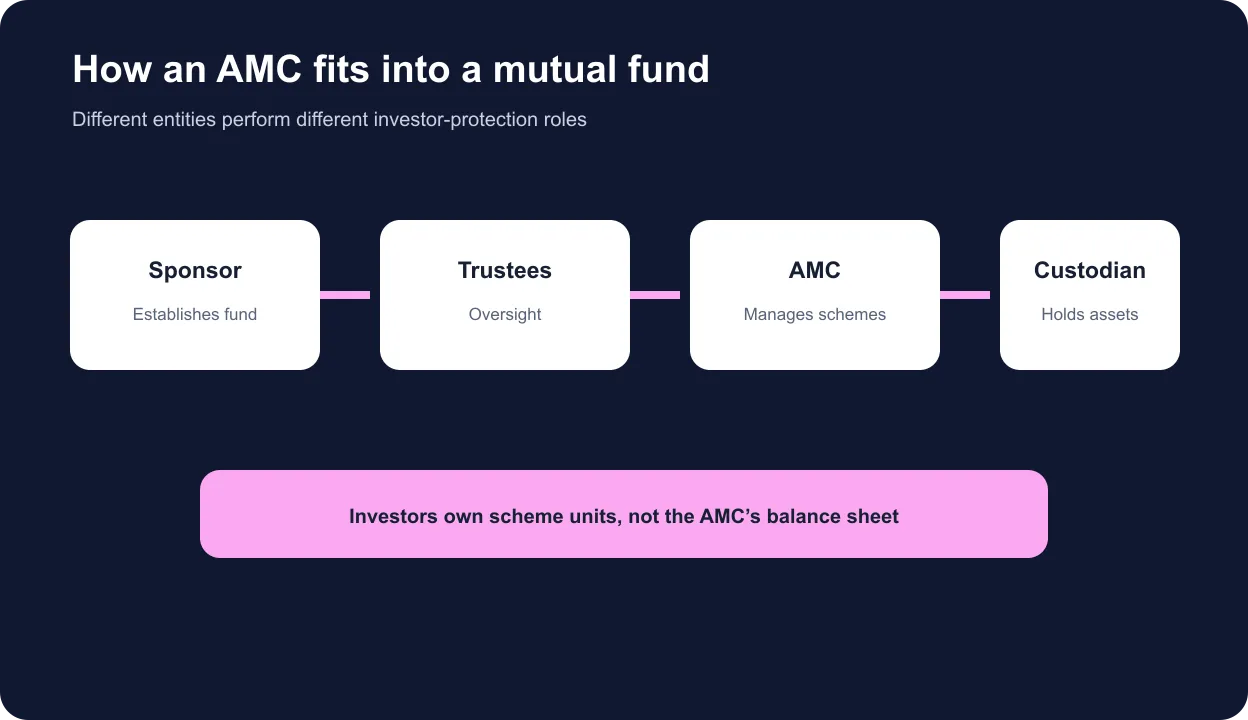
When people compare AMC companies in India , they are usually comparing fund houses. The legal mutual-fund structure also includes a sponsor, trustees and custodian. Scheme assets remain separate from the AMC’s corporate balance sheet.
An AMC earns management fees through scheme expenses. Its responsibility is to follow each scheme’s stated objective and regulatory limits, not to guarantee returns. Equity, debt, hybrid and passive products within one AMC can have very different risks.
Run the numbers on your next investment
Project returns on a lumpsum or SIP with our free calculators.
How AMCs Work Within the Mutual Fund Ecosystem
The sponsor establishes the mutual fund, trustees oversee investor interests, the AMC manages portfolios and operations, and the custodian holds securities. Registrars support transaction records and servicing. This division prevents one organisation from controlling every function.
The mutual fund companies in India publish daily NAVs, portfolios, expense ratios, scheme documents and material updates under SEBI rules. Investors should use those disclosures to assess the actual scheme rather than rely only on brand advertising.
Fund managers make portfolio decisions within the mandate. Risk, dealing, compliance and operations teams provide controls around those decisions. Strong processes matter because one star manager cannot personally handle valuation, settlement, liquidity and every regulatory obligation.
Top AMCs in India in 2026: AUM and Key Facts
AMFI’s April–June 2026 quarterly data places SBI Mutual Fund first with average AUM of about ₹12.57 lakh crore, followed by ICICI Prudential at ₹11.15 lakh crore and HDFC at ₹9.35 lakh crore. Nippon India and Kotak Mahindra complete the top five.
The ranking answers which fund houses manage the most assets, not which is the best AMC in India. AUM can rise because of market appreciation, institutional mandates, money-market assets, mergers and inflows. Product mix affects both scale and economics.
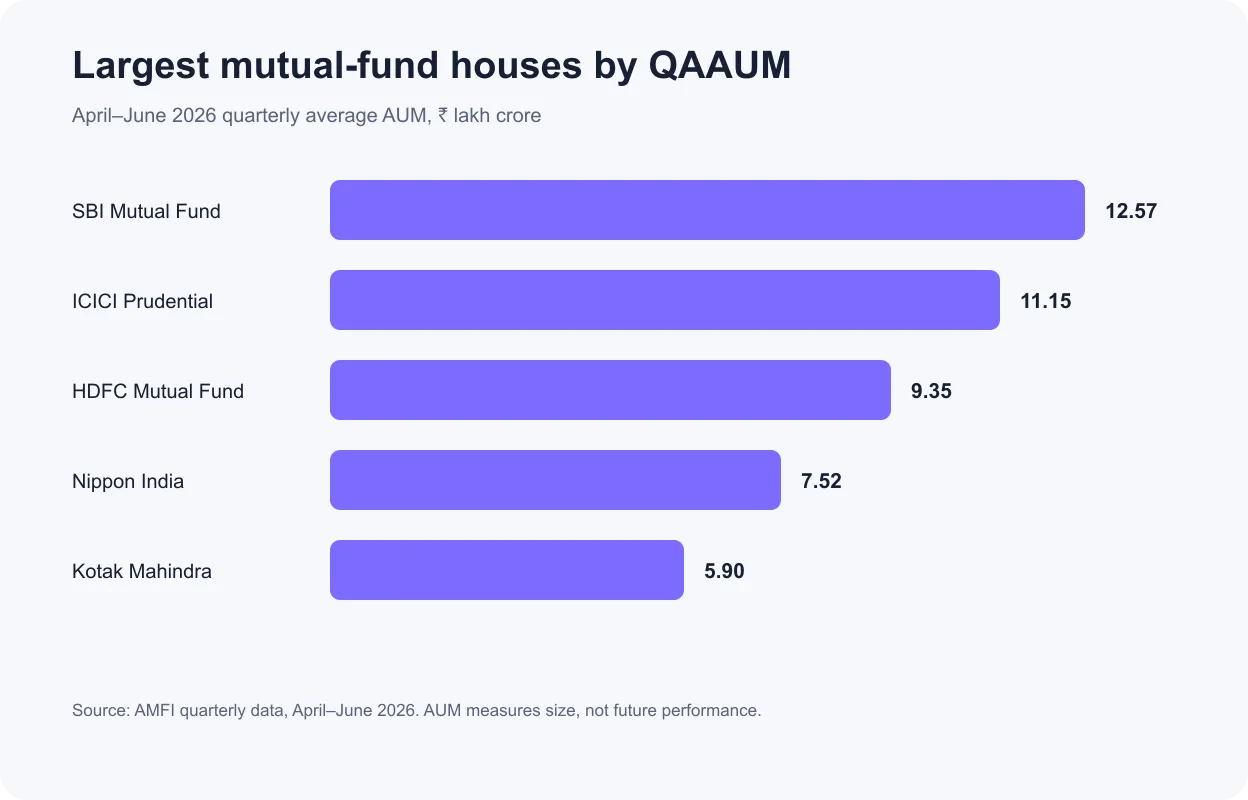
SBI’s leading position makes it the top amc in india by this size measure. That does not imply every SBI scheme leads its category. Rankings should always state the metric and date.
AMC Comparison Table: AUM, Fund Range and Strengths
| Rank | Fund house | QAAUM (₹ lakh crore) | Broad franchise characteristic |
|---|---|---|---|
| 1 | SBI Mutual Fund | 12.57 | Broad active and passive range; large institutional and retail base |
| 2 | ICICI Prudential Mutual Fund | 11.15 | Wide equity, debt, hybrid and passive range |
| 3 | HDFC Mutual Fund | 9.35 | Large active-equity and diversified product franchise |
| 4 | Nippon India Mutual Fund | 7.52 | Strong ETF, passive and retail presence |
| 5 | Kotak Mahindra Mutual Fund | 5.90 | Broad debt, equity, hybrid and passive offering |
| 6 | Aditya Birla Sun Life Mutual Fund | 4.28 | Long operating history and diversified scheme range |
| 7 | UTI Mutual Fund | 3.93 | Established franchise across active and passive funds |
| 8 | Axis Mutual Fund | 3.78 | Equity, debt, hybrid and index offerings |
The table uses size as an objective sorting rule. Descriptions are broad observations, not recommendations. Investors looking for the top amc in india should next narrow the comparison to schemes with the same category, benchmark and investment role.
The biggest asset management companies in india generally offer broad product menus, but a smaller specialist can still manage a strong scheme. More products can improve choice while also making selection harder.
Compare like with like. An equity fund should be judged against its benchmark and category, while an index fund needs tracking difference and a debt fund needs portfolio credit and duration analysis.
Get research like this in your inbox
The week’s research that mattered, in five minutes. Joined by 2L+ investors.
What Makes an AMC Strong or Weak?
A strong AMC combines clear investment processes, independent risk controls, reliable operations, transparent disclosures and stable service. It avoids changing a scheme’s style merely to chase recent performance and communicates material portfolio risks promptly.
Fund-manager continuity helps, but process depth matters more than tenure alone. Examine whether decisions depend on one person or a repeatable team framework. Succession planning is particularly important among large mutual fund companies in India.
Weakness can appear through persistent benchmark underperformance, unstable teams, style drift, high tracking difference, repeated compliance issues or poor investor service. One difficult year is not decisive; patterns across market cycles deserve more weight.
The best AMC in India for one investor may not suit another because goals differ. A passive investor prioritises tracking and cost, while an active-equity investor may focus on process, downside behaviour and portfolio construction.
How to Compare AMCs Beyond AUM
Start at scheme level. Compare rolling returns, benchmark-relative performance, drawdowns, volatility, portfolio concentration, turnover and expenses over consistent periods. Avoid choosing on one-year returns or a current star rating.
For passive funds, measure tracking difference, tracking error and liquidity. For debt funds, study credit quality, duration, issuer concentration and liquidity. These checks reveal more than a generic list of AMC companies in India.
Review how many schemes have delivered reasonably consistent outcomes rather than relying on one winner. Assess changes in fund managers, mandates and ownership. Check whether risk controls worked during stressed markets.
Service quality also matters: accurate statements, dependable transactions, clear disclosures and accessible grievance channels. The top amc in india by service may differ from the AUM leader, and service needs vary by platform and investor.
Read AUM in context. Equity assets can expand when markets rise even without fresh investor money, while liquid-fund assets can move sharply around tax dates and quarter ends. Compare the same AUM measure and reporting period across fund houses. Monthly closing AUM and quarterly average AUM answer related but different questions.
Study performance as a distribution, not a trophy cabinet. A fund house with one category leader and several inconsistent schemes is different from one that produces repeatable, benchmark-aware results across teams. For active funds, examine rolling three-year and five-year periods, downside capture and the sources of excess return. For passive funds, small and persistent tracking difference is generally more informative than a brief spell of outperformance.
Costs should be compared within the same category and plan. A lower expense ratio leaves more of the portfolio return with investors, but the cheapest product is not automatically suitable. Trading efficiency, liquidity management and securities-lending practices can affect index products. Among asset management companies in india , investors should also check whether assets are concentrated in a handful of flagship schemes or distributed across a durable product range.
Governance evidence is found in disclosures and behaviour. Read trustee reports, scheme changes, merger notices and portfolio disclosures. Look for clear explanations when a fund changes a benchmark, manager or fundamental attribute. Repeated surprises, delayed communication or unexplained style changes deserve scrutiny even when recent returns look attractive.
Evaluate the investment team behind each mandate. Note the lead manager, co-manager, research coverage and time spent on the scheme. Then ask whether the process can survive staff turnover. The strongest AMC companies in India combine individual accountability with documented research, risk limits and succession depth.
For debt schemes, review the maturity profile, modified duration, credit-rating mix and exposure to individual issuers or groups. Higher yield can be compensation for higher credit or liquidity risk. For equity schemes, inspect market-cap allocation, sector concentration, cash levels and valuation discipline. These details help separate the top amc in india by scale from the fund house whose particular scheme fits the required role.
Operational experience matters after investing too. Test the quality of account statements, nomination facilities, systematic-transaction controls and grievance handling. The better mutual fund companies in India make risk and cost information easy to find and keep digital journeys reliable without substituting convenience for informed consent.
Finally, use a written scorecard. Give scheme suitability and portfolio risk the greatest weight, followed by process consistency, cost, governance and service. Treat total AUM as supporting evidence of scale, not a deciding score. This prevents a search for the top amc in india from becoming a popularity contest and keeps the comparison tied to the investor’s actual objective.
A diversified shortlist can include both large and focused asset management companies in india. The final choice should explain why the scheme belongs in the portfolio, what would invalidate the thesis and how it will be monitored. That discipline is more useful than assuming all products from a familiar brand are interchangeable.
Recheck the selection at sensible intervals rather than reacting to every monthly ranking. Changes in mandate, people, cost, tracking quality or risk are stronger review triggers than ordinary market volatility. This approach makes comparisons among asset management companies in india repeatable and evidence-led.
AMC vs Mutual Fund vs Fund Manager: What Is the Difference?
| Term | Meaning | Investor decision |
|---|---|---|
| Mutual fund | Trust and pooled-investment structure | Provides the regulated vehicle |
| AMC | Company appointed to manage schemes | Assess organisation, controls and service |
| Fund manager | Professional making portfolio decisions | Assess process, mandate and continuity |
The distinction explains why lists of asset management companies in india should not be treated as lists of schemes. One AMC can operate dozens of funds with different managers, objectives and outcomes.
Likewise, the best AMC in India cannot be inferred from one celebrated manager. Teams change, and individual schemes must remain within their mandates. Organisation-level controls and scheme-level execution both matter.
What Investors Should Check Before Choosing an AMC
Define the goal, horizon and acceptable risk before reviewing a fund house. Then shortlist the relevant category and compare schemes on portfolio, benchmark, expenses, consistency and downside. Choosing the brand first can reverse the correct sequence.
Check the scheme information document, factsheet, Riskometer, portfolio, turnover, exit load and tax treatment. Compare direct and regular plans correctly. Direct plans cost less because they exclude distributor commission, but they require investors to make their own decisions.
When comparing mutual fund companies in India , examine complaints, disclosures, team stability and material regulatory events. Large scale can support research and technology, but can also make some strategies harder to execute in less-liquid markets.
Do not hold overlapping schemes merely because they belong to different fund houses. Portfolio overlap can duplicate the same large stocks or duration exposure. Diversification comes from underlying assets, not the number of AMC logos.
The sensible answer to “which is the top amc in india ?” is to specify the objective. Size, service, passive execution, active performance and product breadth are different rankings. The appropriate AMC is the one whose suitable scheme meets the investor’s requirements at a reasonable cost.
Use current AMFI data when comparing AMC companies in India and record the quarter. AUM changes over time. The best AMC in India should never be selected from an undated league table.
See what markets are pricing in
Live indices, sector moves and market breadth — the backdrop to every story we publish.
FAQ
What is an Asset Management Company (AMC)?
An AMC is the investment manager appointed to manage a mutual fund’s schemes according to their stated objectives and regulatory requirements.
Which are the top AMCs in India in 2026?
By April–June 2026 quarterly average AUM, the five largest were SBI, ICICI Prudential, HDFC, Nippon India and Kotak Mahindra Mutual Fund.
Which AMC has the highest AUM in India?
SBI Mutual Fund ranked first by April–June 2026 quarterly average AUM at approximately ₹12.57 lakh crore.
Is a larger AMC always better for investors?
No. Scale can support resources and operations, but scheme suitability, cost, portfolio, risk and consistency matter more than AMC size alone.
How should investors compare AMCs?
Compare relevant scheme outcomes, risk controls, fund-manager continuity, tracking quality, expenses, service, disclosures and governance rather than relying on one ranking.
What is the difference between an AMC and a mutual fund?
The mutual fund is the trust and pooled investment structure. The AMC is the company appointed to manage its schemes and operations.


