


Bonds are loans packaged as securities. A government, company or other issuer raises money from investors and promises cash flows under defined terms. Those terms may include periodic interest, principal repayment, security over assets, call rights and a maturity date.
For anyone asking what are bonds, the crucial distinction is between promised cash flows and guaranteed outcomes. A bond can pay exactly as scheduled, yet its market price may fall when interest rates rise. A corporate issuer can also be downgraded or default. Investing in bonds therefore requires more than comparing coupon rates.
What Are Bonds?
What are bonds in legal and economic terms? They are debt instruments under which an issuer owes specified obligations to investors. The investor is a creditor, not an owner. This contrasts with a shareholder, whose return depends on dividends and the residual value of a business.
A plain fixed-rate bond has a face value, coupon rate and maturity. If a ₹1,000 bond pays 7% annually, its scheduled coupon is ₹70 a year. At maturity, the issuer ordinarily repays ₹1,000. The price paid in the market may be above or below ₹1,000, so the investor’s return need not equal 7%.
How do bonds work when traded? Existing securities can change hands in the secondary market. Their prices respond to interest rates, credit quality, liquidity, remaining maturity and contract terms. Holding to maturity reduces exposure to an interim sale price but does not remove default, reinvestment or inflation risk.
See what markets are pricing in
Live indices, sector moves and market breadth — the backdrop to every story we publish.
Bond Features and Characteristics
The central characteristics of bonds are issuer, face value, coupon, payment frequency, maturity and seniority. Additional terms can determine whether the debt is secured, callable, convertible, subordinated or perpetual. Every feature changes the expected cash flows or the investor’s priority if the issuer fails.
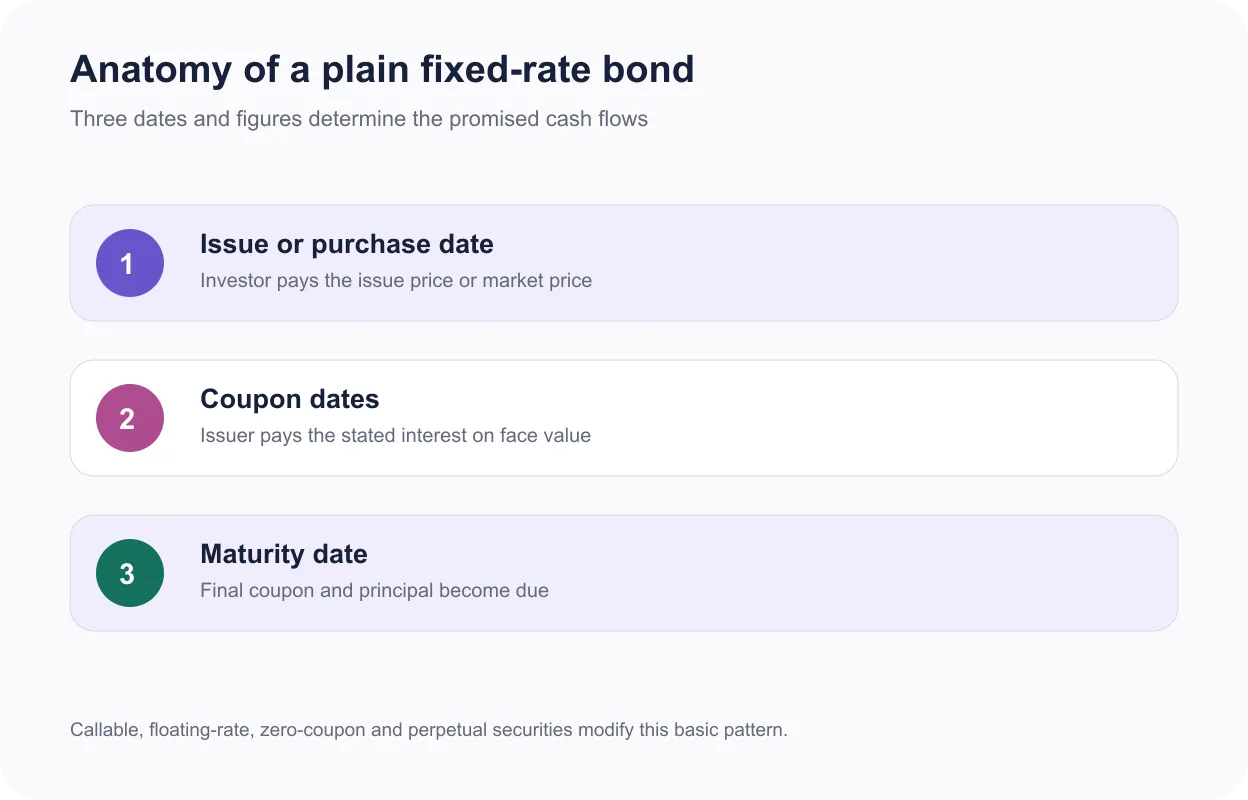
Important bond features also include the credit rating, listing status, covenants, put or call dates, record dates and minimum denomination. A secured label does not make repayment certain; investors must understand the collateral, ranking and enforcement terms.
| Term | What it tells the investor |
|---|---|
| Face value | Principal amount used to calculate repayment and often coupons |
| Coupon | Stated interest rate or payment formula |
| Maturity | Date on which principal is scheduled to be repaid |
| Seniority and security | Claim ranking and assets, if any, supporting the issue |
| Call or put | Whether issuer or investor can end the security early |
| Credit rating | Agency opinion on credit risk, not a guarantee |
These characteristics of bonds should be read in the offer document, information memorandum and exchange disclosures. A marketing card showing coupon and rating is not a substitute for complete terms.
Duration and cash-flow timing
Maturity states when principal is due; duration estimates how sensitive value is to a change in yield. Two securities with the same maturity can have different duration because their coupons and repayment patterns differ. A higher coupon returns more cash earlier and usually reduces sensitivity. Modified duration is often read as an approximate percentage price change for a one-percentage-point yield move, but convexity means the relationship is not perfectly linear.
How Do Bonds Work?
How do bonds work from issue to maturity? In the primary market, investors subscribe and the issuer receives funds. Coupons are then paid according to the schedule. In the secondary market, a buyer pays the prevailing price to the current holder; the issuer does not usually receive that resale amount.
Fixed coupons do not mean fixed market value. Suppose new comparable bonds offer 8% while an existing issue pays 7%. Buyers will generally demand a lower price for the old bond. If comparable yields fall to 6%, its fixed coupon becomes more attractive and the price can rise.
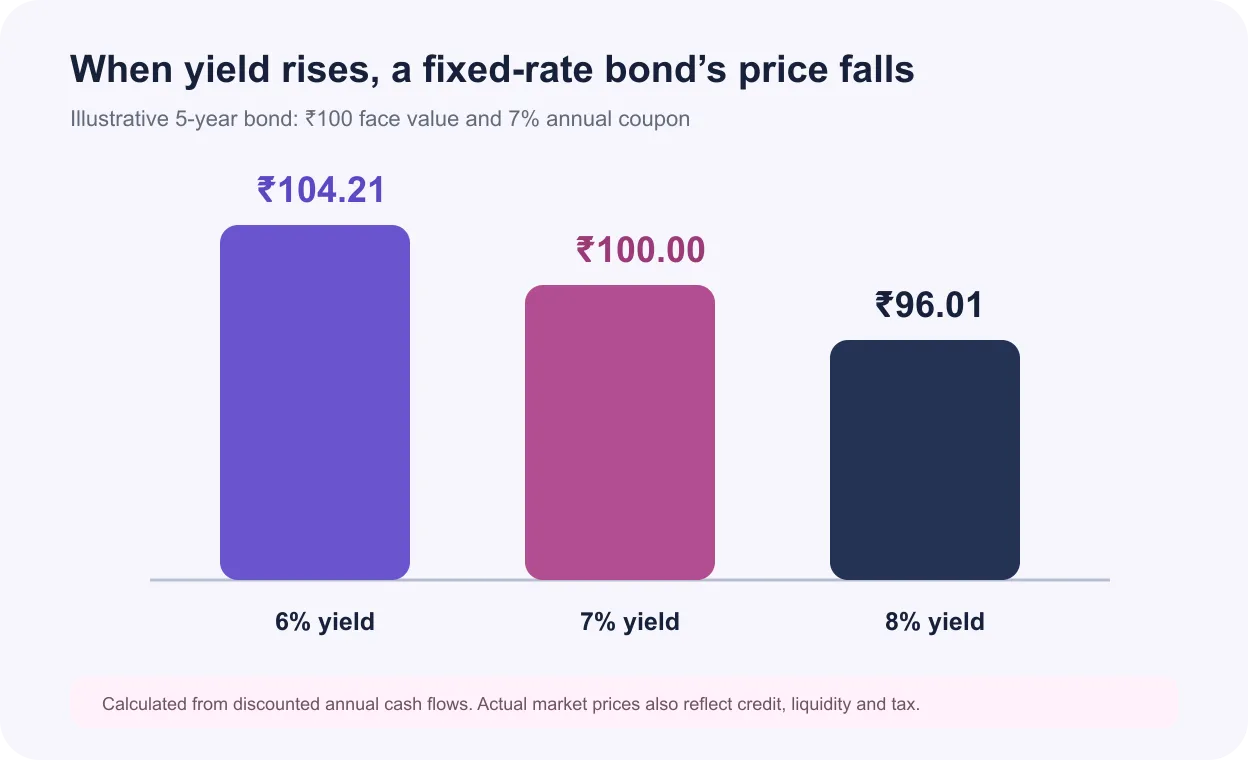
Investing in bonds can produce coupon income, capital gain or loss, and principal repayment. Taxes and transaction costs affect the realised result. A default or restructuring can interrupt both interest and principal.
Types of Bonds in India
The types of bonds available in India differ by issuer, cash-flow design and regulatory route. Government securities include dated central government securities, State Development Loans and short-term Treasury Bills. RBI Retail Direct gives eligible individuals access to primary auctions and the secondary market for government securities.
Corporate bonds and non-convertible debentures finance companies and financial institutions. They range from highly rated senior secured issues to subordinated or high-yield debt. Wright Research’s guide to bonds versus debentures explains how the labels overlap in Indian usage.
Other types of bonds include municipal securities, tax-free legacy issues, infrastructure and 54EC bonds, floating-rate securities, zero-coupon bonds, callable or puttable bonds, convertible debt and perpetual instruments. Sovereign Gold Bonds are government securities linked to gold and have a different return structure from conventional fixed income.
| Category | Typical return structure | Primary risk emphasis |
|---|---|---|
| Treasury Bill | Issued at discount, redeemed at face value | Reinvestment and market-price risk |
| Dated G-Sec | Fixed or floating coupon plus principal | Interest-rate and duration risk |
| State Development Loan | Coupon plus principal | Rate and liquidity risk |
| Corporate bond or NCD | Fixed, floating or structured payments | Credit, liquidity and covenant risk |
| Perpetual bond | Coupon with no conventional maturity | Extension, call, subordination and loss-absorption risk |
Investing in bonds through a debt mutual fund is different from owning an individual security. A fund maintains a portfolio and perpetual NAV; it does not promise to return one bond’s face value on a personal maturity date.
Understanding Bond Yield to Maturity
Bond yield to maturity, or YTM, is the annualised discount rate that equates the current market price with all scheduled remaining coupons and principal. When a bond trades below face value, YTM is usually above its coupon rate; when it trades above face value, YTM is usually below the coupon.
Bond yield to maturity is useful for comparing securities with different prices, coupons and maturities, but it is not a guaranteed realised return. The calculation assumes scheduled payments, no default and reinvestment of interim coupons at the computed rate. Selling before maturity creates a different result.
Investors should also distinguish current yield, which is annual coupon divided by market price, from YTM, yield to call and portfolio yield. Callable securities should be assessed against the earliest plausible call because an attractive maturity yield may never be realised.
Yield spreads and fair comparison
A corporate security’s yield is often compared with a government security of similar maturity. The spread compensates for credit, liquidity, structural and other risks. A wider spread can indicate opportunity, deterioration or simply poor liquidity. Comparisons should use similar maturity, seniority and optionality. Quoted yields may also be based on clean prices, while settlement uses a dirty price that adds accrued interest.
Get research like this in your inbox
The week’s research that mattered, in five minutes. Joined by 2L+ investors.
Bonds vs Stocks vs Fixed Deposits
Bonds create a creditor claim; stocks represent ownership; fixed deposits are bank deposit contracts. The three can all support financial goals, but their cash flows, protections, liquidity and upside differ.
| Feature | Bond | Stock | Fixed deposit |
|---|---|---|---|
| Investor position | Creditor | Owner | Depositor |
| Return | Coupon, price change and repayment | Dividend and price change | Contractual interest |
| Upside | Usually contract-limited | Open-ended business upside | Contract-limited |
| Market price | Can fluctuate if traded | Fluctuates | Usually not market-traded |
| Main risks | Credit, rates and liquidity | Business and market risk | Bank credit, reinvestment and early-withdrawal terms |
Deposit insurance applies to eligible bank deposits only up to the statutory limit and conditions; it does not cover bonds merely because a bank or financial company issued them. Conversely, government bonds have sovereign backing in rupees but their market prices can still fall.
Benefits of Investing in Bonds
Investing in bonds can provide scheduled income, capital preservation at a chosen maturity and diversification from equity risk. A maturity ladder can align principal repayments with future spending needs and reduce dependence on one reinvestment date.
Government securities offer access to the sovereign rupee yield curve, while corporate debt can add a credit spread in exchange for additional risk. Tradable securities also allow an investor to realise gains when yields fall, though the reverse is equally possible.
Another benefit of investing in bonds is portfolio control. Individual securities let an investor select issuer, seniority and maturity. Funds can provide broader diversification and professional management when direct analysis or ticket sizes are impractical.
The wider bond market also informs equity valuation through discount rates and financing costs. Wright Research explains that relationship in its analysis of how the bond market can set the price of stocks.
Risks Associated With Bonds
Credit risk is the possibility that an issuer delays, restructures or fails to make payments. Credit ratings help, but SEBI stresses that a rating is an opinion and can change. Review leverage, interest coverage, cash flows, past defaults, group support and covenant protection.
Interest-rate risk is the sensitivity of price to changing yields. Longer maturity and lower coupon generally increase duration. Inflation can also reduce the purchasing power of fixed cash flows, even when every payment arrives.
Liquidity risk appears when few buyers exist and the sale price is materially below an indicative value. Call risk lets an issuer repay early, often when reinvestment opportunities are less attractive. Perpetual and subordinated instruments can contain deferral, write-down or conversion terms.
Other characteristics of bonds create specific risks: floating coupons can reset lower, secured debt can recover less than expected, and concentrated exposure to one issuer can overwhelm the diversification benefit. High coupon usually signals compensation for something, not free return.
How to Start Investing in Bonds
Begin by defining the goal, required cash-flow date and acceptable loss. For government securities, eligible individuals can open a free RBI Retail Direct Gilt account and access Treasury Bills, dated G-Secs and State Development Loans through primary and secondary channels.
For listed corporate debt, use a registered broker, exchange route or a SEBI-regulated online bond platform provider. SEBI maintains links to registered OBPP lists, and Bond Central provides a central information repository. The face value for many privately placed listed bonds has been reduced to ₹10,000, but availability and transaction minimums vary.
Before investing in bonds , read the offer document, latest financials, rating rationale, security cover, seniority, covenants, call schedule and exchange liquidity. Compare YTM after taxes and charges with a government security of similar maturity; the difference is the credit and liquidity spread, not a bonus.
Build a maturity ladder
Instead of placing the entire allocation into one maturity, an investor can divide it across several dates. As each security matures, the cash can fund a goal or be reinvested at prevailing rates. A ladder reduces dependence on one rate environment, although it does not eliminate credit risk. Issuer diversification remains necessary, and callable securities should not be assumed to mature on the final legal date.
Use limit orders where appropriate and retain contract notes. Diversify across issuers and maturity dates. If analysis is difficult, a suitable debt mutual fund may provide diversification, though it introduces fund expenses and NAV volatility.
Who Should Invest in Bonds?
Investing in bonds may suit people who need defined cash-flow dates, want to reduce equity concentration or can hold a security through temporary price changes. Retirees may value income, while accumulators can use bonds to fund medium-term goals and rebalance during equity volatility.
Suitability depends on the bond. A short Treasury Bill and a perpetual subordinated corporate security do not have the same risk. Investors who may need money unexpectedly should prioritise liquidity and avoid locking most savings into thinly traded issues.
The best answer to what are bonds for a portfolio is role-based: some preserve nominal capital at maturity, some generate income, some add credit risk for yield, and some hedge or express an interest-rate view. The security must match the objective.
Is your portfolio built for what’s coming?
Get a free AI-powered review of your holdings — risk, overlap and quality in minutes.
FAQ
What are bonds and how do they work?
Bonds are debt securities. Investors lend money to a government, company or other issuer; the issuer promises specified interest or other cash flows and repayment according to the security’s terms. Market value can change before maturity.
What are the different types of bonds?
Common categories include central government securities, State Development Loans, Treasury Bills, corporate bonds, municipal bonds, tax-free bonds, floating-rate bonds, zero-coupon bonds, callable bonds and perpetual securities.
What is bond yield to maturity?
Yield to maturity is the annualised discount rate that equates a bond’s current price with its remaining coupons and principal, assuming scheduled payments occur and reinvestment assumptions hold. It is not a guaranteed return when the bond is sold early or defaults.
Are bonds a safe investment?
Safety varies. Government securities have very low sovereign credit risk in rupees but still carry interest-rate and liquidity risk. Corporate bonds add issuer default and downgrade risk. No bond should be judged only by its coupon.
What is the difference between bonds and fixed deposits?
A bond is a transferable security whose market price can fluctuate. A fixed deposit is a contractual bank deposit generally redeemed under bank terms and may have deposit-insurance coverage subject to applicable limits.
How can I start investing in bonds in India?
Investors can use RBI Retail Direct for eligible government securities, registered online bond platforms or exchange and broker channels for listed debt, and debt mutual funds for pooled exposure. Verify the issuer, documents, yield, liquidity and intermediary.


