


Two investors can follow the same investment blueprint and still earn different returns. One buys immediately while the other waits, one reinvests dividends while the other withdraws them, and both may pay different costs. The blueprint tells them what to aim for, not what their accounts will earn.
This guide explains how to read target weights, compare implementation options in India and decide whether a proposed allocation fills a gap in what you already own.
What Is a Model Portfolio?
It is a reference allocation: a set of securities or funds, target weights and rules for keeping the mix aligned with an objective. It can represent a diversified equity basket, a multi-asset allocation or a specialised strategy. The design does not, by itself, tell you who holds the assets, who executes trades or what agreement applies.
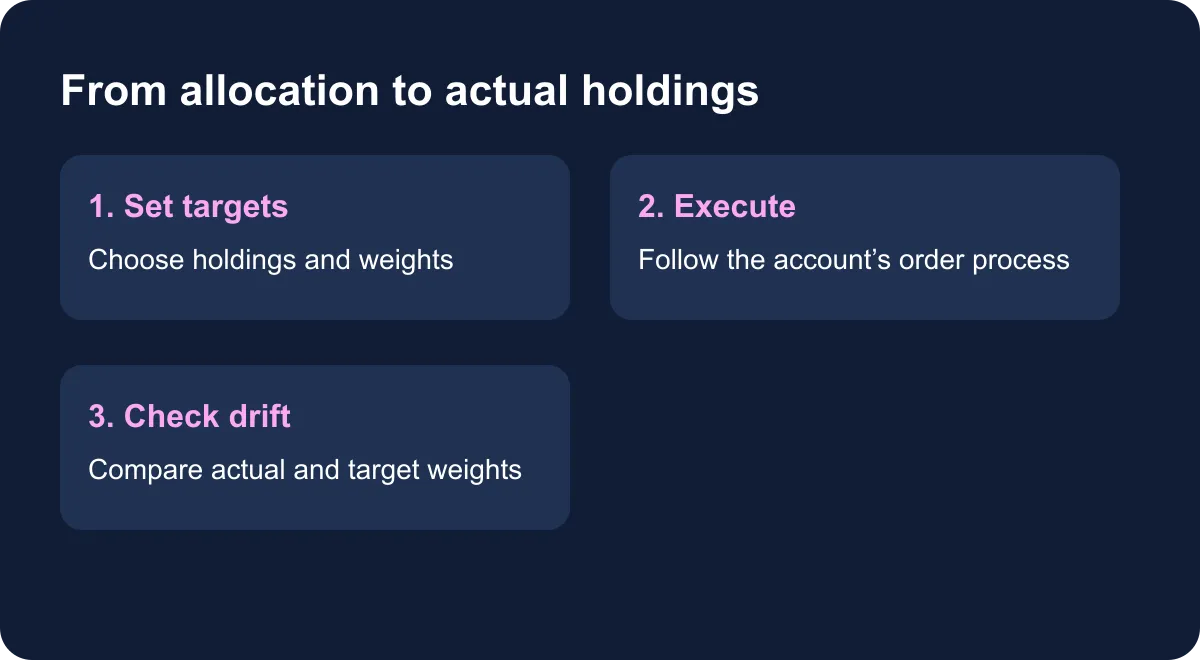
Think of the weights as instructions. If a fund has a target weight of 20%, the design allocates one fifth of the portfolio to it. That is not necessarily the current weight in your account. A useful factsheet tells you both what the target is and how far actual holdings may depart from it before action is needed.
See what markets are pricing in
Live indices, sector moves and market breadth — the backdrop to every story we publish.
How Does a Model Portfolio Work?
The provider publishes the holdings or allocation rules and may issue updates. The investor, adviser or manager then implements those decisions according to the service agreement. Check whether an update triggers trades automatically, requires your approval or is only a recommendation. The BlackRock model range illustrates how one provider offers different allocations for different objectives; the service and costs still depend on how the model is implemented.
An investment model portfolio can show 10% in a particular security while your account holds 9.4% because of price changes, uninvested cash or whole-share rounding. A model’s published performance may also assume different execution timing or expense treatment from your account. Ask which assumptions are used before comparing your statement with the published figure.
Common Types of Model Portfolio Strategies
Start by asking what drives returns. A broad equity basket, a sector basket and a stock-and-bond mix may have similar numbers of holdings yet react very differently to a market correction or a rise in yields. Look at exposure, not just the number of line items.
Equity, multi-asset and factor-based approaches
- Equity: Holds shares or equity funds. A diversified approach spreads exposure across industries; a thematic basket deliberately concentrates it. Owning several holdings in the same sector is not the same as diversifying across sectors.
- Multi-asset: Combines exposures such as equities, debt and gold. Debt can reduce reliance on equity returns, but credit quality and duration matter. Gold can diversify some risks but can also decline.
- Factor-based: Selects or weights stocks using traits such as value, momentum or quality. Different definitions and rebalance rules can produce materially different holdings. Wright Research’s factor-based portfolio gives readers a concrete example to examine, not a benchmark for all factor approaches.
How Is a Model Portfolio Constructed?
Good model portfolio construction starts with the objective and constraints before choosing securities. Define the investment horizon, acceptable losses, cash needs and benchmark. Then decide which exposures serve that objective and which risks are unnecessary. For example, an investor who needs the money soon should not read a long-term growth label as protection against losses before withdrawal.
Asset allocation, security selection and weighting
The model portfolio allocation sets the split across assets. Selection determines the instruments used to deliver those exposures, and weighting determines how much each instrument can influence the outcome. Equal weights can limit an individual name’s initial influence; market-cap weights can give the largest companies more influence. Neither method automatically protects against overlapping sector bets.
Evaluate the underlying liquidity as well as the holdings list. A large position in a thinly traded stock may be cheap to buy in a backtest but expensive to sell in practice. If the design uses funds, check their underlying holdings for duplication. Wright Research’s investment philosophy is one place to see how a provider describes its decision rules.
Rebalancing and review
Rebalancing returns exposures toward their targets. Review is broader: it asks whether the targets and rules still make sense. Consider a ₹10 lakh portfolio with ₹6 lakh in equities and ₹4 lakh in debt. If equities rise 25% and debt is unchanged, equities become ₹7.5 lakh out of ₹11.5 lakh, or about 65.2%. Restoring a 60% equity target would move ₹60,000 out of equity before taxes and costs, assuming no new contributions.
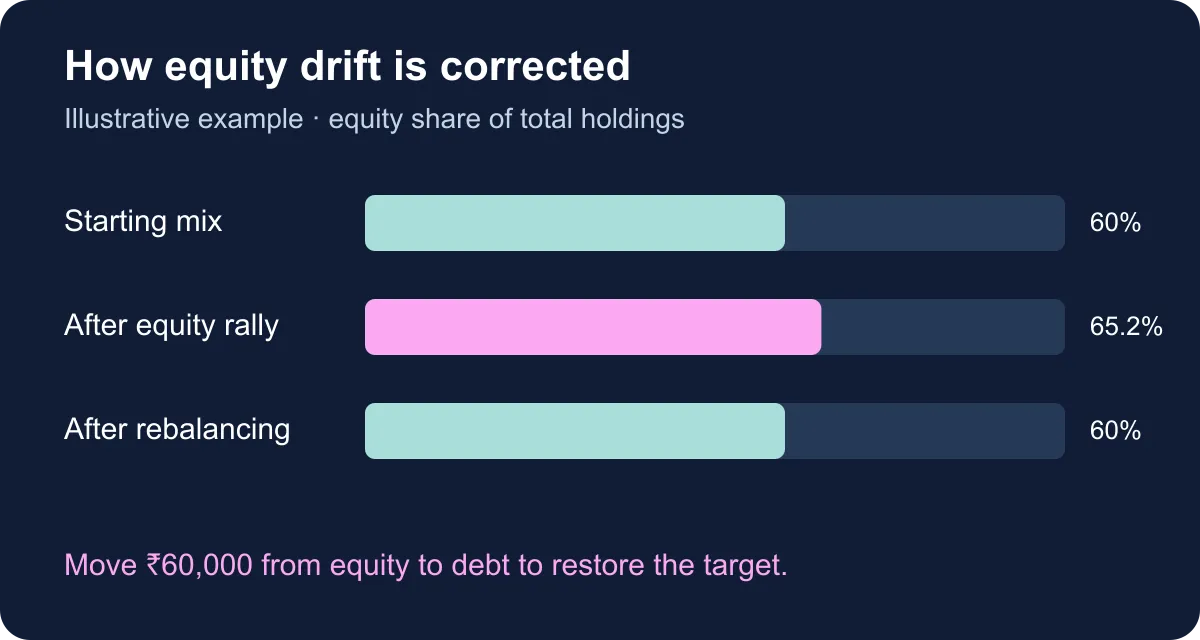
A manager might review weights quarterly but trade only when drift exceeds a stated band. New contributions can sometimes correct drift without selling. Before accepting an update, check the turnover it implies, resulting tax consequences and whether the trigger reflects ordinary drift or an actual strategy change.
Get research like this in your inbox
The week’s research that mattered, in five minutes. Joined by 2L+ investors.
Model Portfolio Examples for Different Risk Profiles
These model portfolio examples are hypothetical, not recommendations or historical results. They isolate one design choice: the amount of equity risk in a three-asset mix. The right weights depend on the investor’s whole balance sheet, capacity to absorb a loss and date of expected withdrawals.
| Illustrative profile | Equity | Debt | Gold | What the mix emphasises |
|---|---|---|---|---|
| Lower equity exposure | 25% | 65% | 10% | Lower dependence on equity, but debt still carries risk |
| Balanced | 55% | 35% | 10% | Meaningful exposure to both equity growth and debt |
| Growth-oriented | 80% | 10% | 10% | Greater participation in equity gains and losses |
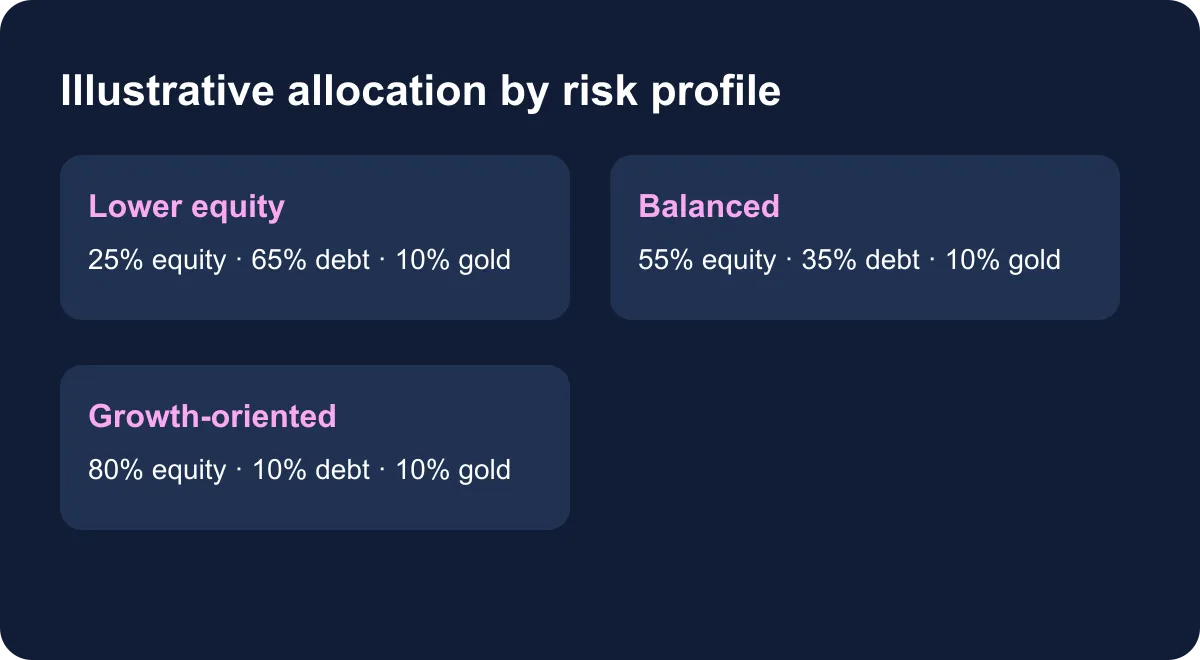
If equity alone falls 30% and the other assets are unchanged, the first mix falls 7.5%, the second 16.5% and the third 24%, before fees and taxes. This is a sensitivity example, not a forecast. In real markets, debt and gold can also fall, and correlations can change. Do not equate a lower-equity label with capital protection.
Model Portfolio vs PMS vs Mutual Funds vs Smallcases
This comparison mixes a design with several ways to deliver it. SEBI’s PMS guide distinguishes individually owned assets under PMS from pooled mutual funds. A smallcase can implement a basket through a brokerage account rather than issuing units in a pooled fund.
| Approach | What the investor owns | Who implements changes |
|---|---|---|
| Reference allocation | Nothing until the design is implemented | Depends on the delivery arrangement |
| Discretionary PMS | Securities held for the individual client | The appointed manager, under the client agreement |
| Mutual fund | Units in a pooled scheme | The AMC trades inside the scheme |
| Smallcase | Underlying stocks or ETFs bought through a brokerage account | Orders are placed through the supported broker workflow |
When comparing a basket with a portfolio management service , check who has discretion to trade, what reporting you receive and which fees apply. With a mutual fund, internal rebalancing is distinct from you redeeming units; in a directly held basket, selling holdings to rebalance can itself create a taxable event. Confirm the treatment for your own circumstances.
Benefits and Risks of Using a Model Portfolio
The main benefit is a repeatable plan. Written weights and rules make it easier to spot drift, compare results with a relevant benchmark and understand why a holding was added or sold. A plan can also make it easier to resist changing your investment approach after every market move.
The main risk is mistaking standardisation for suitability. A diversified basket can duplicate stocks in your existing funds, while a strategy with six months of strong returns may simply be exposed to a factor that is temporarily in favour. Fees, trading costs, market impact and taxes all affect live results. Check what a bad period would look like before looking at what the strategy made in its best one.
How to Evaluate a Model Portfolio Before Investing
When choosing a portfolio for a model-based approach, start with what your current holdings lack. For example, adding an equity basket may increase your exposure to the same large companies you already own through an index fund. Compare holdings before adding a second strategy. Then ask the provider for the benchmark, live record, turnover and full fee schedule. Compare live results over the same dates and on the same fee basis; keep backtests separate. Ask how a missed rebalance, partial fill or cash withdrawal would be handled.
Use Wright Research’s portfolio listings to compare objectives and disclosures, not just recent returns. A candidate should have a discernible role in your wider allocation and a process you can afford to follow. If you cannot explain what you would do during a prolonged drawdown, the strategy may be a poor fit even if its long-run record looks attractive.
Is your portfolio built for what’s coming?
Get a free AI-powered review of your holdings — risk, overlap and quality in minutes.
FAQ
What is a model portfolio in investing?
It is a reference set of investments, target weights and decision rules built for a stated objective. Investors may implement it themselves or through a service, depending on the arrangement.
How is a model portfolio different from a mutual fund?
A blueprint specifies what to hold. A mutual fund is a pooled vehicle that issues units and manages the underlying holdings. A fund can follow an allocation blueprint internally.
What are common examples of model portfolio strategies?
Examples include diversified equity baskets, multi-asset mixes and factor-based portfolios focused on traits such as value or momentum. Their holdings, concentration and turnover can differ substantially.
Who should consider investing through a model portfolio?
It may suit someone who wants a transparent allocation and understands how it will be implemented. Check whether it fits your risk capacity and liquidity needs and whether it overlaps with existing holdings.
How often should a model portfolio be rebalanced?
There is no universal schedule. Some designs trade on a calendar; others use drift thresholds. Compare the benefit of restoring target weights with the likely trading costs and tax impact.


