


A fast-rising stock, a viral screenshot and a friend’s profitable trade can make waiting feel like a mistake. That tension is the core of FOMO investing: urgency replaces analysis, and another person’s outcome begins to dictate your portfolio. FOMO investing becomes especially costly when that urgency also determines position size.
Markets reward some early buyers, but a visible winner does not reveal the many late entries, failed ideas or risks taken to produce it. The practical defence is not to avoid every popular asset. It is to slow the decision down long enough to test whether the opportunity fits your goals, valuation discipline and capacity for loss.
What Is FOMO Investing?
FOMO investing is the fear that delaying or declining a trade will mean missing an exceptional gain. It often appears when prices have already risen, stories are easy to repeat and social proof is everywhere. In that setting, an investor may treat popularity as evidence and speed as an advantage.
This fear is not the same as informed conviction. Conviction should rest on a business, valuation, time horizon and explicit risks. FOMO focuses on what others may earn. A useful test is simple: if you would not want the asset without the recent price chart or online excitement, the thesis may be emotional rather than analytical.
See what markets are pricing in
Live indices, sector moves and market breadth — the backdrop to every story we publish.
How FOMO Shows Up in the Stock Market
A FOMO stock market episode often begins with a strong narrative: a new technology, policy change, listing, turnaround or sector boom. Rising prices attract coverage, coverage attracts buyers, and those purchases can reinforce the story. None of this proves that the asset is worthless, but it can disconnect the entry price from sober expectations.
Common signals include buying immediately after a large move, relying on anonymous tips, copying an influencer, checking prices compulsively and increasing a position because it keeps rising. The SEC warns that social media can create a false impression of consensus and that investors should not decide solely from posts, testimonials or celebrity endorsements.
The same pressure can also appear as selling: an investor abandons a diversified portfolio because a narrow theme has recently outperformed. The comparison period is often too short to reveal drawdowns or survivorship bias.
Common Emotional Investing Mistakes Triggered by FOMO
The first of several emotional investing mistakes is confusing a good outcome with a good process. A speculative trade can work, while a carefully researched investment can fall. One result cannot validate the decision rule.
Other errors include anchoring on a recent high, ignoring valuation, concentrating in correlated assets and averaging up without revisiting the thesis. Investors may also take derivatives or borrowed exposure because a smaller cash outlay seems safer. In reality, leverage can multiply losses and force an exit before the thesis has time to work.
| FOMO cue | Typical mistake | Better question |
|---|---|---|
| “Everyone is buying” | Treating popularity as research | What independent evidence supports the thesis? |
| “It is up 40%” | Extrapolating recent returns | What expectations are already priced in? |
| “I must act today” | Skipping due diligence | What genuinely changes after 24 hours? |
| “I can recover quickly” | Increasing size after a loss | What is my maximum acceptable position? |
Real Costs of Chasing Hype-Driven Trades
The cost of FOMO investing is more than one bad entry. Frequent trading creates taxes, brokerage and slippage; poor liquidity can widen the exit price; concentration increases drawdown; and opportunity cost diverts capital from goals with a clearer expected return.
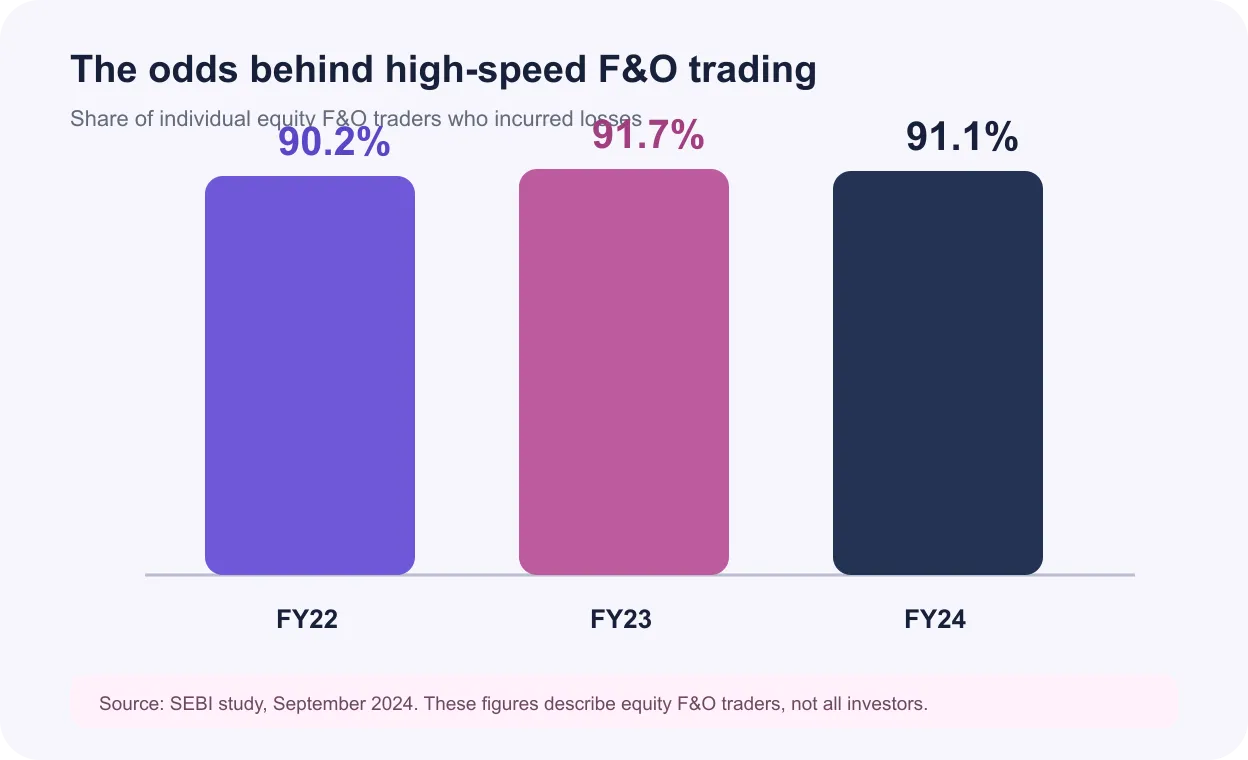
SEBI’s September 2024 study gives useful context for the riskiest end of rapid trading. It reported that 93% of individual equity F&O traders lost money across FY22 to FY24, with aggregate losses above ₹1.8 lakh crore. The annual loss-maker rates were 90.2%, 91.7% and 91.1%. These figures do not measure all investors or prove that every loss was caused by hype. They do show why urgency plus leverage deserves exceptional caution.
A FOMO stock market trade can also damage behaviour after the position closes. Regret may trigger revenge trading, while an early lucky gain can encourage larger, less-tested bets.
Get research like this in your inbox
The week’s research that mattered, in five minutes. Joined by 2L+ investors.
How to Recognise FOMO Before You Act on It
Notice the language in your own reasoning. “Before it is too late”, “everyone knows” and “this time is different” signal urgency without evidence. Physical agitation, repeated app checking and discomfort when a friend reports gains are also clues.
Then separate facts from social cues. Write the source, the expected driver, the valuation, the bear case and the event that would invalidate the idea. If the case cannot be stated without referring to recent price performance, FOMO in investing may be steering the decision.
Another test is counterfactual: would you buy at the same valuation if the price had moved sideways for six months? Would the allocation still be sensible after a 30% fall? Clear answers expose the difference between risk capacity and excitement.
Practical Steps to Avoid FOMO in Investing
To learn how to avoid FOMO in investing , introduce friction. Use a 24-hour cooling-off rule for an unplanned trade, longer for an unfamiliar or illiquid product. Verify the issuer, adviser and original disclosure rather than relying on a forwarded message.
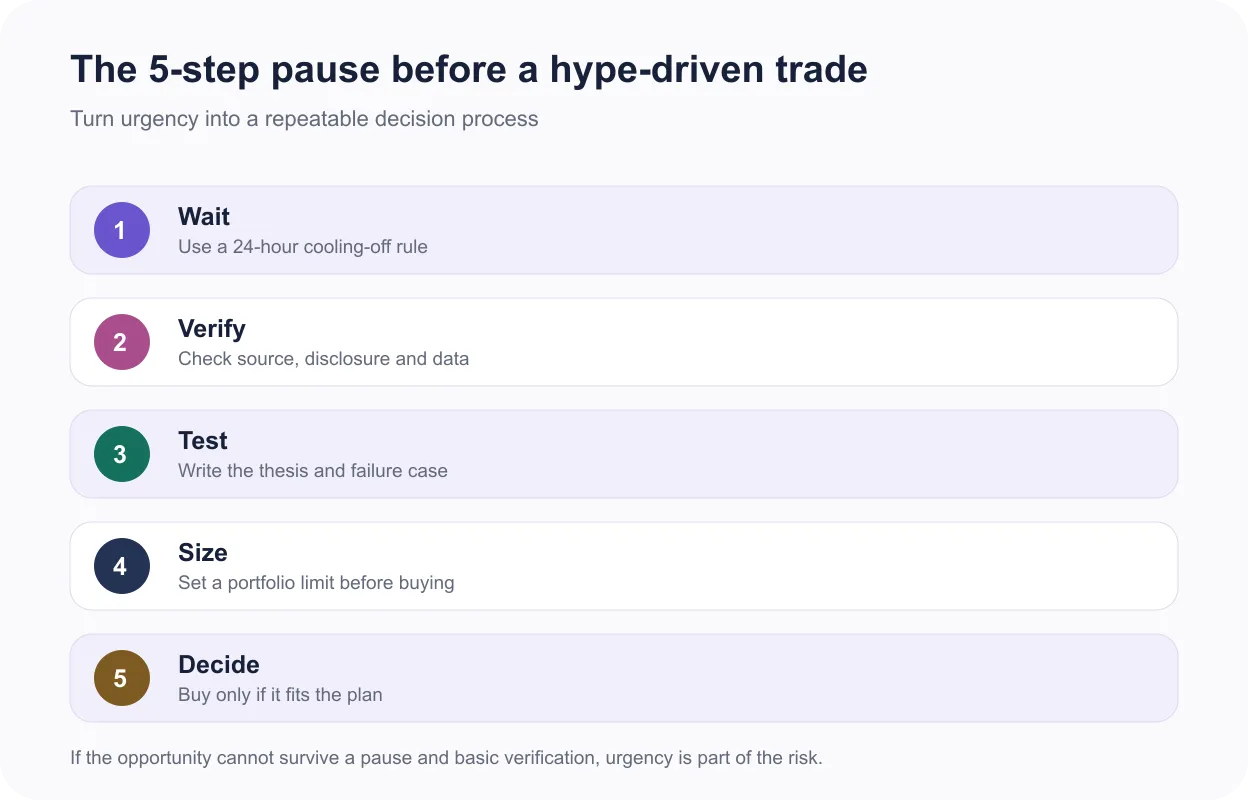
Pre-commit to position limits and rebalance rules. A watchlist can preserve interest without forcing an immediate purchase. Staggered entry may reduce timing pressure, although it cannot make an overvalued or unsuitable asset safe.
For a second answer to how to avoid FOMO in investing, reduce the trigger itself. Mute tip groups, turn off price alerts that do not support a plan, and review performance on a schedule. Compare results with a relevant benchmark and goal, not the best trade visible online.
Building a Process-Driven Portfolio Instead
A process-driven portfolio begins with goals, horizon, liquidity needs and risk capacity. Asset allocation comes before security selection. Each position should have a role, a sizing rule and a review trigger. This structure makes one exciting idea less likely to dominate the whole plan.
Use periodic portfolio reviews to identify concentration, factor overlap and thesis drift. Wright Research’s quant portfolio review framework illustrates how a structured check can replace reactive switching. A focus on quality and low-volatility factors can also support capital protection, though no factor avoids every drawdown.
The goal is not emotionless investing. It is to prevent emotion from becoming the only input. When FOMO investing appears, return to written rules, independent evidence and an allocation you can hold through an unfashionable period. This is the difference between reacting to a feed and maintaining an investment process.
Is your portfolio built for what’s coming?
Get a free AI-powered review of your holdings — risk, overlap and quality in minutes.
FAQ
What is FOMO in investing?
It is the urge to buy, sell or switch investments because other people appear to be profiting and delay feels costly. The decision is driven by urgency and social comparison rather than a tested portfolio case.
How do I stop FOMO investing?
Pause before trading, verify the original information, write down the investment thesis and downside, and compare the proposed position with pre-set allocation and risk limits.
Why is FOMO dangerous in the stock market?
It can lead investors to buy after a sharp rise, ignore valuation and liquidity, take excessive concentration, or use leverage without understanding how quickly losses can compound.
What are signs of emotional investing?
Repeated price checking, sudden changes to a long-term plan, anxiety about others’ profits, urgency created by social posts, and increasing position size after a rally are common warning signs.
How can I avoid impulsive stock market decisions?
Use a cooling-off period, a written checklist, position-size limits and scheduled portfolio reviews. Separate idea discovery from the final decision and record why a trade belongs in the portfolio.
Does FOMO affect long-term investors too?
Yes. A long horizon does not prevent an investor from chasing a fashionable theme, abandoning diversification or replacing a sound plan after comparing returns with a recent winner.


