


If a mutual fund application stalls even though you have invested before, check the status of your KYC record before submitting another form. An existing record can be registered without being validated for reuse across intermediaries. A pending application, meanwhile, may simply be waiting for verification.
This guide explains how to find the agency holding your record, read the result and resolve a problem through the right channel. Start with the status rather than assuming you need to open a new account or send your documents again.
What Is CAMS KRA?
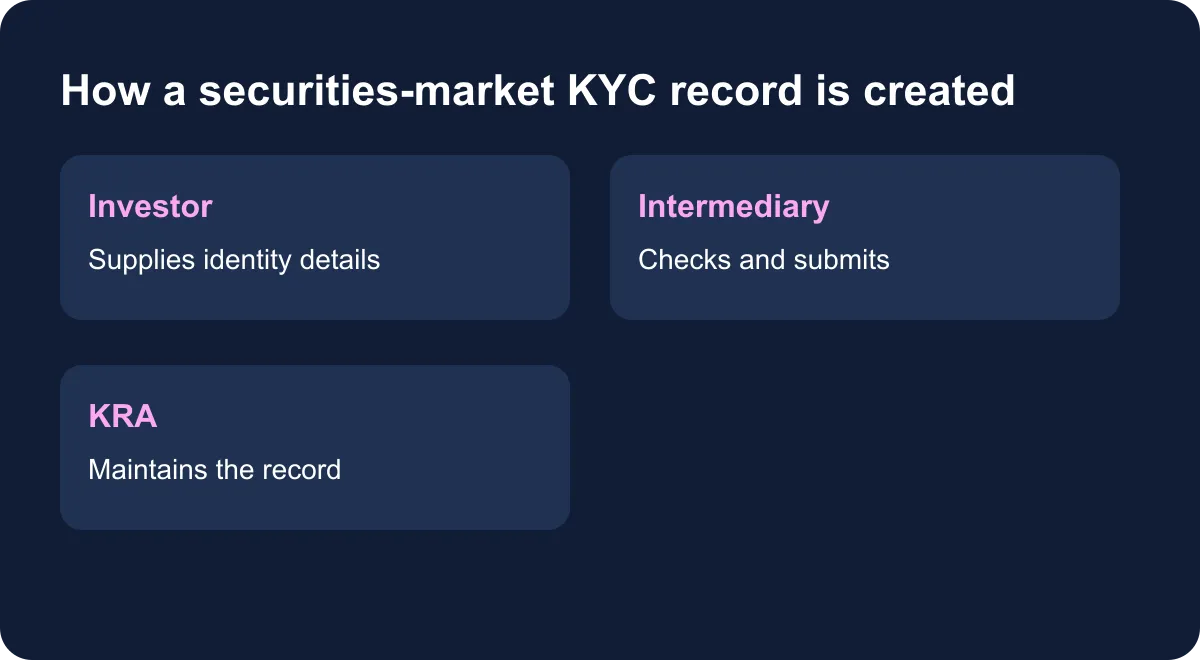
CAMS KRA is a SEBI-registered Know Your Client Registration Agency operated by Computer Age Management Services. It stores and maintains securities-market KYC records, which eligible intermediaries can retrieve under the applicable rules. The agency does not select investments, open a demat account for you or hold your portfolio.
CAMS also provides registrar and transfer agent services to fund houses. That is a different function: a transfer agent services transactions and folios, while the KRA maintains identity records. A folio statement confirms holdings, not whether your KYC record can be reused.
See what markets are pricing in
Live indices, sector moves and market breadth — the backdrop to every story we publish.
Why KYC Registration Matters for Mutual Fund and PMS Investors
Your identity record is part of onboarding for both mutual fund investments and a portfolio management service (PMS). Before committing money, ask whether your provider can retrieve the record and what additional documents it needs. A PMS provider may still require an agreement, bank or demat information and its own due diligence. A fund house may need folio details or tax-residency declarations.
Under SEBI’s KRA validation framework , validated records can generally be reused across securities-market intermediaries when the details are unchanged. That saves duplicate identity paperwork, but does not guarantee acceptance of an investment application.
CAMS KRA vs Other KYC Registration Agencies
Other agencies, such as CVL KRA and KFin KRA, serve the same broad purpose. Investors do not need to register separately with every agency or move a valid record simply because a new provider uses another KRA. Ask your provider to identify the agency maintaining your record. If that agency is not CAMS, follow its official update instructions rather than assuming a CAMS form will fix the problem.
How CAMS KRA KYC Works: Step-by-Step
- Check for an existing record. Give the intermediary your PAN through its official onboarding channel. If it can retrieve a usable record, ask what else it needs before repeating any identity checks.
- Submit the required proofs. If you need CAMS KRA registration or an update, complete the relevant form and supply the requested identity, address and contact details. Complete in-person or video verification if applicable.
- Wait for the record to be processed. The intermediary checks and uploads the details. The KRA performs its checks and records the outcome. Save the submission reference so the provider can trace a delay.
- Confirm the result. Check the CAMS KRA KYC status before assuming an investment order can go through. If it shows a problem, address the specific issue rather than starting from scratch.
Documents Required for CAMS KRA KYC
For an individual, expect to provide PAN, an accepted identity and address document as applicable, contact details and any photograph or signature required on the form. Use the current document list from your intermediary or CAMS’s KYC guidance. The permitted digital and offline routes may ask for different evidence. Do not assume that any accepted document automatically produces a Validated status.
NRIs should ask about passport, overseas address proof and any applicable certification or attestation requirements. Check that your name agrees across your documents and that your email or mobile is accessible. Prepare separate bank or tax-residency documents if the investment provider asks for them.
Get research like this in your inbox
The week’s research that mattered, in five minutes. Joined by 2L+ investors.
How to Check Your CAMS KRA KYC Status Online
Go directly to the official CAMS portal and use its KYC status enquiry. Follow the prompts and note the status, the agency name where shown and any reason provided. A KYC status check online is an enquiry, not a new application. Do not assume a CAMS KRA login is required for a public enquiry or enter credentials into a third-party page that claims to offer one.
If the result is missing or unclear, confirm your PAN entry and ask the submitting intermediary whether it uploaded the application and which KRA received it. Recheck the CAMS KRA KYC status after an acknowledged update. Use a CAMS KRA login only through the official portal if the service you need actually requires sign-in.
KYC Status Types: Validated, Registered and Under Process
The CAMS status guidance distinguishes between a record on file and one that can be independently validated. Use the result to decide what to do before applying elsewhere.
| Status | What it means in practice | Next action |
|---|---|---|
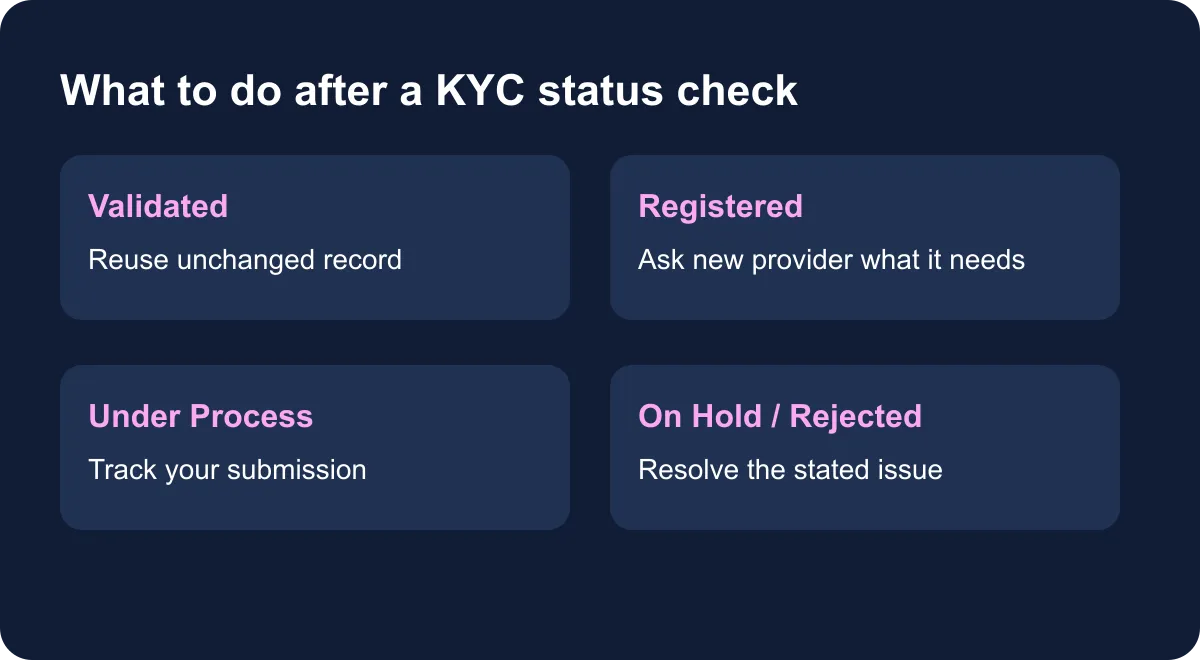
| Validated | The agency validated the record against applicable checks | Ask the new provider to retrieve it if details are unchanged |
| Registered | A record is on file but does not have Validated status | Existing relationships can generally continue; check document requirements before using a new provider |
| Under Process | The submission is not yet final | Keep the acknowledgement and check again after the provider’s stated turnaround |
| On Hold or Rejected | A verification or document issue needs attention | Get the specific reason and follow the responsible agency’s correction route |
What to Do if Your KYC Is Not Validated
If your record says Registered and you plan to invest with a new provider, first ask whether it needs fresh documents. If the record says On Hold or Rejected, ask which check failed. Typical issues include an unverified contact detail, a document mismatch or a PAN-Aadhaar linking issue where the requirement applies. Do not assume it applies to you if you are exempt.
Submit corrections through the responsible KRA or intermediary and keep the acknowledgement. After KRA KYC verification, run a KYC status check online again and confirm the provider can proceed. CAMS KRA registration alone does not resolve a validation failure, and repeating the same submission without addressing the reason can leave it unresolved.
CAMS KRA, CKYC and Re-KYC: Key Differences
A KRA maintains records used by securities-market intermediaries. CKYC refers to the separate Central KYC Records Registry, which serves the wider financial system and issues a KYC identifier. SEBI requires KRAs to upload KYC information to that registry , but having a CKYC identifier does not establish your securities-market validation status. Re-KYC is the process of updating or verifying an existing record, for example after an address change.
Is your portfolio built for what’s coming?
Get a free AI-powered review of your holdings — risk, overlap and quality in minutes.
FAQ
Is CAMS KRA valid for PMS investments?
A PMS provider can generally retrieve a validated KRA record if the details are unchanged. The provider can still ask for documents specific to its service and onboarding checks.
What should an investor do if KRA KYC status shows 'On Hold'?
Ask the agency or submitting intermediary for the precise reason. Correct the failed check through the official route, retain the acknowledgement and recheck the result before submitting another investment application.
Can NRIs complete CAMS KRA verification online?
Some intermediaries support digital submissions for eligible NRIs. Confirm whether your documents, address and verification route qualify. If the provider requires attested copies or another verification method, an online upload alone may not complete the process.
How long can it take for KRA KYC status to update after submission?
The time depends on when the intermediary uploads the record and whether checks or corrections are outstanding. Ask for the upload date and expected turnaround. Follow up with the submission reference if the status remains pending past that window.
Does KYC need to be repeated when switching mutual fund houses?
Generally not if your KYC is Validated and the details are unchanged. If it is Registered, the new fund house may require fresh documentation. You may still need to complete fund-specific folio or bank formalities.


