


A mutual fund redemption statement can contain a deduction so small that it is easy to overlook: Securities Transaction Tax, or STT. The tax does not apply to every fund or every transaction. For most investors, STT on mutual funds appears only when units of an equity-oriented scheme are sold or redeemed.
The statutory rate for that transaction is 0.001% of the sale or redemption value, payable by the seller. That means a ₹5 lakh equity-fund redemption produces ₹5 of STT. The amount is modest, but understanding it prevents confusion with exit load, expense ratio and capital gains tax.
What Is Securities Transaction Tax (STT)?
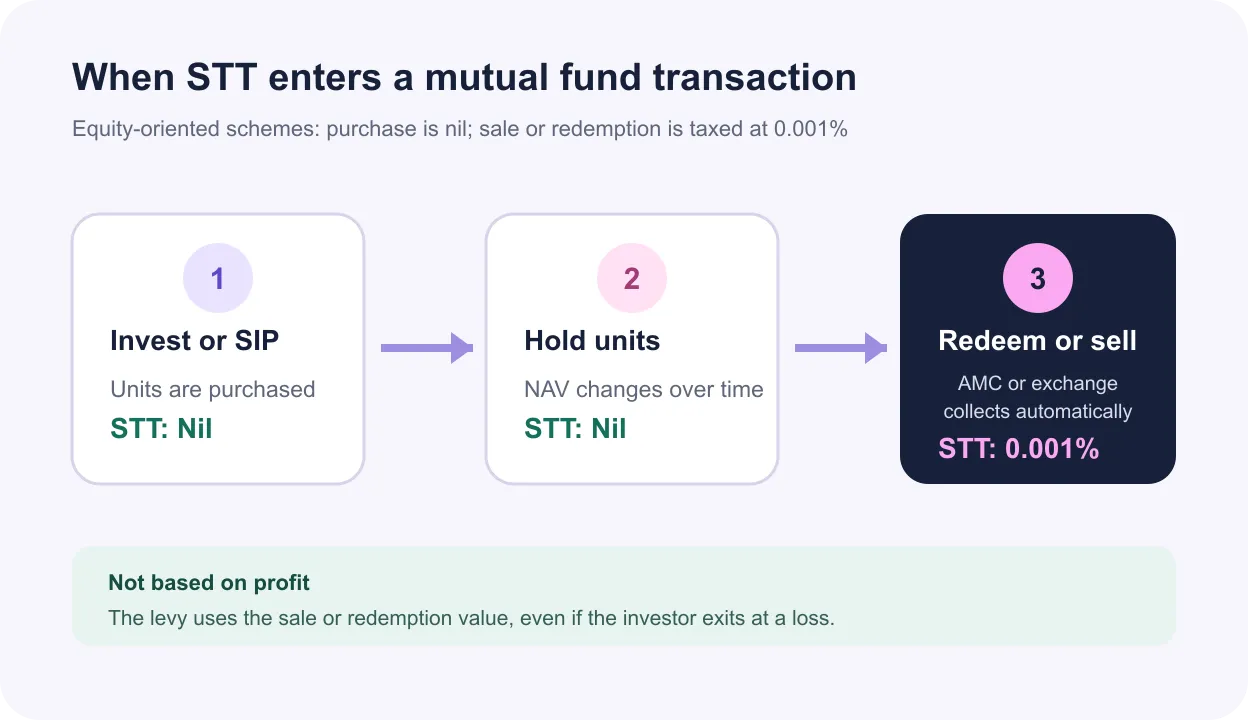
STT is a tax on specified securities transactions under the Finance (No. 2) Act, 2004. It is calculated on transaction value, not on the investor's gain. A sale at a loss can therefore still attract STT.
For mutual funds, the key statutory entry covers the sale of a unit of an equity-oriented fund to the mutual fund. Section 98 specifies a 0.001% rate and places the liability on the seller. The fund house or other prescribed collecting entity deducts and remits it, so investors normally see the charge in the transaction statement.
This is narrower than the general idea of securities transaction tax on mutual funds. The product category and transaction type must both fall within the law.
See what markets are pricing in
Live indices, sector moves and market breadth — the backdrop to every story we publish.
Is STT Applicable on Mutual Funds?
If an investor asks is STT applicable on mutual funds , the answer depends on the scheme. It applies to the sale or redemption of units of equity-oriented funds. It does not apply merely because an investor owns any mutual fund.
Equity-oriented status is determined by the applicable tax definition, not by a marketing label. Equity funds, eligible equity-oriented hybrid schemes and equity ETFs can fall within the rule. Debt funds, gold funds and other non-equity schemes do not attract this specific levy on purchase, sale or redemption.
STT on Equity Mutual Funds vs Debt Mutual Funds
| Transaction | Equity-oriented fund | Debt or other non-equity fund |
|---|---|---|
| Lump-sum purchase | Nil | Nil |
| SIP purchase | Nil | Nil |
| Redemption to the fund | 0.001% of redemption value, paid by seller | Nil |
| Sale of eligible units on recognised exchange | 0.001% for delivery-based sale | No equity-oriented-fund STT |
The practical difference is categorical. STT on mutual funds is an equity-oriented-fund transaction cost. It is not a universal charge on all mutual fund withdrawals.
Hybrid funds need classification rather than assumption. Their equity allocation and tax status determine whether securities transaction tax on mutual funds applies. Investors should check the scheme information document or transaction statement when classification is unclear.
Current STT Rates on Mutual Fund Transactions
The current rate on the sale of a unit of an equity-oriented fund to the mutual fund is 0.001%, payable by the seller. Section 98 also provides 0.001% for a delivery-based sale of equity-oriented fund units on a recognised stock exchange.
| Event | Rate | Who bears it? | Tax base |
|---|---|---|---|
| Purchase or SIP into a mutual fund | Nil | Not applicable | Not applicable |
| Equity-oriented fund redemption | 0.001% | Seller or redeeming investor | Redemption value |
| Delivery-based sale of equity-oriented fund units on exchange | 0.001% | Seller | Sale value |
| Debt or other non-equity fund redemption | Nil | Not applicable | Not applicable |
Rates can change through legislation. Investors evaluating STT on mutual funds should verify the applicable rate for the transaction date rather than rely on an old illustration.
Do not carry over the rate applicable to ordinary equity shares or derivatives. Section 98 lists different transactions separately, with different rates and responsible parties. For a mutual fund investor, the relevant entry must match both the instrument and the way it is sold. This is why a rate quoted for a delivery-based share sale cannot be used for an equity mutual fund redemption.
Get research like this in your inbox
The week’s research that mattered, in five minutes. Joined by 2L+ investors.
STT on Mutual Fund Purchases, Redemptions & SIPs
stt on mutual fund purchase is nil. This remains true whether units are bought in one lump sum or through monthly SIP instalments. The entire subscription amount, subject to normal fund-processing rules, is used to allot units.
STT on mutual fund redemption is different. When equity-oriented units are redeemed, the AMC calculates the charge on the redemption value and deducts it before paying the proceeds. The same principle applies to systematic withdrawal plan instalments because each withdrawal is a redemption.
A switch includes a redemption from the source scheme and a purchase into the destination scheme. If the source is equity-oriented, STT on mutual fund redemption can apply to that leg. The purchase leg has nil stt on mutual fund purchase.
SIP is only a purchase method. There is no immediate STT on mutual funds when an instalment is invested, but a later exit from eligible equity-oriented units can trigger the tax.
How STT Is Calculated: An Example
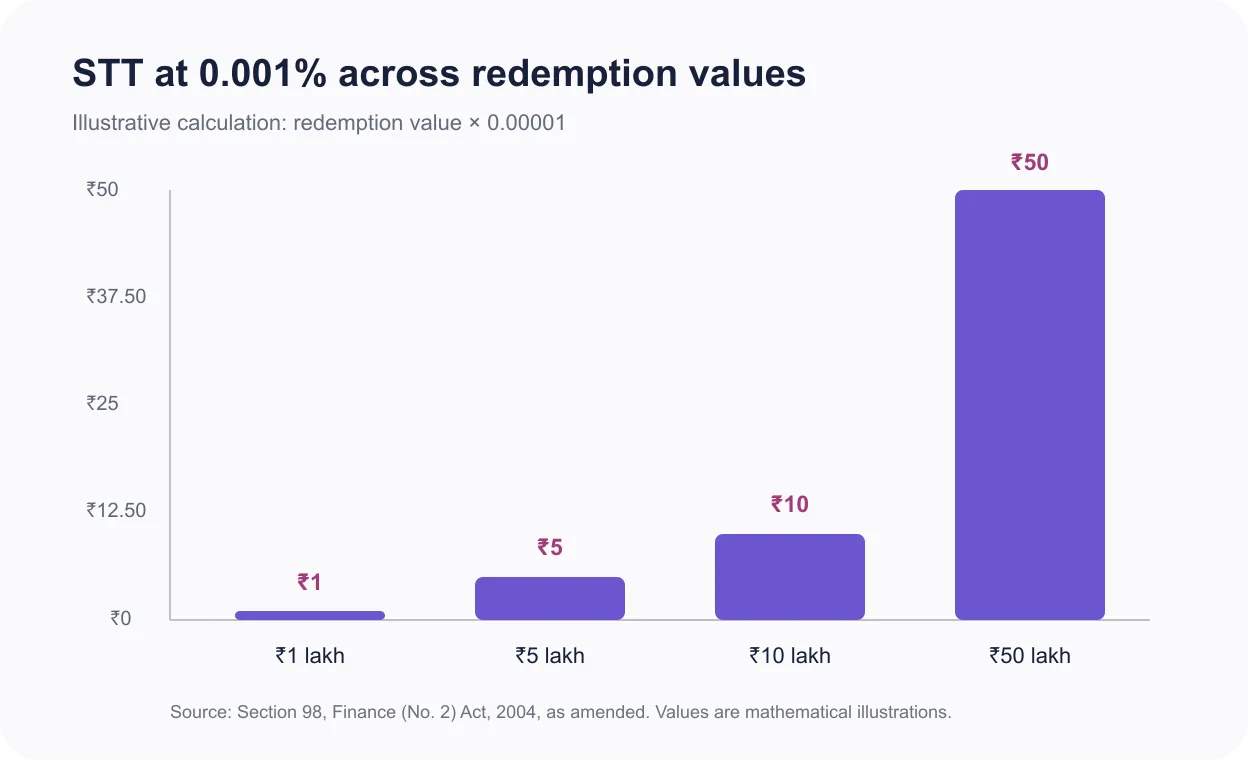
The calculation is straightforward: redemption value × 0.001%. In decimal form, multiply the redemption value by 0.00001.
Suppose an investor redeems equity mutual fund units worth ₹5,00,000. STT on mutual fund redemption is ₹5,00,000 × 0.00001 = ₹5. The calculation uses ₹5,00,000 even if the original investment was higher and the investor records a loss.
Operational rounding may determine the final amount displayed on a statement. The example explains the rate and should not replace the AMC's transaction record.
STT vs Other Mutual Fund Taxes and Charges
STT is only one item among mutual fund tax charges and operating costs. Capital gains tax is assessed on taxable gains, while an exit load is a scheme-level charge that may apply when units are redeemed within a stated period. The expense ratio is reflected in the scheme's NAV over time.
| Item | Basis | When it matters |
|---|---|---|
| STT | Eligible transaction value | Sale or redemption of equity-oriented units |
| Capital gains tax | Taxable gain | When a transfer produces taxable gains |
| Exit load | Redemption value under scheme rules | Usually when exiting within a specified period |
| Expense ratio | Scheme assets and recurring expenses | Reflected continuously in NAV |
securities transaction tax on mutual funds cannot be treated as capital gains tax. Income Tax Department guidance also states that STT paid is not deductible when calculating capital gains from the sale of securities.
How STT Impacts Your Overall Returns
At 0.001%, the direct effect is small: ₹1 per ₹1 lakh redeemed. It is still useful to reconcile because it explains why net proceeds can differ slightly from the stated redemption value.
Frequent withdrawals create repeated taxable transactions, but STT should rarely dominate an investment decision. Asset allocation, fund risk, expense ratio, exit load and capital gains tax generally have a larger financial effect.
For return measurement, compare like with like. A fund's published NAV performance already reflects recurring scheme expenses, while investor-level proceeds can additionally reflect exit load, STT on mutual funds and taxes. Mixing gross transaction value with net bank proceeds can make a personal return calculation appear inconsistent.
Maintain the redemption confirmation or consolidated account statement with the purchase record. It provides the transaction value and charge needed to reconcile cash flows, particularly when several folios or partial withdrawals are involved. STT on mutual funds is small, but recording it keeps the investment ledger complete.
The correct takeaway is precision rather than alarm. Check whether the source scheme is equity-oriented, identify the redemption value, apply the current rate and confirm the statement. That process answers is STT applicable on mutual funds without treating all schemes alike.
For a broader explanation of the levy across securities, read Wright Research's guide to STT on mutual funds. Investors comparing an exit's tax consequences can also review the guide to short-term capital gains.
Is your portfolio built for what’s coming?
Get a free AI-powered review of your holdings — risk, overlap and quality in minutes.
FAQ
Is STT applicable on mutual fund redemption?
Yes, when units of an equity-oriented mutual fund are redeemed, STT is collected from the investor at 0.001% of the redemption value. Debt and other non-equity fund redemptions do not attract this levy.
What is the STT rate on mutual funds?
The rate relevant to the sale or redemption of equity-oriented mutual fund units is 0.001% of the transaction value. The seller bears it.
Is STT charged on SIP investments?
No STT is charged when a SIP instalment purchases mutual fund units. If units of an equity-oriented scheme acquired through SIP are later redeemed, STT applies at redemption.
Is STT applicable on debt mutual funds?
No. Purchase, sale and redemption of debt mutual fund units do not attract STT under the equity-oriented mutual fund entries. Other tax rules may still apply.
How is STT different from capital gains tax?
STT is charged on the transaction value whether there is a profit or loss. Capital gains tax applies to the taxable gain and depends on the fund category, holding period and applicable law.
In short, stt on mutual fund purchase is nil, while eligible equity-fund exits attract the levy. STT on mutual fund redemption is automatically collected, so investors generally do not pay it separately.


