


Gujarat International Finance Tec-City (GIFT City) hosts India's International Financial Services Centre (IFSC), from which fund managers can pool and deploy foreign-currency capital under the International Financial Services Centres Authority (IFSCA). The label "GIFT City fund" covers several different legal forms: some are retail schemes or ETFs, others are private-placement restricted schemes or venture-capital pools. Eligibility, minimum investment, liquidity, currency and tax treatment differ by structure.
What are GIFT City funds?
GIFT City funds are schemes launched by registered Fund Management Entities (FMEs) in GIFT IFSC under the IFSCA (Fund Management) Regulations, 2025. The IFSC is treated as a separate international financial jurisdiction for regulatory and foreign-exchange purposes although it is physically in India. A scheme may invest in securities in the IFSC, India or other jurisdictions, depending on its category and offer document. See also this overview of international mutual funds.
The phrase "GIFT City mutual funds" is used informally for pooled products. Restricted and venture-capital schemes are regulated by IFSCA and are not the same as domestic SEBI-regulated mutual funds.
Run the numbers on your next investment
Project returns on a lumpsum or SIP with our free calculators.
Why the IFSC exists
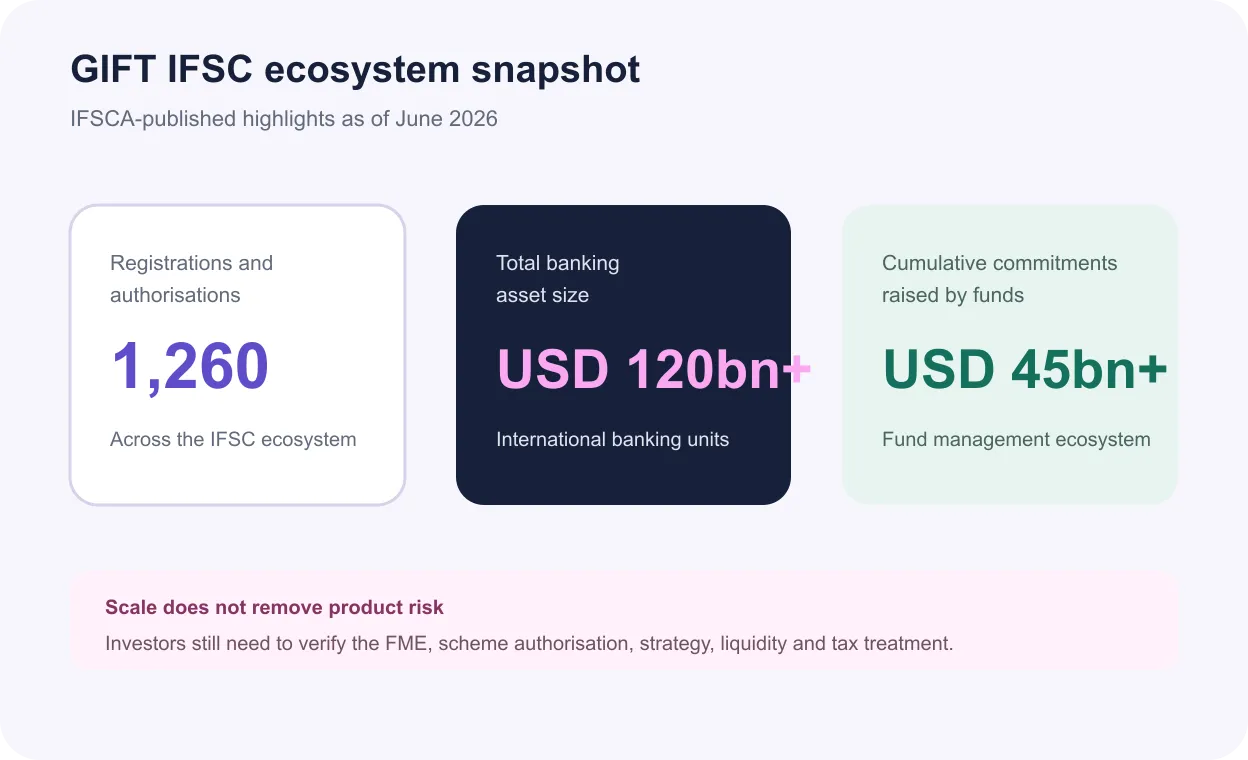
GIFT IFSC was set up so that international financial activity that might otherwise be booked in overseas centres could be carried out in a regulated Indian hub, with IFSCA as the single regulator for products, services and institutions there. IFSCA's published highlights show the scale as of June 2026: 1,260 registrations and authorisations, more than USD 120 billion of banking assets, and more than USD 45 billion of cumulative commitments raised by funds (Business Standard reported the commitments figure as USD 45.08 billion across 401 funds and schemes).
Types of GIFT City funds
The IFSCA Fund Management Regulations, 2025 (consolidated text amended up to 10 September 2026 on the IFSCA website) organise investable products by scheme type: retail schemes, exchange-traded funds, restricted schemes and venture-capital schemes.
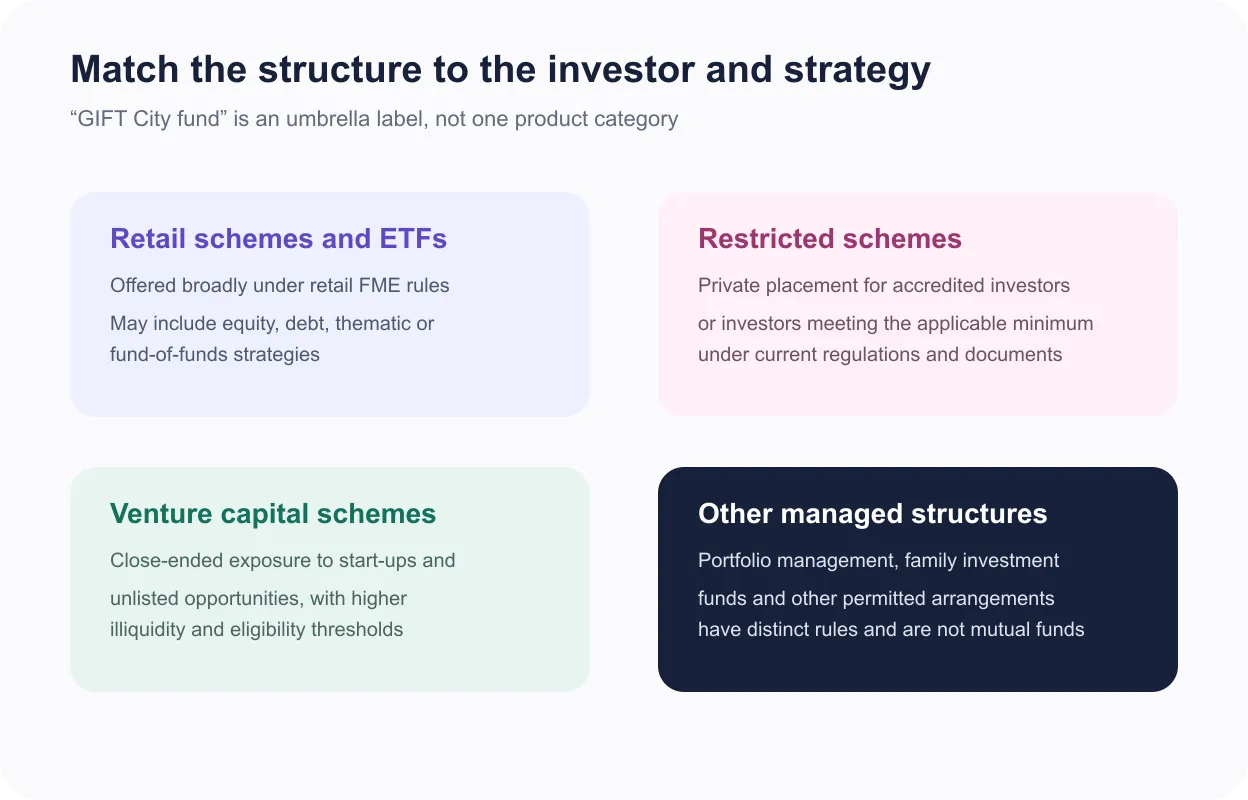
| Structure | Typical access | Main characteristics |
|---|---|---|
| Retail scheme | Offered to all investors or a section of investors; no ceiling on investor count | Open- or close-ended strategies across permitted asset classes |
| ETF | Investors with access to a recognised IFSC exchange | Units trade on exchange; price can differ from NAV |
| Restricted scheme | Private placement to accredited investors or investors committing at least USD 150,000; up to 1,000 investors unless IFSCA specifies otherwise | Minimum corpus USD 3 million; open- or close-ended |
| Venture-capital scheme | Accredited investors or investors meeting the specified commitment (USD 250,000 for non-accredited investors) | Close-ended; start-ups and unlisted opportunities |
| Fund of funds | Depends on the parent scheme | Invests through other funds, adding a layer of fees |
Thresholds are as stated in the 2025 regulations and IFSCA brochures and may be amended; the offer document of each scheme governs. Funds may also invest in listed Indian securities by registering as foreign portfolio investors (FPIs).
Open-ended, close-ended and listed formats
An open-ended scheme issues and redeems units according to its dealing calendar. A close-ended scheme has a fixed tenure and may offer limited interim liquidity. An ETF trades on an IFSC exchange, so its market price can differ from NAV and an eligible broker and settlement arrangement are needed. Restricted and venture-capital pools usually call capital over time and return it as investments are realised, so their cash flows, valuation frequency and reporting differ from those of an open-ended scheme. Some schemes invest directly in securities; others allocate through overseas ETFs or underlying funds, which adds a fee layer and exposes the scheme to the liquidity and valuation policies of the underlying vehicles.
Features commonly cited for GIFT City funds
- Global access: depending on the mandate, schemes can hold international equities, bonds, money-market instruments, other funds and permitted derivatives.
- Regulatory location: the fund is based in an Indian IFSC under IFSCA rather than in a foreign domicile; the IFSCA directory and scheme documents are public sources for verification.
- Range of products and investors: structures exist for retail investors, accredited investors, institutions, NRIs, OCIs and other eligible participants, covering India-inbound, global outbound and multi-jurisdiction strategies.
- Foreign-currency denomination: this can match an overseas liability, and it also introduces currency risk for anyone measuring value in rupees. Hedged and unhedged classes behave differently.
- Tax and operations: certain provisions of the Income-tax Act apply to qualifying specified funds and some non-resident income, but they are not universal and depend on the fund, the investor and the income.
Overlapping exposures can also be obtained through domestic international funds, Indian ETFs, direct overseas brokerage accounts and conventional offshore funds, with different costs, taxes and regulators. Cost items compared across such routes typically include management and performance fees, administration, custody, distribution, hedging, underlying-fund expenses, dealing spreads and currency conversion charges.
Get research like this in your inbox
The week’s research that mattered, in five minutes. Joined by 2L+ investors.
Eligibility
Eligibility is set by the offer document and the regulations. Retail schemes may be offered broadly or to a defined segment. Restricted schemes allow accredited investors without a minimum and other investors at USD 150,000 or more. Employees and directors of the FME and other categories can receive specific treatment under the regulations. For resident Indians, remittances to the IFSC fall under FEMA and the Liberalised Remittance Scheme (LRS). NRIs, OCIs, foreign investors, institutions and family vehicles follow the rules for their status. A GIFT City fund therefore does not imply that every investor can enter every scheme at a small ticket size.
How subscription generally works
- The scheme and its FME are identified in the IFSCA directory, and the offer document is read for objective, benchmark, eligible investors, minimum commitment, dealing frequency, lock-in, redemption gates, currency, fees, valuation and conflicts of interest.
- KYC, beneficial-owner and tax-residency documents are completed. A resident individual typically needs an IFSC banking channel and LRS documentation, including purpose code and declaration.
- Subscription is made through the FME, an authorised distributor, a platform or, for listed units, an exchange, in the permitted currency. Contract notes, statements and remittance documents are retained.
- Private funds may issue capital-call notices rather than requiring full subscription at the outset. Dealing cut-offs, NAV date, allotment timeline, bank charges and redemption notice periods are set out in the documents.
The fund's base currency and the funding currency may differ, creating conversion spreads at entry and exit.
Taxation
Tax outcomes depend on the investor's residence, the scheme's legal form, underlying assets, source and type of income, holding period and applicable law. GIFT City funds do not all receive one investor-level exemption. Resident Indians may need to report distributions, capital gains, foreign-currency conversion and remittances; tax collected at source (TCS) on an LRS remittance, where applicable, is generally a credit rather than the final tax. Disclosure obligations may arise depending on legal ownership.
| Question | Why it matters |
|---|---|
| What is the fund's legal and tax classification? | Determines whether specific IFSC provisions may apply |
| Is the investor resident, non-resident or an institution? | Changes source, withholding and reporting rules |
| What income is expected? | Interest, dividends, distributions and gains can be taxed differently |
| Is capital remitted under LRS? | Affects process, limits and TCS credit |
| Which currency is used? | Conversion can affect computation and realised return |
Risks and documents that define a scheme
- Market and currency risk: an overseas portfolio can lose value in its local market, and exchange-rate movement can amplify or reduce the rupee result.
- Liquidity: open-ended retail schemes may offer periodic dealing, while restricted or venture funds can lock capital for years. Gates, notice periods, suspensions and side pockets can delay redemptions.
- Manager, valuation and custody: the FME's experience, service providers, independent valuation, audit, leverage and derivative use are described in the documents; fund-of-funds structures add expense layers and may have less transparency into underlying funds.
- Minimum investment: large minimums reflect private-placement or illiquidity features, not lower risk.
- Regulatory and tax change: the regulations were amended as recently as September 2026, and later circulars and the tax position may change.
Legal documents, not presentations or distributor summaries, define a scheme. Track records should be read with attention to whether they are live results, backtests or results from a different vehicle.
See what markets are pricing in
Live indices, sector moves and market breadth — the backdrop to every story we publish.
FAQ
What are GIFT City funds?
Schemes established in GIFT City's International Financial Services Centre and managed under the IFSCA fund-management framework. The label covers several structures, not one standard product.
Are GIFT City funds taxable in India?
Tax depends on investor residence, structure, income type, asset location and applicable exemptions or treaty provisions. GIFT status does not create one universal outcome.
What is the difference between GIFT City funds and offshore funds?
A GIFT fund is established in an Indian IFSC and regulated by IFSCA. A conventional offshore fund is established and regulated in another jurisdiction, although either may invest internationally or into India.
What is the minimum investment?
There is no single minimum. Restricted schemes use USD 150,000 for non-accredited investors, venture-capital schemes use USD 250,000 for non-accredited investors, and other schemes set their own amounts in the offer document.
Figures are from IFSCA publications and the 2025 Fund Management Regulations as amended, checked on 23 November 2026. Mention of any structure is not a recommendation.
This article is for educational purposes only and is not investment advice.


