


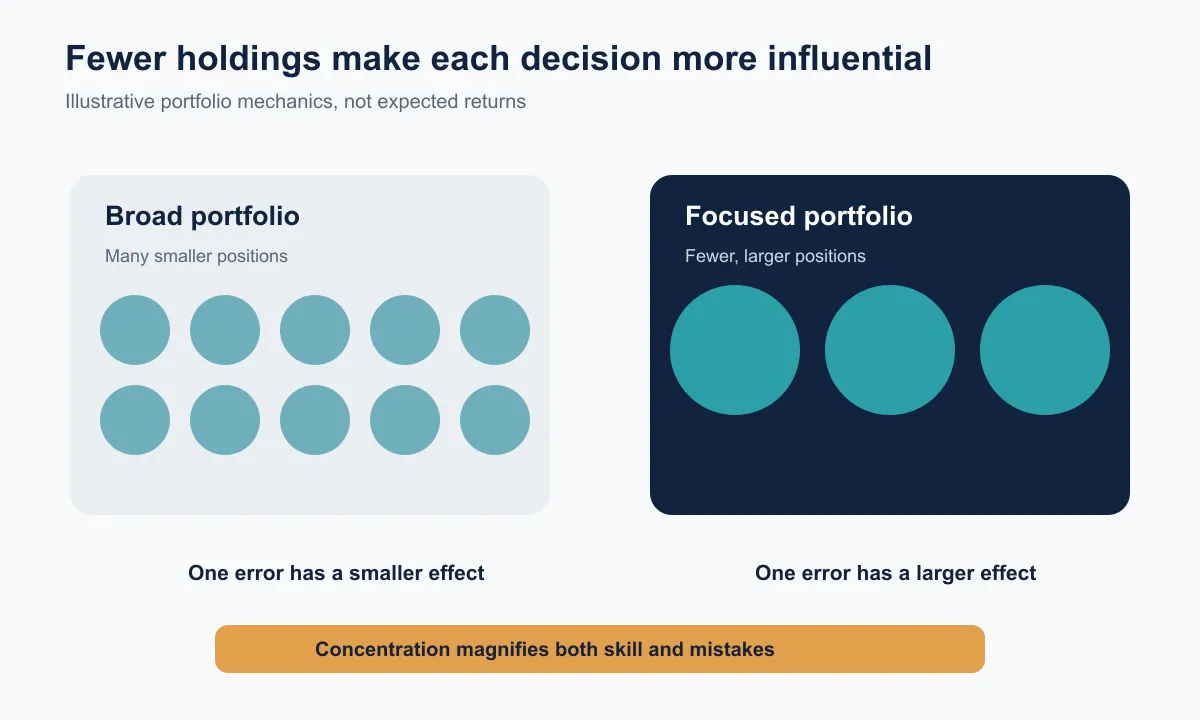
A focused mutual fund deliberately owns fewer companies than a broadly diversified equity scheme. The manager concentrates capital in the ideas considered most attractive, so each holding can make a larger difference to performance. That creates the possibility of meaningful outperformance, but also greater stock-specific and manager-selection risk.
This guide explains the focused fund meaning, SEBI's portfolio limit, taxation and the checks investors should complete before investing. It is educational, not a scheme recommendation.
What Is a Focused Mutual Fund?
A focused fund is an open-ended equity scheme that invests in a maximum of 30 stocks. SEBI's March 2026 master circular requires at least 80% of total assets in equity and equity-related instruments. The scheme must also state where it intends to focus, such as large cap, mid cap, small cap or multi cap.
The focused fund meaning is therefore defined by concentration, not by one investment style. One manager may emphasise quality companies, another value opportunities, and another growth businesses. Two schemes in the same category can hold different sectors, market-cap mixes and cash levels.
For investors asking what are focused funds, the simplest answer is: actively managed equity portfolios in which a limited number of holdings carry greater influence. “Maximum 30” is a ceiling, not a target or a promise that every scheme will always own exactly 30 companies.
Check the macro backdrop
GDP, inflation, rates and more — India’s key economic indicators in one dashboard.
How Focused Funds Work and the SEBI 30-Stock Limit
The manager researches a broad universe, selects a concentrated portfolio and assigns weights based on conviction and risk controls. A 7% position that rises 20% adds roughly 1.4 percentage points before costs and other effects. The same position falling 20% subtracts roughly the same amount. Weight matters as much as stock count.
SEBI's limit applies to total equity-security exposure. A 2026 policy letter clarified that index-derivative positions can create exposure to all index constituents and may breach the category's basic 30-stock principle unless used as an eligible hedge. This reinforces that the rule concerns effective exposure, not merely the cash-equity line items shown in a factsheet.
A focused equity fund may invest across market capitalisations if its scheme documents permit it. It does not have the mandatory 25% allocation to each of large, mid and small caps that applies to multi-cap funds. Investors must read the scheme mandate and current portfolio rather than infer the mix from the category name.
Key Features of Focused Equity Funds
Common features include:
- A maximum of 30 equity holdings and at least 80% in equity and equity-related instruments.
- Active security selection with relatively large weights in the manager's highest-conviction ideas.
- Potential flexibility across sectors and market capitalisations, subject to the scheme mandate.
- A benchmark that may be broad even though the portfolio is concentrated.
- Higher dependence on fund-manager judgement, position sizing and sell discipline.
- The same direct and regular plan distinction that applies to other mutual funds.
These concentrated schemes can still hold cash, debt instruments or derivatives within their permitted asset-allocation range. Review monthly portfolios and the Scheme Information Document for the actual structure. A scheme with 25 stocks can nevertheless be dominated by its top five positions.
Benefits and Risks of a Concentrated Portfolio
Concentration can prevent strong ideas from being diluted by dozens of small positions. It can also make the portfolio easier to understand and monitor. When the manager's research and timing are correct, the best holdings have a meaningful effect on returns.
The trade-off is reduced diversification. A governance failure, earnings disappointment or regulatory change in one large position can materially damage performance. Sector clustering can create hidden concentration even when the scheme owns 25 or 30 stocks. Portfolio overlap with the investor's other funds can magnify the same exposure.
| Potential benefit | Matching risk |
|---|---|
| High-conviction ideas influence returns | A wrong thesis causes greater damage |
| Portfolio is easier to analyse | Fewer holdings reduce diversification |
| Manager can avoid benchmark-like dilution | Performance depends heavily on manager skill |
| Flexible stock selection may create alpha | Style and market-cap exposure can shift |
Volatility is only part of the risk. A focused fund may underperform for several years when its preferred style is out of favour. Investors need the temperament and time horizon to avoid reacting to short-term ranking changes.
Get research like this in your inbox
The week’s research that mattered, in five minutes. Joined by 2L+ investors.
Focused Funds vs Flexi-Cap and Multi-Cap Funds
These categories solve different portfolio-design problems.
| Feature | Focused fund | Flexi-cap fund | Multi-cap fund |
|---|---|---|---|
| Number of stocks | Maximum 30 | No category-specific 30-stock cap | No category-specific 30-stock cap |
| Equity minimum | 80% | 65% | 75% |
| Market-cap rule | As stated by scheme | Flexible across market caps | At least 25% each in large, mid and small caps |
| Core risk | Stock and manager concentration | Manager allocation choices | Mandatory mid- and small-cap exposure |
A flexi-cap scheme can concentrate, but it is not required to remain within 30 holdings. A multi-cap fund must maintain its minimum allocations even when one segment appears expensive or risky. The focused category is defined chiefly by the number of holdings.
Use the Wright Research mutual-fund platform to compare mandate, holdings and risk. The label alone does not show whether a scheme belongs in an investor's core portfolio.
Taxation of Focused Mutual Funds
An Indian scheme that qualifies as an equity-oriented mutual fund follows equity-fund capital-gains rules. For transfers on or after 23 July 2024, units held for up to 12 months generate short-term capital gains taxable at 20% under Section 111A when applicable conditions, including STT, are met.
Units held for more than 12 months generate long-term capital gains. Under Section 112A, aggregate eligible long-term gains above ₹1.25 lakh in a financial year are taxable at 12.5%. Applicable surcharge and 4% health and education cess are additional. The ₹1.25 lakh threshold is shared across eligible listed-equity and equity-oriented-fund gains, not separately available for every scheme.
| Holding period | Gain type | Base tax treatment for resident investors |
|---|---|---|
| Up to 12 months | Short term | 20% under Section 111A, subject to conditions |
| More than 12 months | Long term | 12.5% on eligible aggregate gains above ₹1.25 lakh under Section 112A |
IDCW distributions are generally taxable at the investor's applicable slab rate, with TDS rules applying where relevant. Tax treatment depends on investor status and transaction facts, so confirm the current law or consult a tax professional before redeeming.
Who Should Consider a Focused Fund?
A focused scheme may suit an experienced equity investor who already has a diversified core, understands drawdowns and can remain invested through periods of underperformance. It may be used as a satellite allocation when the investor has conviction in the process and manager.
It is less suitable for someone seeking one simple first equity fund, a short investment horizon or low volatility. Investors whose existing portfolio already owns similar top positions may gain little diversification from adding another concentrated scheme.
When deciding what are focused funds appropriate for, assess capacity for loss rather than only willingness to earn more. A SIP can spread purchase dates, but it cannot diversify the underlying holdings or remove manager risk.
How to Evaluate a Focused Fund
Start with the scheme mandate, benchmark and portfolio history. Then review:
- Concentration: top five and top ten weights, sector exposure and number of holdings.
- Manager process: research framework, position-sizing rules, sell discipline and tenure.
- Consistency: rolling three- and five-year returns, not one trailing period.
- Downside: maximum drawdown, downside capture and recovery time.
- Portfolio change: turnover, market-cap shifts and style drift.
- Costs: direct versus regular expense ratio, exit load and tax consequences.
- Overlap: common holdings with the investor's other equity funds.
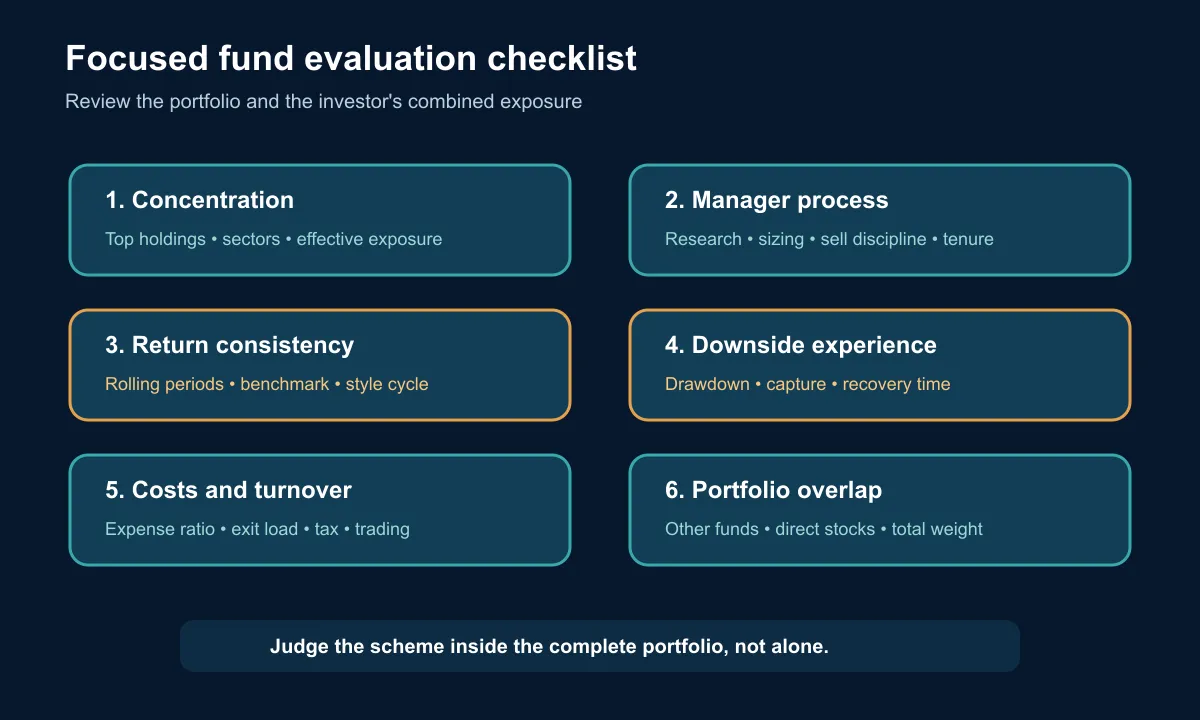
Use the Wright Research analysis tools to inspect holdings and overlap. For a focused equity fund, calculate how much of the investor's total portfolio sits in the scheme's largest positions after combining every fund and direct stock.
Do not choose a focused fund simply because it recently topped a performance table. The relevant question is whether its repeatable process, concentration and downside characteristics fit the overall allocation.
See what markets are pricing in
Live indices, sector moves and market breadth — the backdrop to every story we publish.
FAQ
Can focused mutual funds invest across large-cap, mid-cap and small-cap stocks?
Yes, when the scheme mandate permits a multi-cap approach. Some schemes may state a specific large-, mid- or small-cap focus, so read the Scheme Information Document and latest portfolio.
How many focused funds should an investor hold in a diversified portfolio?
There is no universal number. Holding several can recreate a broad portfolio while adding fees and overlap. Examine combined holdings and the role each scheme serves before adding another.
Can a focused fund be used as a satellite allocation instead of a core holding?
Yes. A limited satellite allocation around a diversified core can make the concentration explicit. Suitability still depends on risk capacity, horizon, portfolio overlap and manager confidence.
Should investors use SIPs to invest in focused mutual funds?
An SIP can reduce the risk of investing the entire amount on one date and encourage discipline. It does not protect against losses or reduce the scheme's underlying concentration.
The practical focused fund meaning is concentrated decision-making. The structure can reward skill, but it also magnifies mistakes. Evaluate the portfolio as part of the investor's complete allocation, not in isolation.
For education only, not investment or tax advice. Regulations and tax rules can change. Consult a SEBI-registered investment adviser and qualified tax professional where appropriate.


