

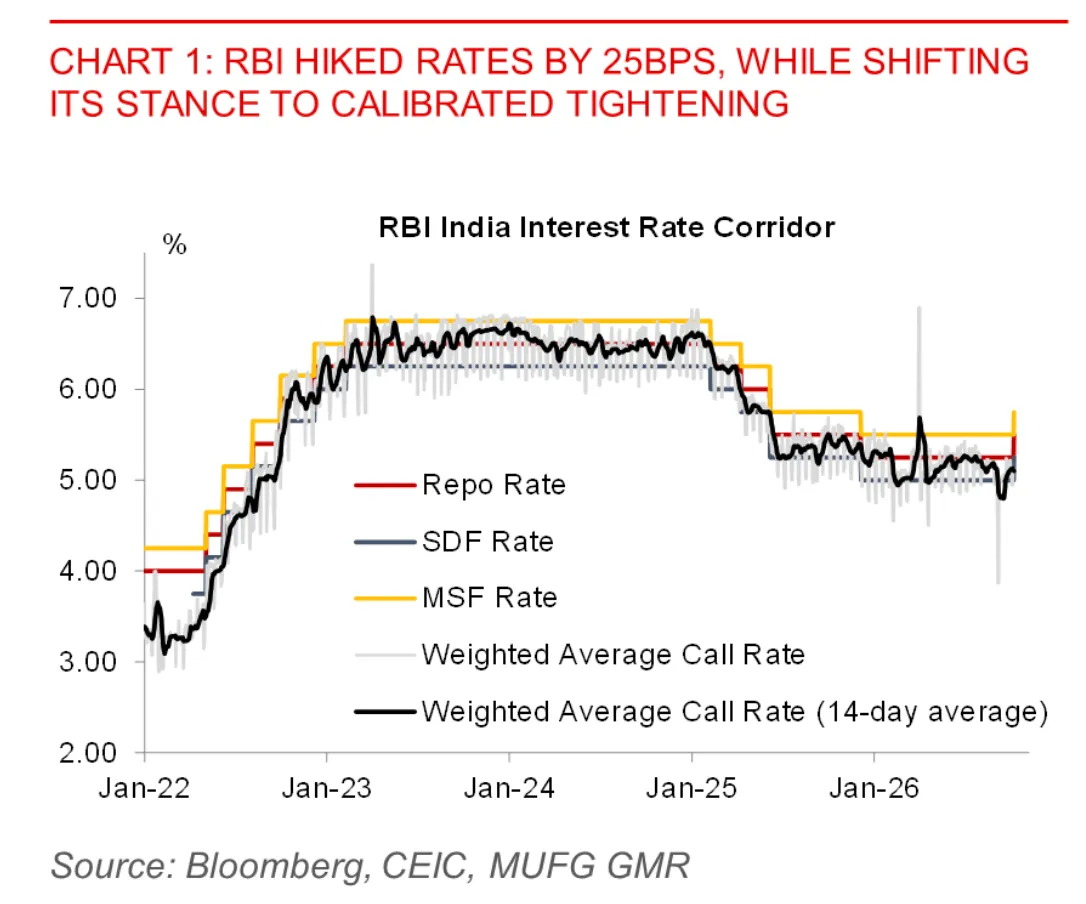
On 7 October 2026, the Reserve Bank of India raised its repo rate by 25 basis points to 5.50%. It was the first increase since February 2023, and it came with a change in stance from neutral to calibrated tightening. Governor Sanjay Malhotra said rate cuts are off the table in the near term, which leaves a hike or a pause as the only options at the next meeting.
The decision sits where three pressures meet. Oil prices have climbed again as the conflict in West Asia re-escalated. The US Federal Reserve has started raising rates. Global investors have spent most of 2026 moving money out of India and into markets tied to artificial intelligence and semiconductors. This article looks at what the RBI is trying to achieve, how markets have responded, and what a higher cost of money can realistically do for India in this setting.
Why did the RBI raise rates in October?
The RBI raised rates because inflation is rising and spreading, growth is strong enough to absorb tighter policy, and a higher US rate has put pressure on the rupee.
Inflation is spreading beyond food and fuel
The RBI now projects consumer price inflation at 5.2% for FY27, up from 5.0% in August. It expects inflation to peak at 6.0% in the October to December quarter, the upper edge of its tolerance band, and to stay at 5.6% in April to June 2027. Core inflation, which excludes food and fuel, rose to 4.2% in August after three flat months. That shift matters because it shows higher energy costs feeding into the prices of other goods and services.
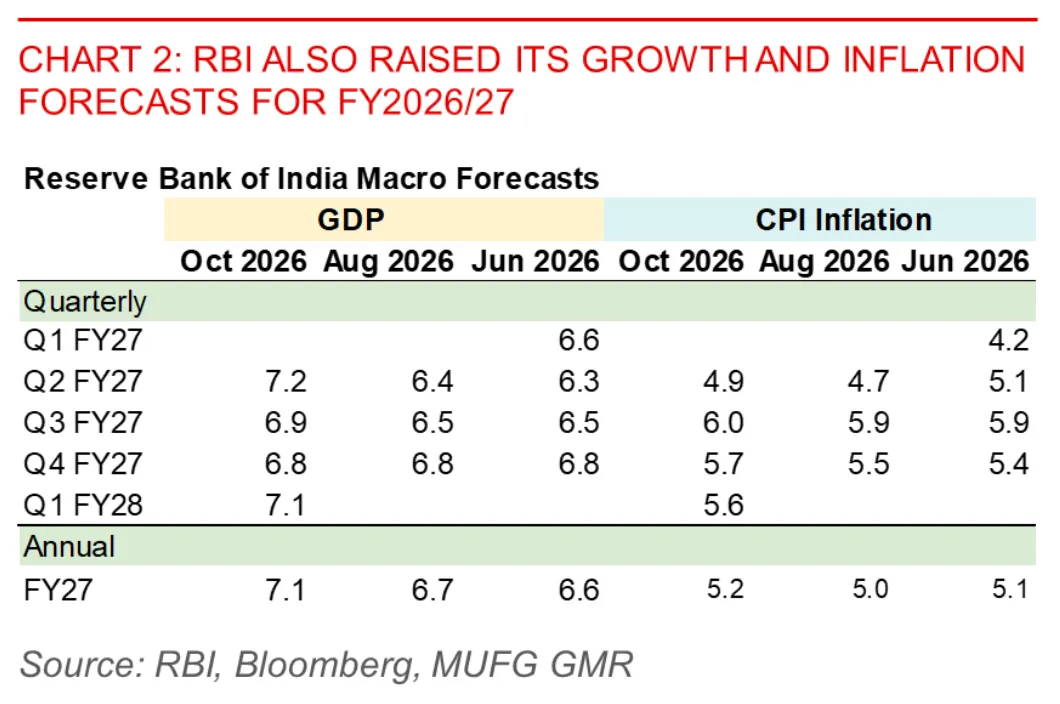
Growth gave the RBI room to act. First-quarter GDP growth of 7.8% beat the central bank's own forecast, and the FY27 growth projection was raised to 7.1% from 6.7%. Strong growth and rising inflation together make a straightforward case for tightening, and the Committee chose to move before the inflation peak arrives.
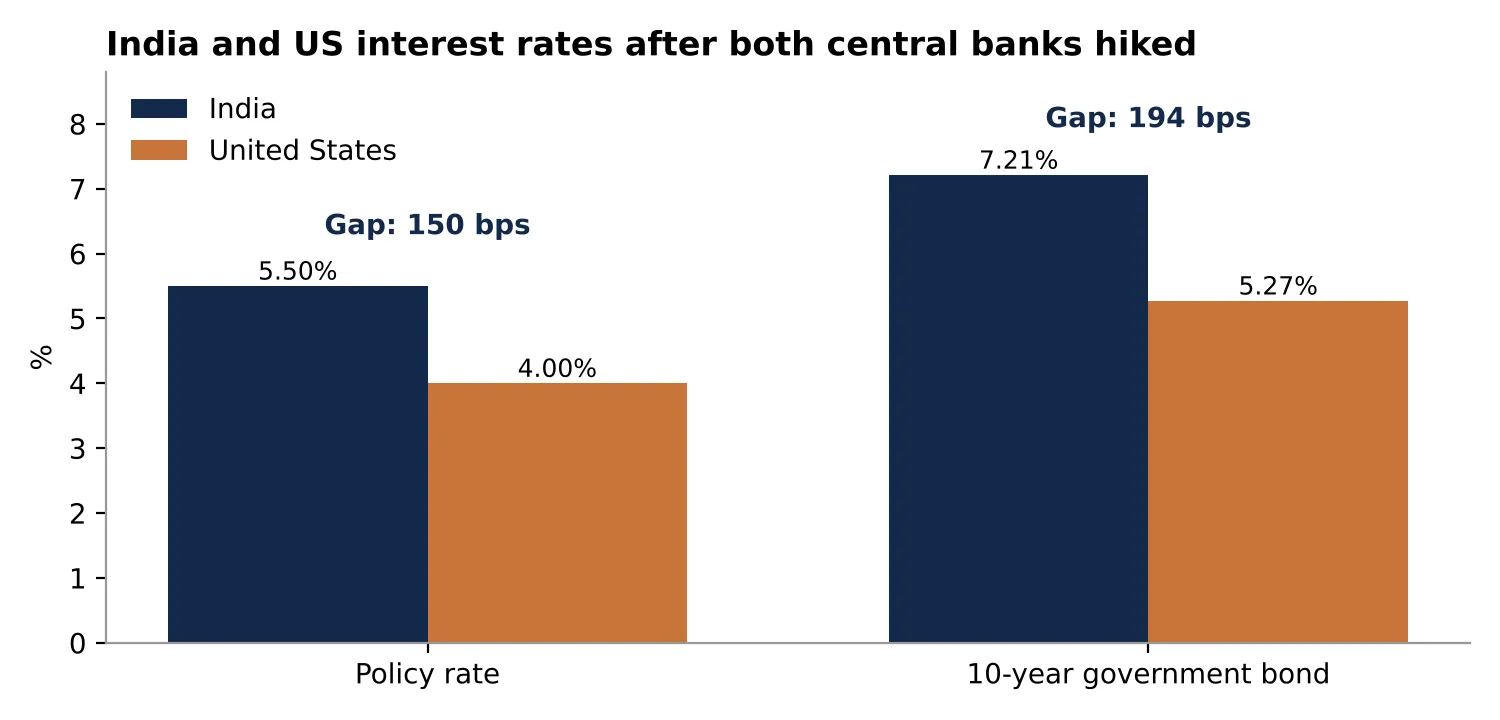
The Federal Reserve raised its target range to 3.75% to 4.00% on 16 September, its first increase since 2023, and its projections point to one more hike this year. US 10-year Treasury yields are near 5.3%. Higher US returns draw money toward dollar assets. The rupee stood at 96.47 per dollar on 7 October, about 7% weaker than at the start of the year. Keeping the gap between Indian and US interest rates intact is now part of how the RBI defends the currency.
Check the macro backdrop
GDP, inflation, rates and more — India’s key economic indicators in one dashboard.
Is the world returning to tighter money?
Yes. Central banks that spent 2024 and 2025 cutting rates have reversed course in 2026. Hours after the Fed's September decision, the Hong Kong Monetary Authority raised its base rate for the first time since 2023. The Bank of Korea is expected to hike again in November, and the Bank of Japan is moving toward a policy rate last seen in 1995. Headline inflation in the Philippines reached 7.2% in September.
Energy is the common thread
Brent crude has traded near US$100 a barrel for much of the second half of 2026, as shipping through the Strait of Hormuz remains disrupted. That corridor carries most of South Korea's crude imports, which ties the world's memory chip supply to the same oil shock that is lifting inflation in India.
AI spending is a second source of price pressure
Bank of Japan Governor Kazuo Ueda listed AI-related demand alongside import costs as an upside risk to inflation. The scale of that demand is large. Global chip sales are forecast at about US$1.5 trillion in 2026, close to double the 2025 total, and the four largest US cloud and platform companies plan about US$730 billion of capital spending this year. That spending lifts demand for power, construction and equipment across several economies, which adds to pressure on prices and interest rates.
Tighter money meets a crowded listing calendar
Higher rates arrive while public markets are being asked to absorb very large AI-linked listings. SpaceX listed in June at a valuation of US$1.77 trillion and then fell sharply. Anthropic is preparing a listing that could value it near US$2 trillion, and OpenAI is raising private money at US$1.4 trillion. Rising bond yields raise the return investors require from these stocks. A repricing of AI valuations would reach every market that has benefited from the AI trade, and every market that has funded it.
Why has foreign money been leaving India?
Foreign money has been leaving India because global funds want exposure to AI hardware, and India's listed market has very little of it. Foreign portfolio investors sold a record ₹3.05 lakh crore of Indian equities in the first nine months of 2026. The selling continued into October, with foreign investors net sellers for eight straight sessions before the policy decision.
Capital has followed the chip supply chain
Much of this money went to markets at the centre of AI hardware. Taiwan, home to about 90% of the world's most advanced logic chip production, overtook India as the world's fifth-largest stock market in May. South Korea, whose two memory makers hold roughly 80% of high bandwidth memory output, moved ahead a week later after its Kospi index more than doubled this year. Global funds treated India as a source of cash to pay for those positions.
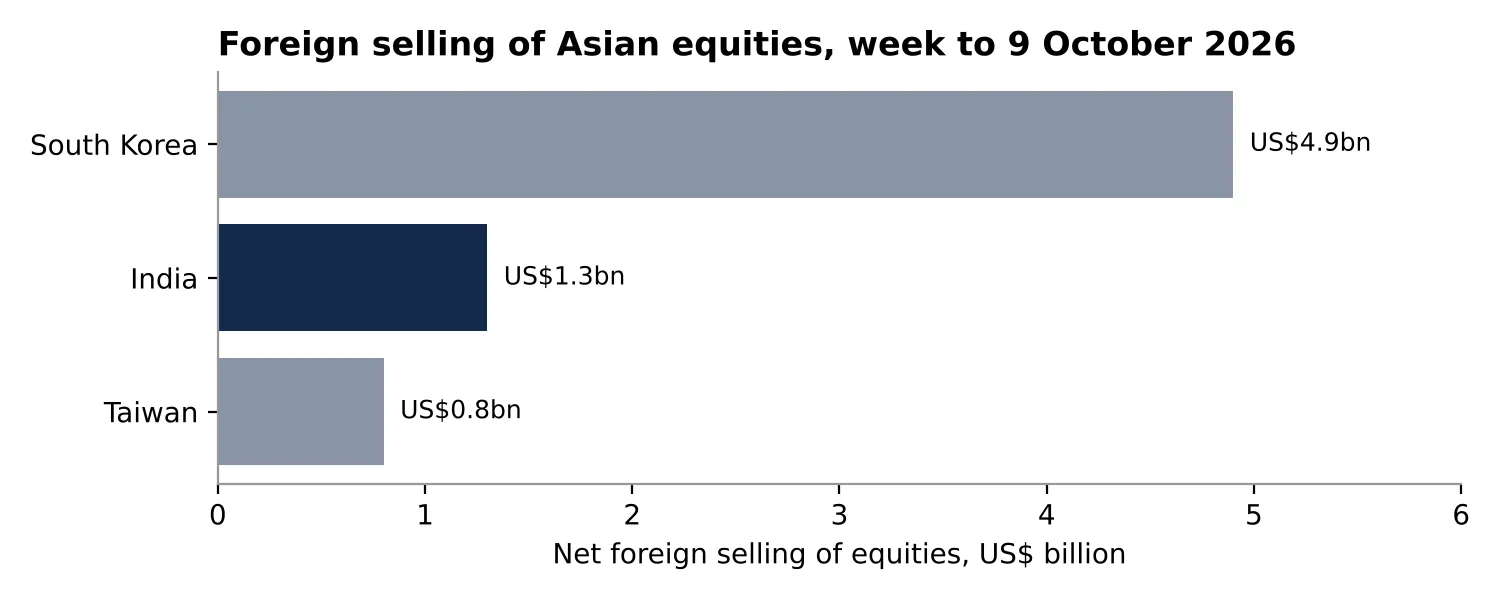
The latest weekly data shows the selling is regional. South Korea had the largest outflows as investors took profit in chip stocks. India's outflows are smaller in dollar terms, but they have persisted for most of the year and arrive alongside an expensive oil import bill, which compounds the pressure on the rupee.
Get research like this in your inbox
The week’s research that mattered, in five minutes. Joined by 2L+ investors.
Can a higher repo rate bring investors back?
A higher repo rate helps hold bond investors and steady the rupee. Bringing equity investors back depends on earnings and on how the AI trade performs.
The rate gap protects the currency
After the hike, India's 10-year government bond yields 7.21%, about 194 basis points above the US 10-year Treasury. Preserving that gap gives foreign bond investors a reason to stay and limits outflows that would weaken the rupee and raise the cost of imported fuel.
Markets expect more than the RBI has signalled
The RBI has turned hawkish, though less hawkish than markets have priced. One-year swap rates in India were around 6.26% after the meeting, which implies several further hikes. Markets are expecting one more 25 basis point increase, to 5.75% in February 2027, with a risk of 6.00%. Some analysts are expecting that move earlier, at the 2 to 4 December meeting. Both point to a repo rate near 5.75% by early 2027. We also expect 10-year yields to drift toward 7.50% as the RBI sells bonds to manage liquidity.
The RBI has a large buffer
Reserves cover about 11 months of imports, and the RBI's June measures for non-resident deposits brought in close to US$140 billion. The rupee could touch 97.50 per dollar by the 3rd quarter of 2027. That is a gradual decline, with the RBI positioned to smooth sharp swings.
Equity money follows earnings
Foreign funds that sold India to buy Taiwanese and Korean chipmakers were pursuing AI-linked earnings growth. A higher Indian policy rate does little to change that calculation. Its main benefit to foreign shareholders is a steadier rupee, which reduces currency losses. A sustained return of equity money depends on stronger Indian earnings, lower crude prices or a cooling in AI valuations elsewhere.
How did Indian stocks react to the hike?
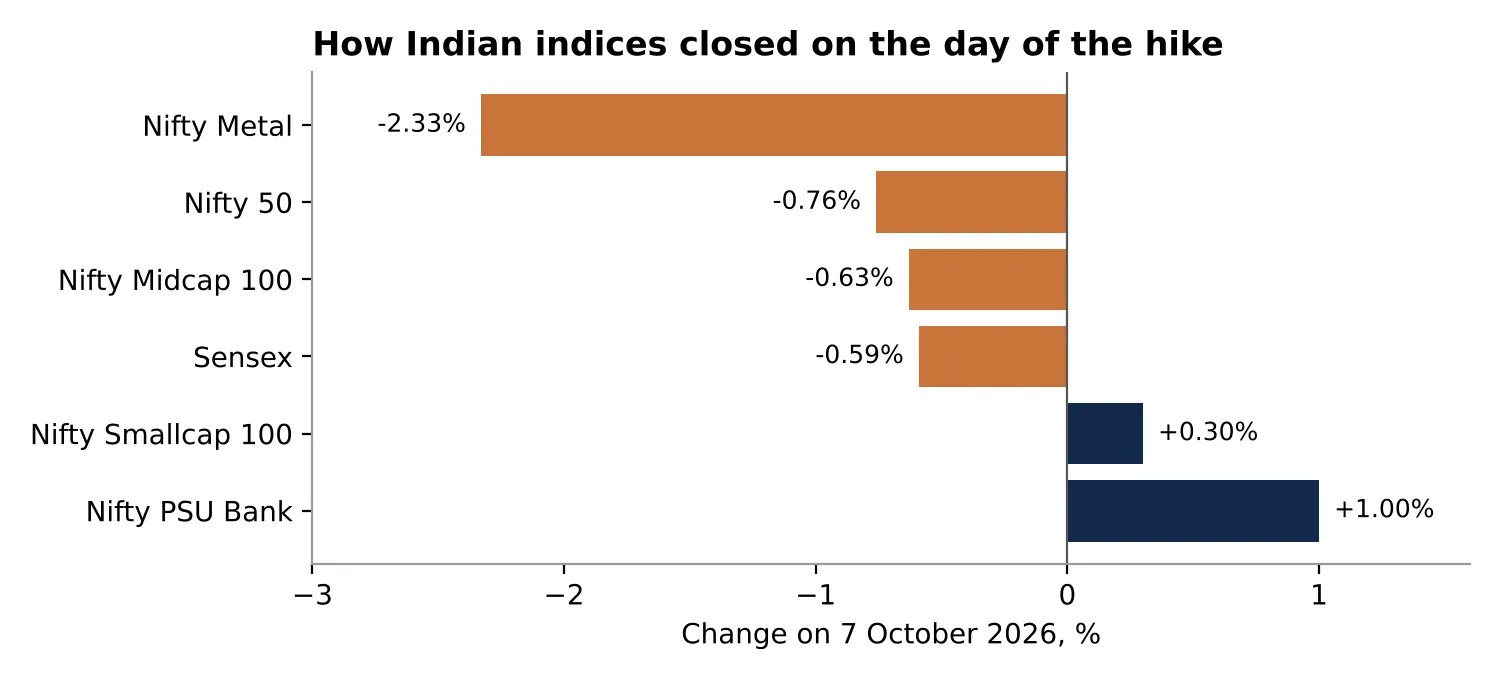
Indian stocks fell modestly, and the change in stance moved prices more than the hike itself. The Sensex fell 0.59% to 72,638.70 on 7 October and the Nifty 50 fell 0.76% to 22,603.05. Brokers said the 25 basis point increase was expected. The shift to calibrated tightening signalled a turn in the rate cycle, and that drove the selling. The market had already fallen for eight consecutive weeks before the meeting.
Banks gained while borrowers' sectors fell
Sector moves followed the mechanics of a rate hike. The Nifty PSU Bank index rose 1%, and private lenders such as Kotak Mahindra Bank and ICICI Bank gained, because loans linked to the repo rate reprice faster than deposits and lending margins widen. Metals fell 2.33%, the weakest sector on the day, and real estate, autos and consumer stocks also declined. These businesses rely on borrowing and on household spending, both of which tighten as rates rise.
Indian IT services face a separate pressure. Investors have repriced the sector this year as AI agents automate testing, documentation and routine coding work. A weaker rupee raises the value of their dollar revenue, which offers some support, but the sector's valuation now depends on how quickly it wins AI implementation work.
What does the hike mean for households and companies?
For most households, the hike means slightly higher loan payments now and better deposit rates over the coming months.
Group | What changes | What to expect |
|---|---|---|
Home and MSME borrowers | Repo-linked loans reprice at the next reset | Higher EMIs now, and again if the RBI hikes in December or February |
Savers | Banks raise term deposit rates with a lag | Gradually better returns on fixed deposits through H2 FY27 |
Bond investors | Short-term yields have moved up 25 basis points | Shorter maturities preferred until inflation peaks |
Banks | Loan yields rise faster than deposit costs | Wider margins in the near term |
Rate-sensitive sectors | Real estate, autos and consumer durables face costlier credit | Slower demand if rates keep rising |
Importers and exporters | A weaker rupee raises import costs and lifts export earnings | Higher fuel costs, support for IT and pharma revenue |
The broader economy is strong enough to absorb a modest increase. The RBI expects growth above 6.5% in every quarter through mid-2027. The main domestic risk is food. Kharif sowing is slightly below last year, and El Niño conditions could hurt the winter crop. A poor harvest would add to inflation and keep the RBI tightening for longer.
See what markets are pricing in
Live indices, sector moves and market breadth — the backdrop to every story we publish.
What will decide the RBI's next move?
The next move depends on two inflation prints, the Fed and the price of crude. The calendar below covers the events that will shape the December decision and the direction of foreign flows.
Date | Event | Why it matters |
|---|---|---|
Mid-October | India September CPI and trade data | First test of the RBI's revised inflation path and the oil import bill |
21 October | RBI MPC minutes | Reasoning of the two members who opposed the change in stance |
27 to 28 October | US Federal Reserve meeting | A further Fed hike would widen pressure on the rupee |
Late October | Big Tech earnings | Capital spending plans for 2027 and the strength of the AI trade |
Mid-November | India October CPI | Last inflation print before the RBI decides |
Late November | Planned Anthropic listing | A test of AI valuations and of global appetite for new tech stock |
2 to 4 December | RBI MPC meeting | Some experts expect a hike to 5.75%, others are expecting it in February 2027 |
Two developments would argue for a pause at 5.50%: a durable de-escalation in West Asia that brings crude down, or September and October inflation running below the RBI's revised path. A sharp fall in AI stocks after the large US listings would also change the flow picture, because funds that left India for AI markets would need a new destination.
The October hike is a defensive move. It addresses imported inflation and protects the rupee as the Fed tightens and oil stays expensive. The structural reason money has left Indian equities in 2026 lies elsewhere: global investors want AI exposure, and India's listed market offers little of it. Over the coming months, the cost of capital in India will rise. The return on that capital will depend on events outside the RBI's control, from the price of crude to the reception of the next trillion-dollar AI listing.


