


An employer can offer the National Pension System as part of an employee's retirement benefits while contributions accumulate in the employee's own Permanent Retirement Account Number. The account remains market-linked and portable, rather than becoming an employer-owned pension pool.
This guide explains corporate NPS, contribution mechanics, tax treatment, investment choices, job changes and the updated exit framework. Rules can depend on the employee's tax regime, service terms and accumulated pension wealth, so payroll and personal records should be checked before acting.
Corporate NPS: How the Employer-Backed Model Works
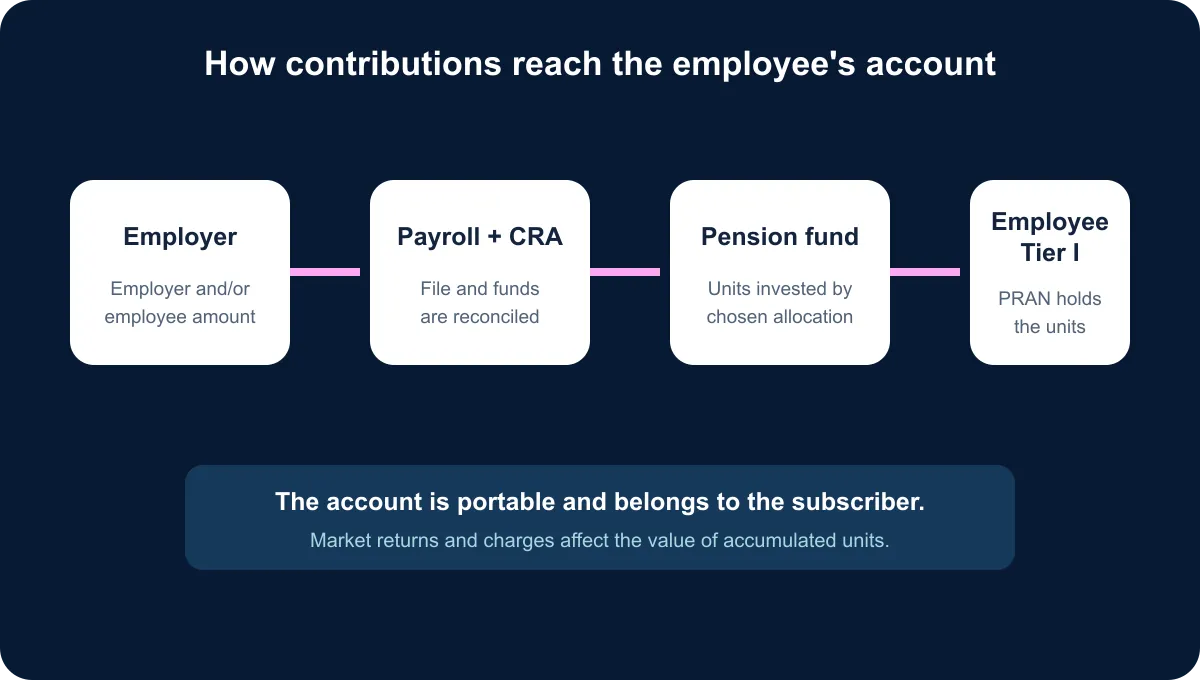
Under the Corporate Sector Model, an eligible employer adopts NPS and facilitates employee onboarding, contribution uploads and service requests through a registered Point of Presence and Central Recordkeeping Agency. Contributions buy units in selected pension-fund schemes, whose net asset values change with markets.
The key distinction is ownership. A corporate NPS Tier I account is mapped to the subscriber's PRAN. The employer helps operate the benefit, but the retirement account follows the employee across eligible jobs and locations. The arrangement can sit alongside provident fund, gratuity and other benefits.
See what markets are pricing in
Live indices, sector moves and market breadth — the backdrop to every story we publish.
What Is the NPS Corporate Sector Model?
PFRDA classifies non-government NPS accounts based on an employer-employee relationship under the Corporate Sector Model. Contributions may come from the employer, the employee or both, in proportions set by company policy and applicable law.
The employer completes institutional onboarding, while the employee completes subscriber KYC and receives or maps a PRAN. An employer NPS scheme is therefore an access and contribution arrangement within the regulated NPS architecture, not a guaranteed-return product. Pension funds invest according to the chosen scheme and regulatory limits.
Who Is Eligible?
An employer eligible under PFRDA's corporate framework can adopt the model for employees covered by its policy. PFRDA's current corporate FAQ also describes resident individuals, NRIs and OCIs among potential subscribers, subject to account, KYC, banking and regulatory conditions.
Employees should not assume automatic coverage. Company policy may specify eligible grades, joining windows, contribution rates or salary components. Corporate NPS registration normally requires subscriber details, PAN, address and bank evidence, and may be completed through the employer's chosen service channel.
How Employer and Employee Contributions Work
The company decides whether contributions are employer-only, employee-only or shared. Payroll deducts the agreed employee amount and uploads it with any employer amount. The CRA records units against the subscriber's PRAN after funds and contribution files reconcile.
An NPS employer contribution is not the same as the employee's own salary deduction. The distinction matters for payslips, tax treatment and reconciliation. Employees should compare monthly payroll entries with the CRA transaction statement and promptly report missing credits.
| Contribution source | Operational treatment | Main employee check |
|---|---|---|
| Employer | Deposited under company policy into Tier I | Amount agrees with salary structure and CRA statement |
| Employee through payroll | Deducted from pay and uploaded | Deduction and unit credit match |
| Employee voluntarily | Added through an available NPS channel | Correct PRAN and transaction acknowledgement |
The NPS employer contribution rate is a benefit-policy decision subject to tax and payroll limits. It is not automatically 10% or 14%; those percentages primarily cap deductions in specified tax contexts rather than compelling an employer to contribute that amount.
Tax Benefits of Corporate NPS
Section 80CCD(2) permits a deduction for qualifying employer contributions. For assessment year 2026-27, the Income Tax Department states that the limit under the new tax regime is 14% of salary for all employer categories. Under the old regime it is generally 10% for a private or other non-government employer and 14% for Central or State Government employers. “Salary” has a specific tax definition, so payroll calculations should not use total CTC automatically.
These corporate NPS tax benefits are separate from an employee's own deductions. Under the old regime, eligible personal NPS contributions may fall under Section 80CCD(1), within the combined ₹1.5 lakh ceiling, and Section 80CCD(1B), up to an additional ₹50,000. Most Chapter VI-A deductions, including those personal NPS deductions, are unavailable under the new regime, while 80CCD(2) remains available.
| Tax item | New regime | Old regime |
|---|---|---|
| Qualifying private-employer contribution under 80CCD(2) | Up to 14% of defined salary | Generally up to 10% of defined salary |
| Eligible employee contribution under 80CCD(1) | Generally unavailable | Within combined ₹1.5 lakh limit |
| Additional eligible employee contribution under 80CCD(1B) | Generally unavailable | Up to ₹50,000 |
The combined employer contribution to recognised provident fund, NPS and approved superannuation fund also interacts with the ₹7.5 lakh annual perquisite threshold and related accretion rules. This makes corporate NPS tax benefits fact-specific. Employees should obtain payroll or tax advice rather than relying only on a contribution percentage.
Get research like this in your inbox
The week’s research that mattered, in five minutes. Joined by 2L+ investors.
Corporate NPS vs EPF and Other Retirement Benefits
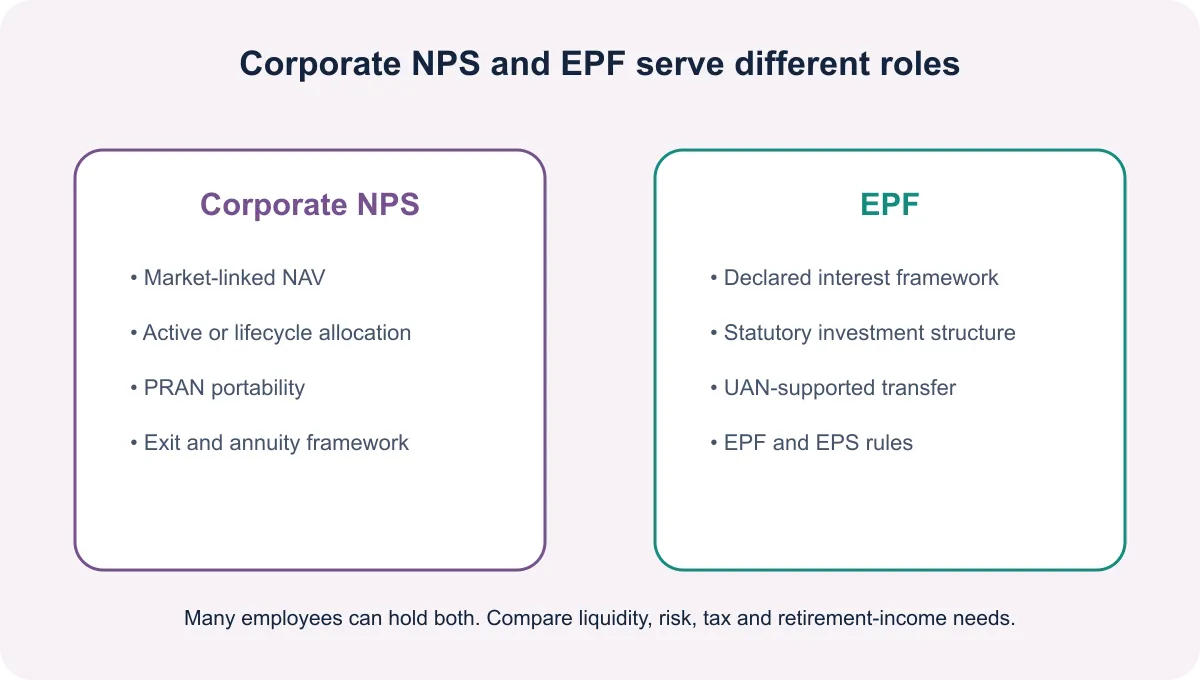
The NPS vs EPF choice is not always either-or. An employer can offer both, and each serves a different role. EPF operates under provident-fund law with a declared interest framework and prescribed contribution rules. NPS is market-linked, offers asset-allocation choices and applies its own exit rules.
| Feature | Corporate NPS | EPF |
|---|---|---|
| Return | Market-linked NAV | Interest declared under EPF framework |
| Investment choice | Active or lifecycle options | Managed under EPF rules |
| Portability | PRAN follows subscriber | UAN supports transfers |
| Retirement payout | Corpus-based lump sum, systematic withdrawal and annuity rules | EPF withdrawal and EPS rules apply separately |
| Main tax route | Sections 80CCD(1), 80CCD(1B) and 80CCD(2), as applicable | EPF-specific contribution and withdrawal provisions |
An NPS vs EPF comparison must also consider volatility, liquidity, annuity needs and the employee's total retirement allocation. NPS may diversify retirement sources but does not replace the need for emergency liquidity.
Investment Options and Fund Management
Under current common schemes, Active Choice permits up to 75% equity, while corporate bonds and government securities can each be selected up to 100%, provided total allocation remains 100%. Auto Choice uses age-linked lifecycle allocations that generally reduce equity exposure with age.
Either the employer or employee may initially exercise the pension-fund and allocation choice under the corporate setup. If the employer exercises it, PFRDA says the employee can revise the choice after one year. Thereafter, investment choice can generally be changed four times per financial year and the pension fund once per financial year.
These corporate NPS benefits include choice and portability, but returns are not guaranteed. Compare pension funds within the same asset class and period, and review risk rather than selecting only the latest leader.
What Happens When You Change Jobs?
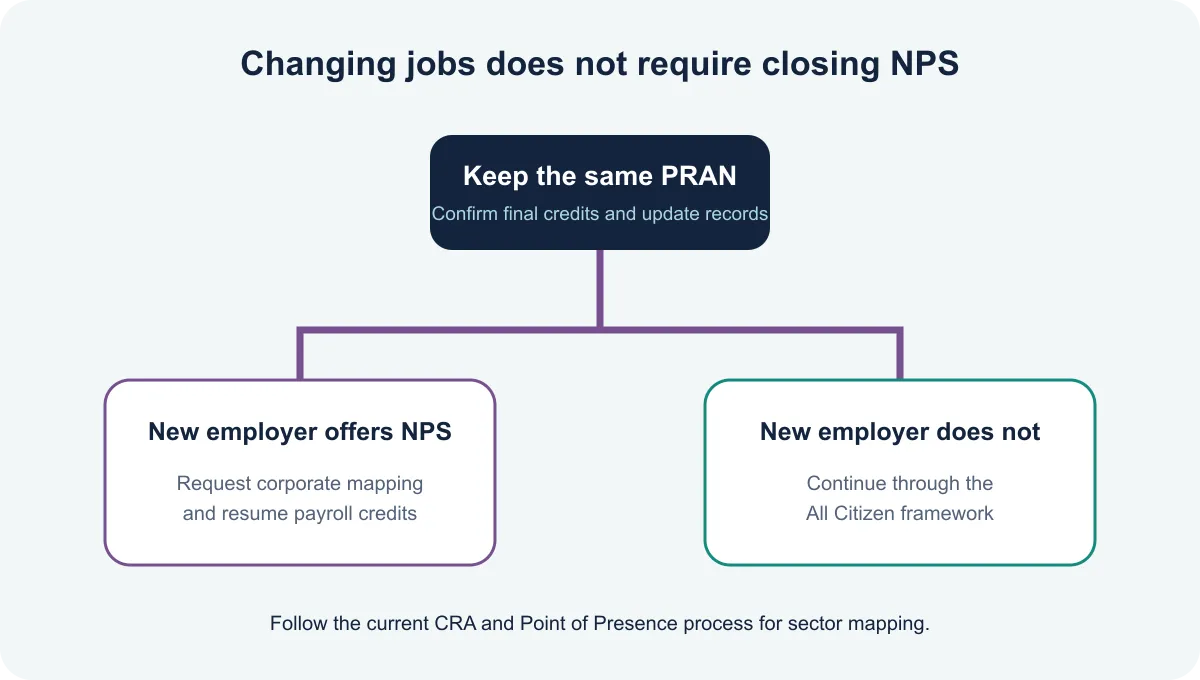
The PRAN is portable. When joining another employer that offers NPS, the employee can request sector or employer mapping through the relevant service process instead of opening a duplicate Tier I identity. If the new employer does not offer the benefit, the subscriber can generally continue under the All Citizen framework and contribute individually.
Before leaving, download the transaction statement, confirm the final NPS employer contribution, update contact and bank details, and record pending payroll credits. Do not close the account merely because employment ends. A portable corporate NPS account preserves its investment history and accumulated units.
Withdrawal and Exit Rules
The latest NPS withdrawal rules distinguish partial withdrawal, normal exit and premature exit. PFRDA's March 2026 corporate guidance links normal-exit choices to accumulated pension wealth. For corpus above ₹12 lakh, the broad option is up to 80% lump sum or approved phased withdrawal and at least 20% annuity; smaller corpuses have additional full-withdrawal or systematic-unit-redemption options.
Premature-exit treatment depends on subscription period and corpus. Current PFRDA material states that an exit before completing three years generally requires at least 80% for annuity and permits 20% lump sum, while an exit after completing three years generally requires at least 40% for annuity and permits 60% lump sum, subject to small-corpus exceptions and the operative regulations.
Because NPS withdrawal rules were updated, employees should verify the latest PFRDA matrix at the date of exit. Tax treatment of the lump sum, annuity purchase and later pension income must be assessed separately.
Is your portfolio built for what’s coming?
Get a free AI-powered review of your holdings — risk, overlap and quality in minutes.
FAQ
Can employees make voluntary contributions to a Corporate NPS account?
Yes. Employees can generally add personal contributions to their Tier I account through supported channels, in addition to payroll or employer amounts. The tax result depends on the chosen tax regime and applicable deduction provisions.
How can employees verify employer contributions in their NPS account?
Compare the payslip and employer contribution schedule with the CRA transaction statement. Check the contribution month, amount, unit-credit date and PRAN. Raise discrepancies with payroll and the designated NPS service channel.
What happens if an employer delays or stops Corporate NPS contributions?
First verify the employment policy, payslip deductions and CRA statement. Escalate an unexplained delay through payroll or HR and the relevant Point of Presence or CRA grievance mechanism. The response depends on whether the amount was contractually due or deducted from salary.
Can an employee hold both an individual NPS account and a Corporate NPS account?
NPS is designed around the subscriber's PRAN and portable sector mapping. An existing account can generally be mapped to the corporate setup rather than creating a duplicate identity. From October 2025, non-government subscribers may access multiple approved schemes under updated PFRDA arrangements, but the employee should follow CRA and employer procedures.
The strongest corporate NPS benefits are portability, regulated market-linked investing and a separate employer-contribution deduction. Their value depends on contribution policy, tax regime, allocation, time and exit planning. A retirement advisory review can coordinate NPS with other assets, financial calculators can test contribution scenarios, and a portfolio management perspective can help place retirement capital within the wider household plan.


