


Claiming a deduction you qualify for, relying on an artificial arrangement and deliberately hiding income are three different things. All can lower the tax shown on a return, but the facts behind that reduction determine whether you can defend it.
For Indian investors, tax evasion vs tax avoidance is more than a terminology question. It affects what you should document before a transaction, what you must disclose at filing and what to do when you discover an error.
Tax Evasion vs Tax Avoidance: Why the Difference Matters
In a tax evasion vs avoidance comparison, start with two questions: Were the facts disclosed accurately, and does the claimed tax treatment reflect what actually happened? False reporting can point to evasion. Even if the facts are disclosed, an arrangement can still be challenged under anti-avoidance rules. A genuine transaction that meets the conditions of a relief is a different case.
See what markets are pricing in
Live indices, sector moves and market breadth — the backdrop to every story we publish.
What Is Tax Evasion?
Tax evasion means illegally escaping tax, for example by deliberately concealing taxable income or submitting false information. An honest reconciliation error is not automatically deliberate evasion, but it can still leave tax outstanding. The reason for the discrepancy and the evidence supporting your return matter when the authorities assess it.
Common Forms of Tax Evasion
For investors, examples include knowingly leaving taxable dividends off a return, fabricating an acquisition cost to shrink a capital gain, or claiming a deduction for a payment that never happened. Tax deducted at source is not a reason to omit the underlying income if you are required to report it. Likewise, an item missing from a prefilled return does not by itself remove the reporting obligation.
What Is Tax Avoidance?
Tax avoidance generally refers to arrangements designed to secure a tax advantage without the straightforward concealment or false reporting associated with evasion. That does not mean they are automatically acceptable. India’s Income-tax Act, 2025 includes the General Anti-Avoidance Rule (GAAR). Where its statutory conditions are met, the authorities can deny a benefit from an impermissible avoidance arrangement. Lack of commercial substance is one factor, not an automatic conclusion.
When reading tax avoidance examples, distinguish a genuine transaction eligible for a benefit from a contrived sequence designed primarily to obtain one. Similar tax outcomes do not make those arrangements equivalent.
Examples of Lawful Tax Planning
Examples include claiming an available deduction after checking your tax regime and retaining proof, or setting off a genuine capital loss against an eligible gain under the applicable rules. Before carrying a loss forward, check the filing deadline and other conditions. These are not aggressive tax avoidance examples simply because they reduce tax.
Use financial calculators to compare scenarios, then confirm the legal treatment separately. Wright Research’s tax-efficient investment guide for HNIs offers context on planning across a portfolio.
Get research like this in your inbox
The week’s research that mattered, in five minutes. Joined by 2L+ investors.
Tax Evasion vs Tax Avoidance: Side-by-Side Comparison
| Approach | What to look for | Possible result |
|---|---|---|
| Lawful planning | Accurate facts; genuine transaction meets the relief’s conditions | Eligible benefit can be claimed |
| Aggressive avoidance | Tax-driven structure whose substance or use of the law may be challenged | Benefit may be denied if anti-avoidance conditions apply |
| Evasion | Illegal conduct such as deliberate concealment or false claims | Tax recovery and applicable sanctions; serious cases may face prosecution |
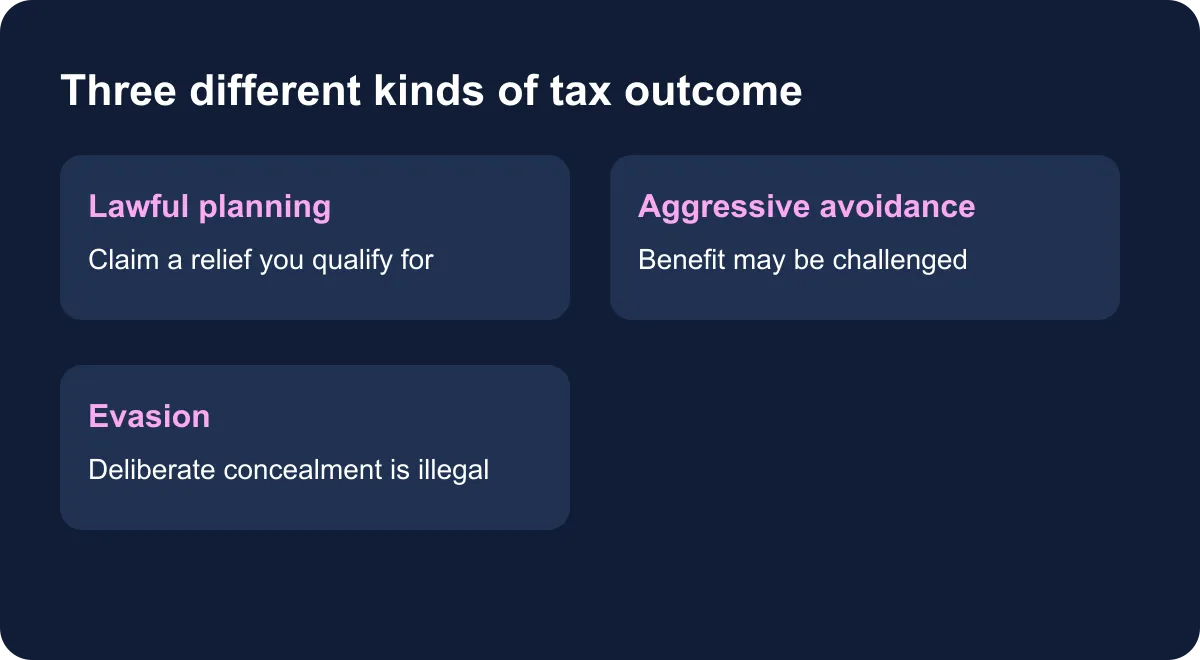
Tax Avoidance vs Tax Planning vs Tax Evasion
A useful tax planning vs tax evasion test is whether the return accurately describes the transaction and you can support the claim with records. That test is necessary, but not sufficient: an accurately reported structure may still be challenged. In a tax evasion vs tax avoidance review, keep the question of truthful reporting separate from the question of whether the arrangement qualifies for the claimed treatment.
Consequences of Non-Compliance
Tax evasion penalties depend on the provision and facts. Where Section 439 of the Income-tax Act, 2025 applies, the penalty is 50% of the tax payable on under-reported income, or 200% where that under-reporting results from misreporting. On a hypothetical ₹20,000 of tax payable on that income, the figures are ₹10,000 and ₹40,000 respectively. They are percentages of tax, not of the income omitted.
These are not universal tax evasion penalties. Statutory exclusions can matter, interest may apply separately, and prosecution is a distinct process.
How Investors Can Stay Tax Compliant
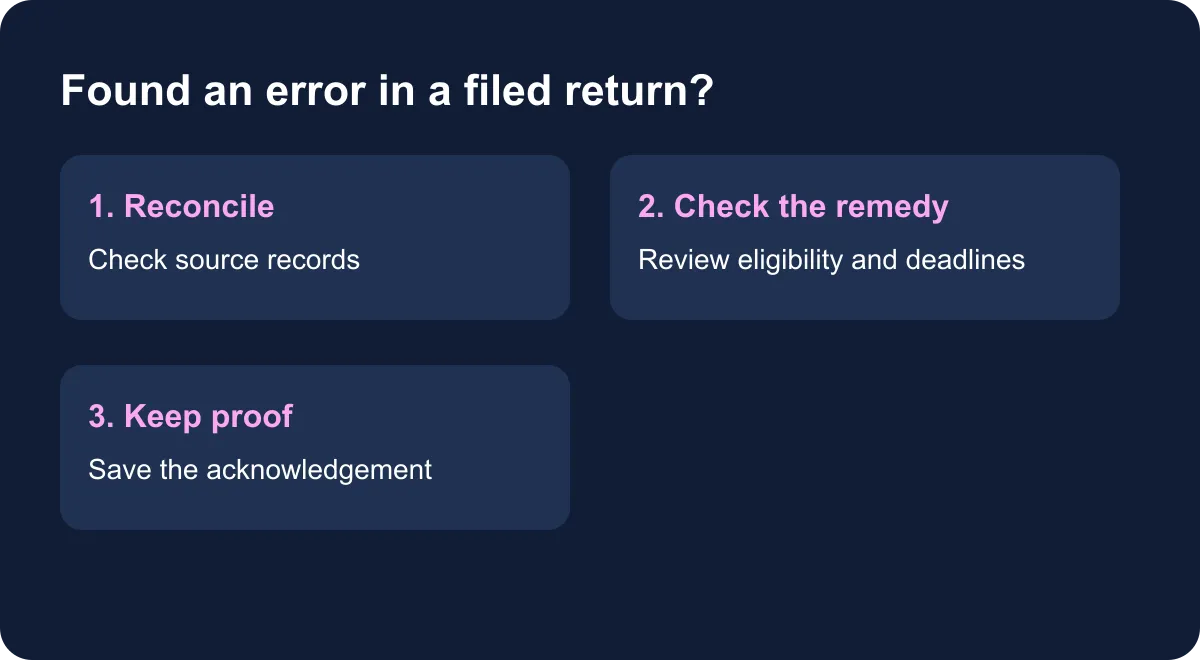
Reconcile broker, bank and fund statements with the Annual Information Statement and Form 26AS. Investigate differences rather than blindly copying prefilled figures. Keep a dated record of how you calculated gains and why you claimed each relief. Use a portfolio advisory review to coordinate investment decisions, and ask a qualified tax professional to resolve filing or legal questions.
Is your portfolio built for what’s coming?
Get a free AI-powered review of your holdings — risk, overlap and quality in minutes.
FAQ
How does tax planning differ from aggressive tax avoidance?
Planning uses reliefs on their stated terms. Aggressive avoidance may rely on a tax-driven arrangement whose substance or treatment can be challenged. The governing provisions and specific facts determine the outcome.
What should an investor do after discovering an error in a filed income-tax return?
Reconcile the figures and check whether a revised return is still available for the relevant year. If not, ask whether an updated return or another remedy applies. Updated returns have eligibility restrictions and can require additional tax.
Can an incorrect deduction claimed unintentionally lead to a tax penalty?
Yes, depending on the facts and law. A genuine mistake does not automatically amount to misreporting, but tax and interest may still be due. Evidence of a bona fide explanation and full disclosure can matter.
What records should investors keep to support investment-related tax claims?
Keep contract notes, acquisition and sale records, fund and bank statements, proof of eligible payments, tax computations and filing acknowledgements. Preserve the supporting records for any open proceeding.


