


November 2026 has turned the contest over AI chips back into a security issue. Jensen Huang resigned as Nvidia's chief executive on 12 November after reports linked him to a former executive of Megaspeed, a Singapore-based cloud company accused of supplying Chinese customers with restricted GPUs. Four days later, the US Commerce Department required export licences for advanced AI chips going to Malaysia, Singapore, Thailand, Indonesia and Brazil. Both events arrived while markets were already pricing a peak in AI capital spending. Together they change the outlook for technology stocks, for Asian growth models built on data centres, and for India, a market that spent most of the past two years on the wrong side of the AI trade.
What changed in the chip contest this month?
The focus of US policy has moved from where a chip is shipped to who ends up using it. The interim rule released on 16 November names five countries as carrying a higher-than-normal risk of diversion to China. It also adds a worldwide licence requirement for any data centre that the exporter knows will give large amounts of compute to China-headquartered companies. Shipments to US-headquartered firms can still qualify for an exemption if they meet reporting requirements.
The scale of the leakage explains the urgency. The Institute for Progress estimates that Megaspeed rented about 86,000 GPUs to Alibaba and other Chinese customers, mostly from data centres outside China. Jefferies estimates that as many as 240,000 Nvidia AI chips have been diverted to China since 2024.
Politics will add pressure. Democrats take control of Congress on 3 January. Bills already before it would require location tracking for advanced chips and push Japan and the Netherlands to adopt US export criteria. Huang was the most prominent voice in Washington for selling to China. His exit removes that voice just as the national security camp regains influence.
China has already planned around the ban
Beijing's official position is that China does not need Nvidia's top chips. Yangtze Memory Technologies plans to source as much as 70% of the equipment for its next Wuhan fab from domestic suppliers, up from just over half at its third fab. China also holds the rare earth lever. US officials said in September that China was meeting about two-thirds of its rare earth pledges under the Busan trade truce, which now expires on 10 January. The direction is toward two separate technology systems, each with its own chips, models and access to critical minerals.
Check the macro backdrop
GDP, inflation, rates and more — India’s key economic indicators in one dashboard.
Why does the AI trade look more fragile now?
Nvidia also acts as a financier of the AI build-out. Over two years it invested about US$61 billion in equity stakes across 229 startups and 13 listed companies, and extended US$164.5 billion in lease guarantees and cloud capacity backstops.
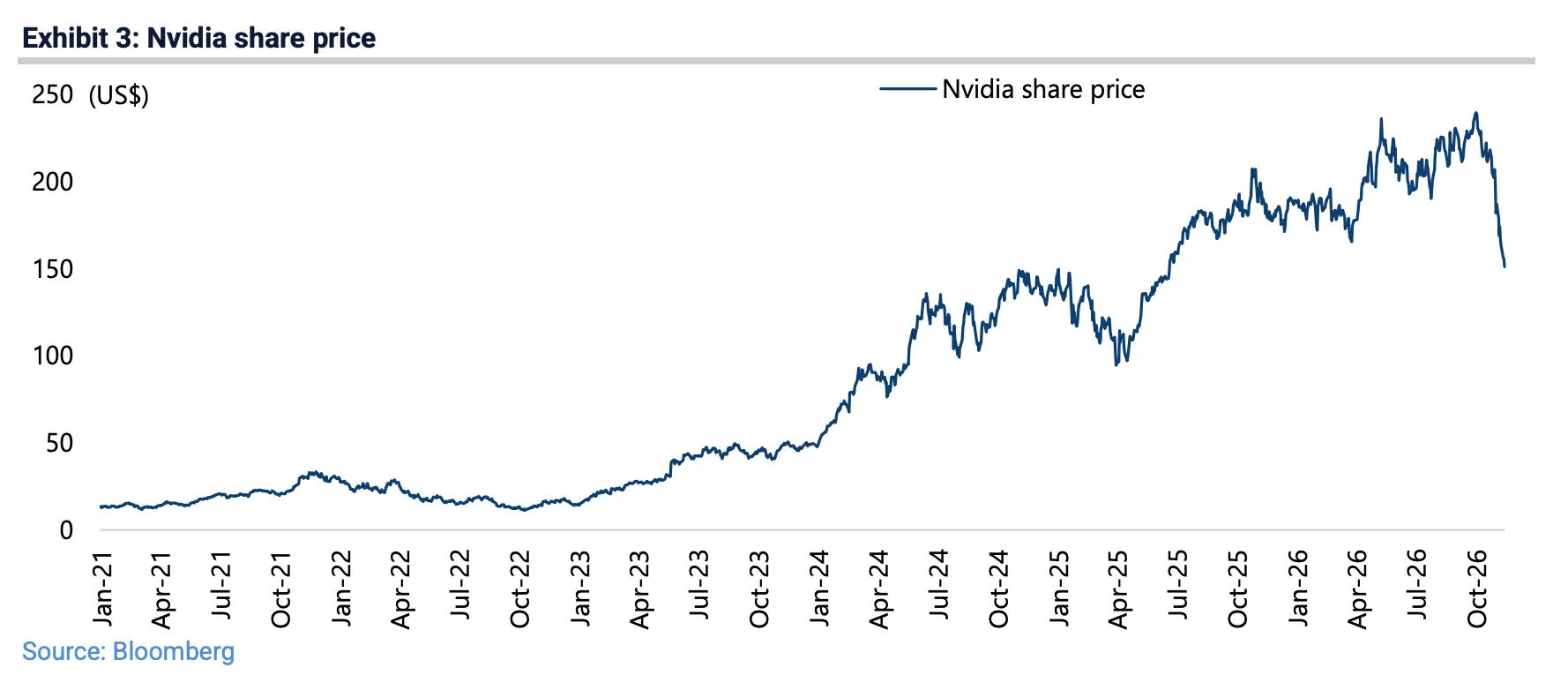
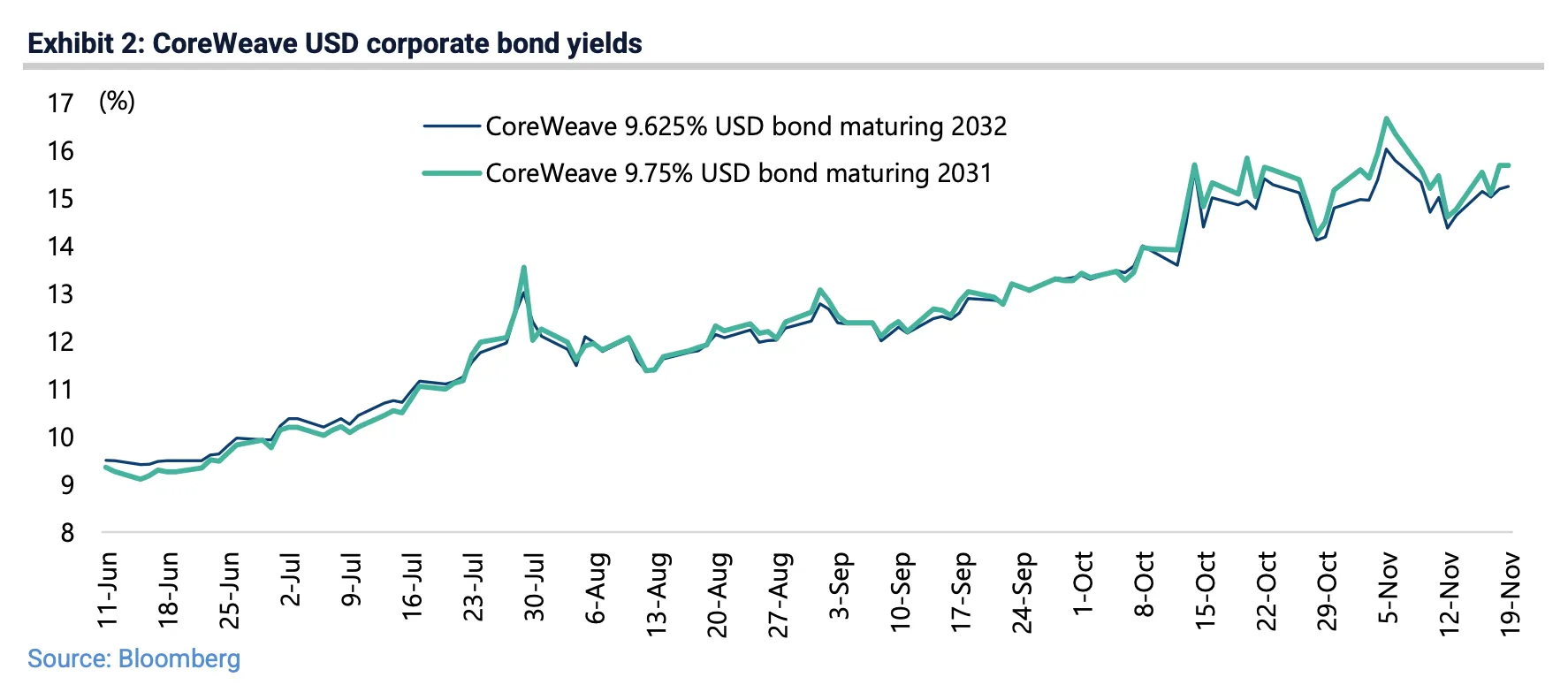
Much of that support went to neoclouds, the start-up data centre operators that compete with the large cloud providers. Interim chief executive Colette Kress, Nvidia's finance head for 13 years, reportedly had reservations about the size of this exposure. A more cautious Nvidia means tighter funding for the most speculative buyers of compute. CoreWeave's shares fell about 25% after the story broke, and its dollar bonds now yield around 15.7%.
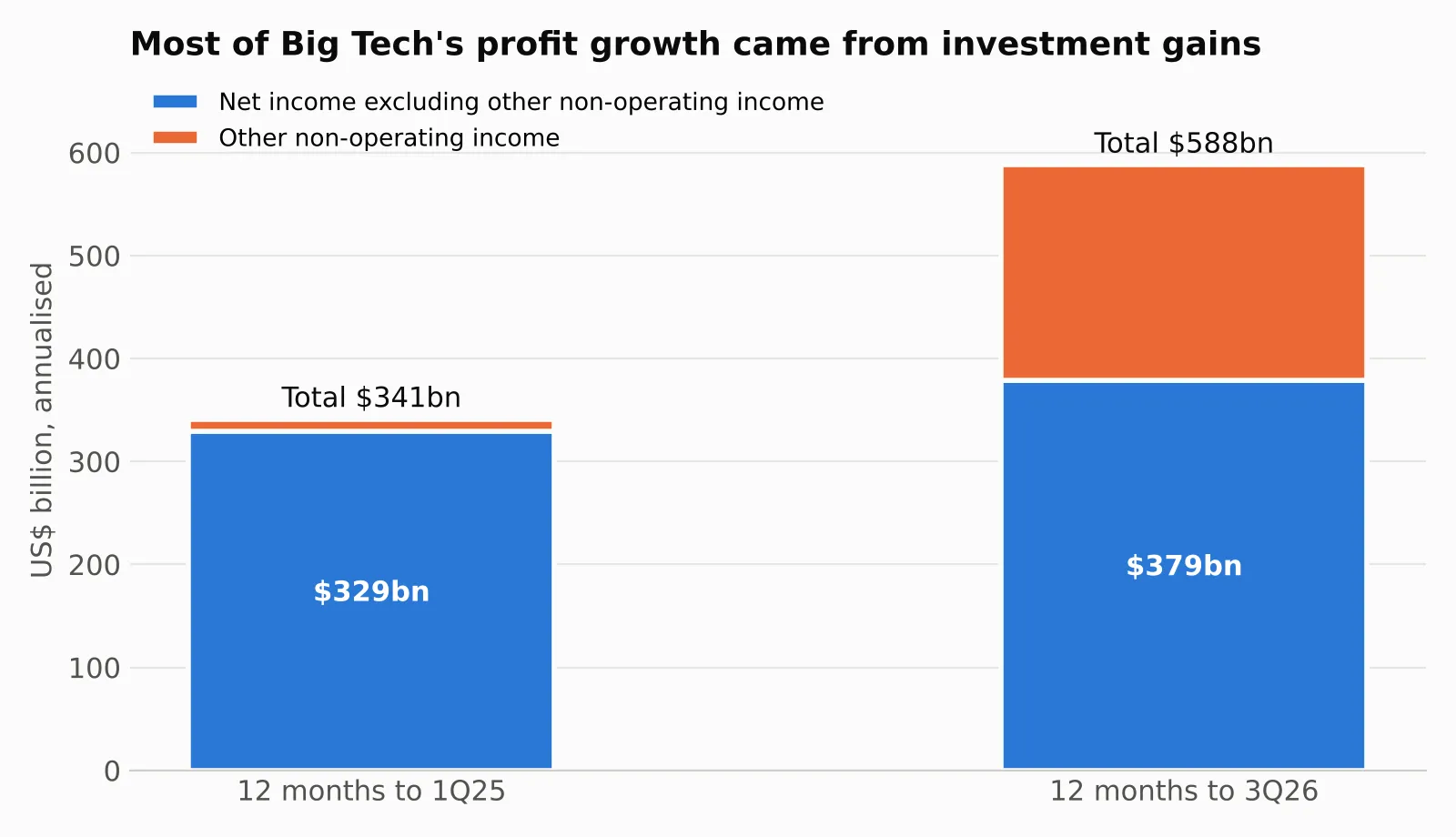
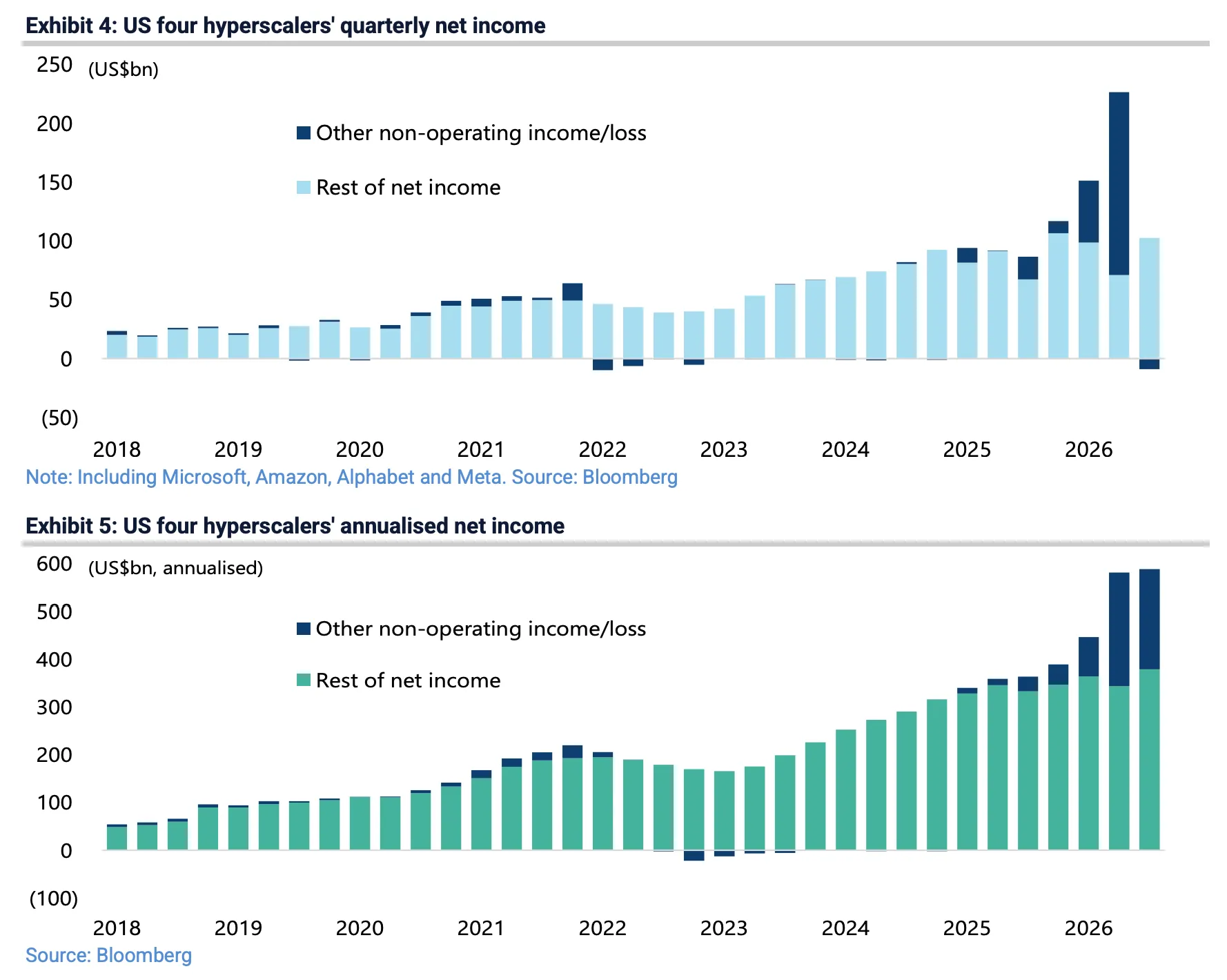
Earnings quality is the second concern. For Microsoft, Amazon, Alphabet and Meta combined, annualised net income rose from US$340 billion to US$588 billion between early 2025 and the third quarter of 2026. About US$198 billion of that increase came from other non-operating income, a line that largely reflects unrealised gains on investments, including stakes in unlisted AI companies. Excluding it, net income grew 15% over six quarters. That same line turned negative in the third quarter as AI stocks sold off.
Bonds are offering little shelter
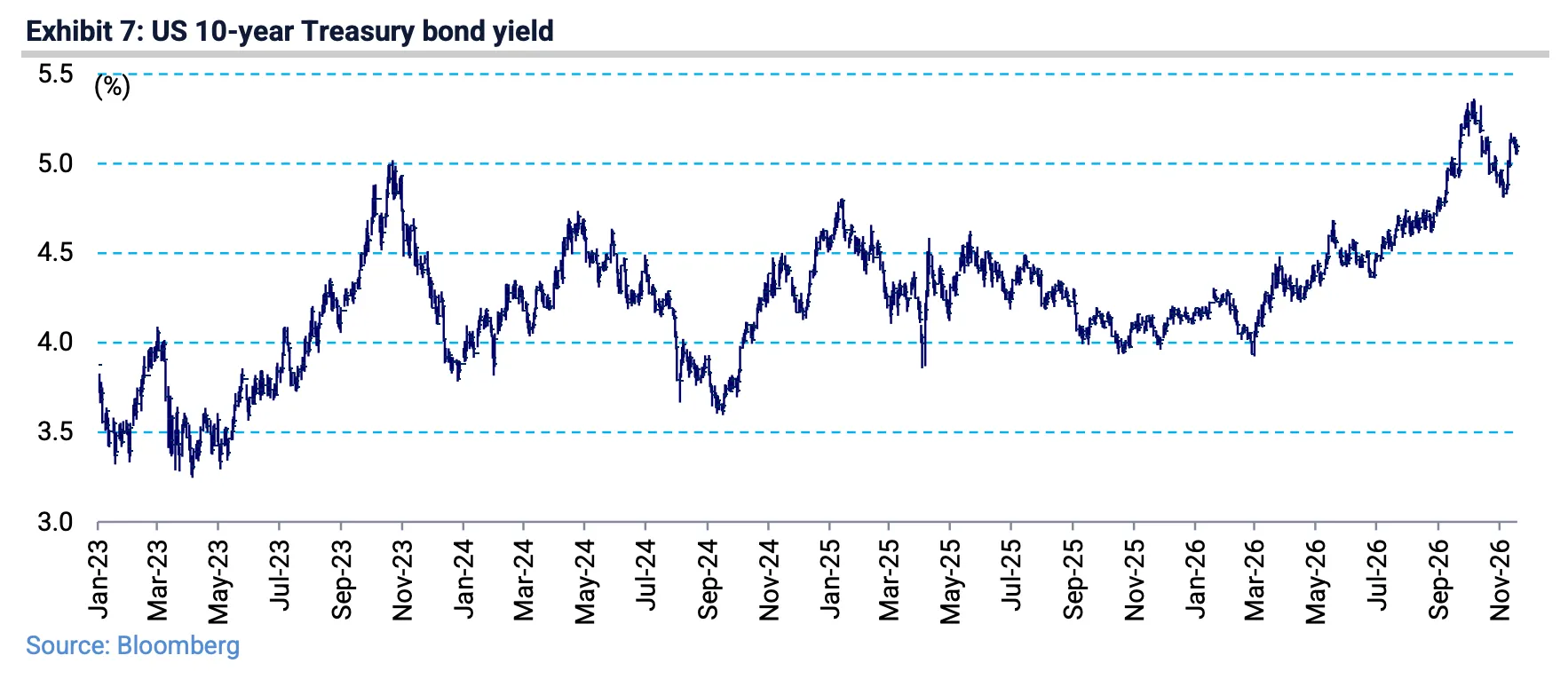
Long-dated US Treasuries usually cushion an equity sell-off. This time the 10-year yield has risen back to 5.1%, even though oil fell about 12% after the mid-term elections. The US deficit reached an annualised 6.6% of GDP in the 12 months to October, and net interest costs crossed US$1 trillion. The debt ceiling is expected to bind in February or March. Investors are turning to gold instead. Central banks bought a net 321 tonnes in the third quarter, and China added to its reserves for a 24th straight month.
How does a split in technology change the global economy?
The first effect falls on countries that grew by staying neutral. ASEAN drew US$244 billion of foreign direct investment in 2025, about 15% of the global total, and a large share of the recent wave went into data centres. Malaysia has 61 announced data centre projects with combined maximum demand of 8.35 GW, against national generating capacity of 42 GW. In Thailand, 66% of approved foreign investment in the first nine months of 2026 was in the digital category, and 93% of that came through ASEAN, mainly Singapore. Jefferies reads this as China-linked capital, and Chinese banks have funded most Thai data centres.
These are the markets now under licensing. Data centres built to serve Chinese clients face slower chip deliveries, higher compliance costs and the risk of idle capacity. Selling into both technology systems at once is becoming harder.
The second effect is cost. Global semiconductor sales are forecast at about US$1.5 trillion in 2026, produced by a small number of firms in a small number of places. Each new layer of licensing, tracking and verification adds friction to that chain. Duplicated supply chains raise the price of chips and cloud services, add modest inflation pressure, and slow the spread of AI tools to countries outside the two blocs.
Market | Status under the 16 November rule | Data centre position |
Malaysia | Export licence required | 61 announced projects, up to 8.35 GW of demand |
Thailand | Export licence required | 57 approved projects, 3.7 GW |
Singapore | Export licence required | Regional cloud hub, base of Megaspeed |
India | Not named | 1.79 GW operational, 3.86 GW more expected by 2030 |
Get research like this in your inbox
The week’s research that mattered, in five minutes. Joined by 2L+ investors.
Why did India miss the AI rally?
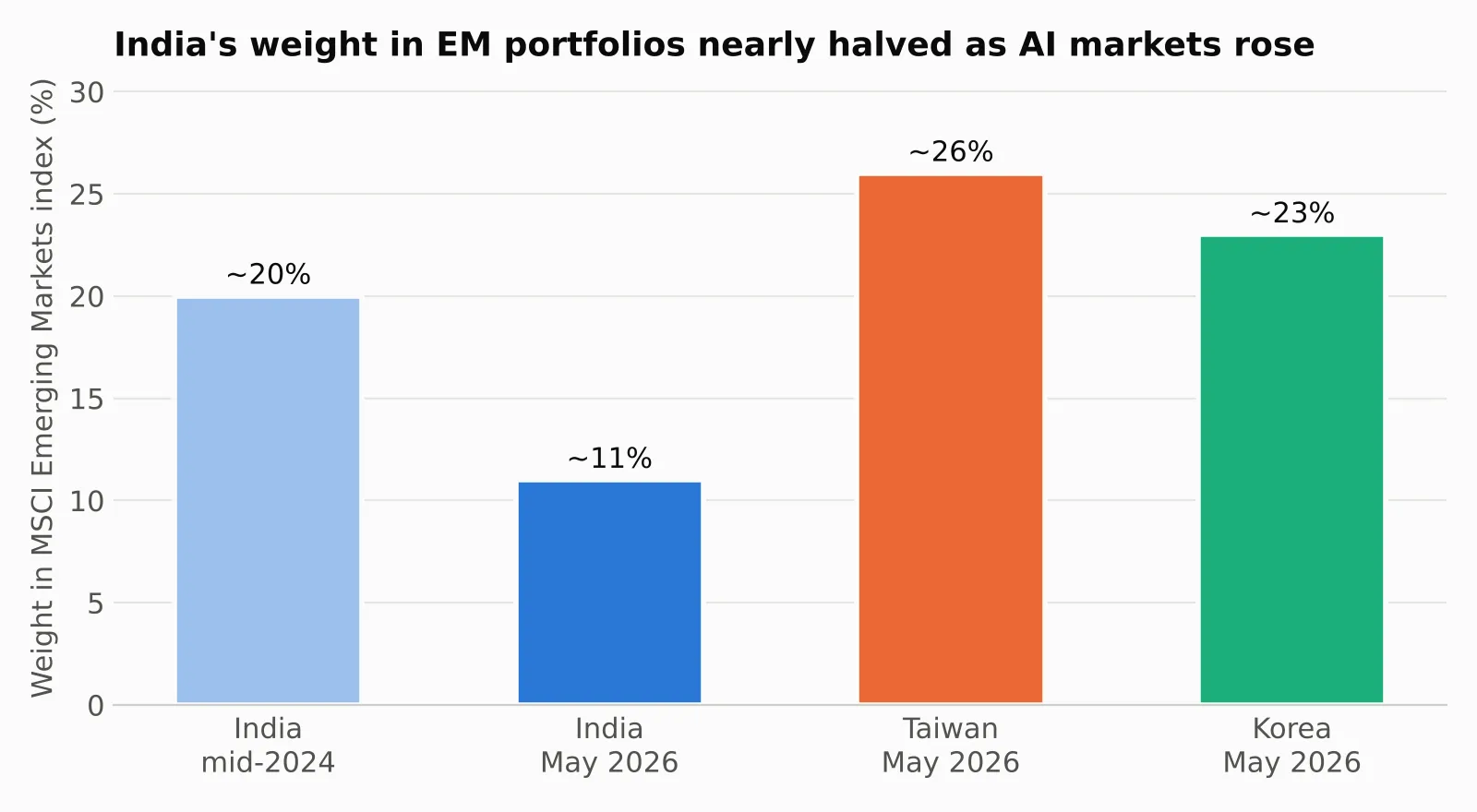
India's listed market has little direct AI exposure. Stocks with AI-linked revenue make up roughly 30% of the MSCI Emerging Markets index, including about 80% of Taiwan's index and half of Korea's. India's share is negligible. As global money moved into chips, India's weight in the EM index fell from about 20% in mid-2024 to about 11% by May 2026, while Taiwan and Korea rose to roughly 26% and 23%. Foreign ownership of Indian equities dropped to a 14-year low.
The gap reflected index composition more than the economy. Motilal Oswal described India's underperformance as structural, driven by the global AI trade, while domestic institutions kept buying. The Reserve Bank of India's August projection put real GDP growth for FY27 at 6.7%.
Is foreign money returning to India?
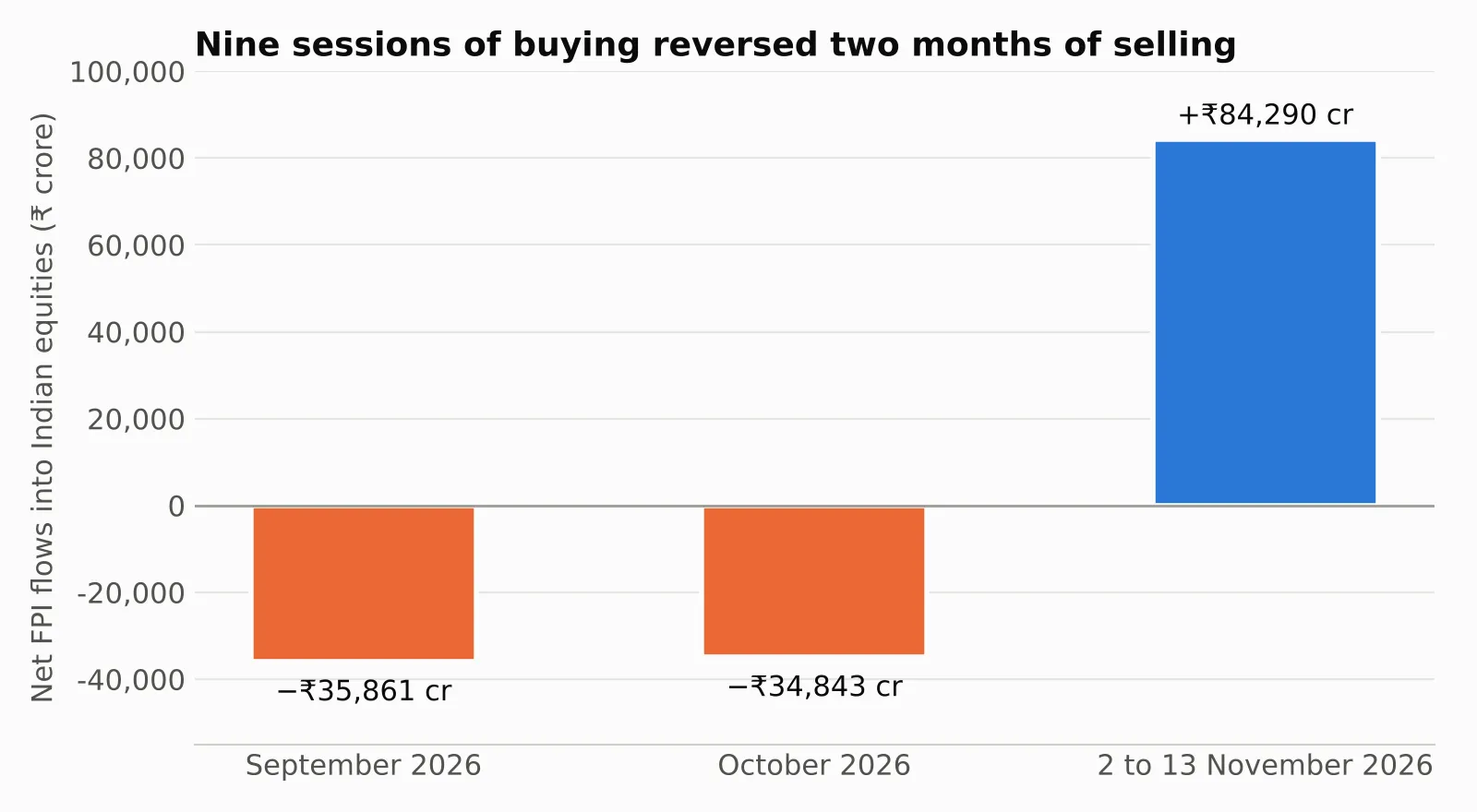
The early evidence points that way. Foreign investors bought a net ₹84,290 crore of Indian equities between 2 and 13 November, more than the combined outflows of September and October. The Nifty 50 rose more than 13% from its 8 October close. Analysts linked the turn to the sell-off in AI stocks, a fall in crude oil and stronger September-quarter earnings. Jefferies has raised India's weight in its Asia Pacific ex-Japan portfolio by one percentage point, to 15% against a 13.3% benchmark, and cut Taiwan by the same amount.
What could interrupt the recovery?
Oil and inflation are the main risks. Retail inflation rose to 6.09% in October, above the RBI's 6% upper limit, and crude has recovered from its early-November lows on renewed West Asia tensions. The rupee trades near ₹93.7 to the dollar. Foreign investors remain net sellers of about ₹2.1 lakh crore for 2026 as a whole. Trade is also unsettled. India and the US agreed a framework in February that set an 18% US tariff on Indian goods, and New Delhi is still waiting for clarity on Washington's tariff structure before signing.
Where does India fit in the new map of chips and compute?
India sits inside the US-led system. It joined the Pax Silica supply chain coalition on 19 February 2026, and the 16 November rule leaves India off the licensing list while naming several of its regional competitors for data centre investment.
Capacity is growing from a small base. India's top seven markets had 1,789 MW of operational data centre capacity in the first half of 2026, with another 3,860 MW expected by 2030. Google's planned AI hub in Visakhapatnam involves about US$15 billion over 2026 to 2030. Some analysts expect fraud probes in Singapore and Malaysia to push hyperscaler investment toward Mumbai, Chennai and Hyderabad.
Chips and electronics are moving from plans to shipments
Micron's assembly and test plant in Sanand began commercial production in February 2026, and five chip plants were in commercial production by September. Tata Electronics' fab at Dholera, built with Taiwan's PSMC, targets the 28 nm node. Electronics exports rose 44% to US$31.97 billion in April to September 2026, with non-smartphone products growing faster than phones. Most of this activity is in assembly, packaging and testing, the same back-end segments where Southeast Asia has led.
India faces its own constraints
Tighter chip policing could slow GPU deliveries to Indian projects, and Indian manufacturers still rely heavily on Chinese components, which leaves them exposed if Beijing retaliates. China's October draft on restricted technology exports adds limits on AI software and models. Rhodium Group has warned that India is building compute faster than it can use it.
See what markets are pricing in
Live indices, sector moves and market breadth — the backdrop to every story we publish.
What should investors watch over the next three months?
3 January: the new Congress and bills on chip tracking and allied export controls.
10 January: expiry of the US-China Busan truce and its rare earth commitments.
February to March: the US debt ceiling and the level of Treasury yields.
Nvidia's lending and guarantees under new leadership, and credit spreads at neoclouds.
Indian inflation, crude oil prices and the signing of the US-India trade agreement.
The Tech Cold War raises costs for the global economy and shrinks the neutral space that Southeast Asia used to grow. For India, it changes how investors read a market with little AI exposure: a reason to sell during the AI rally has become a source of diversification as that rally cools. A lasting re-rating will depend on domestic factors, namely inflation, earnings, and the speed at which chip and data centre plans become output.


