


Every futures and options contract has a final trading day. On that day, liquidity, margin needs and price sensitivity can change quickly as traders close, roll or allow positions to enter final settlement.
The f&o monthly expiry is not merely a calendar marker. Open index contracts are handled through final value-based settlement, while expiring single-stock derivatives can create securities-delivery obligations. Options also separate into in-the-money and out-of-the-money outcomes.
This guide explains how the f&o monthly expiry date is determined, what happens after market close and how to prepare. Exchange rules can change, so the live contract specification and holiday calendar always override a remembered weekday.
What Is F&O Monthly Expiry Date?
An f&o monthly expiry date is the last day on which a specific monthly futures or options series can be traded. After the closing session, open positions cease as expiring contracts and move into the applicable final settlement or exercise process.
Monthly equity derivatives commonly include near-month, mid-month and far-month contracts. When the near-month series expires, the exchange introduces a new far-month series under its trading cycle. Traders therefore need to identify the contract month, not just the underlying symbol.
The monthly contract expiry affects futures, index options and stock options differently. A futures position is marked against a final settlement price. An option’s outcome depends on whether it finishes ITM or OTM. Stock derivatives may also require delivery capacity.
Expiry does not mean every trader must wait for final settlement. A position may be closed before the f&o trading expiry date or rolled by closing the expiring contract and opening a later-month contract. Rolling creates a new trade with a different price and risk profile.
What’s the market feeling today?
Our India Fear & Greed index tracks sentiment so you don’t trade on headlines.
How F&O Expiry Dates Are Determined
SEBI’s framework limits an exchange’s equity-derivatives expiries to its approved Tuesday or Thursday schedule. Each exchange may offer weekly options on one benchmark index. Other equity-derivatives contracts have a minimum one-month tenor and expire in the last week on the exchange’s designated day.
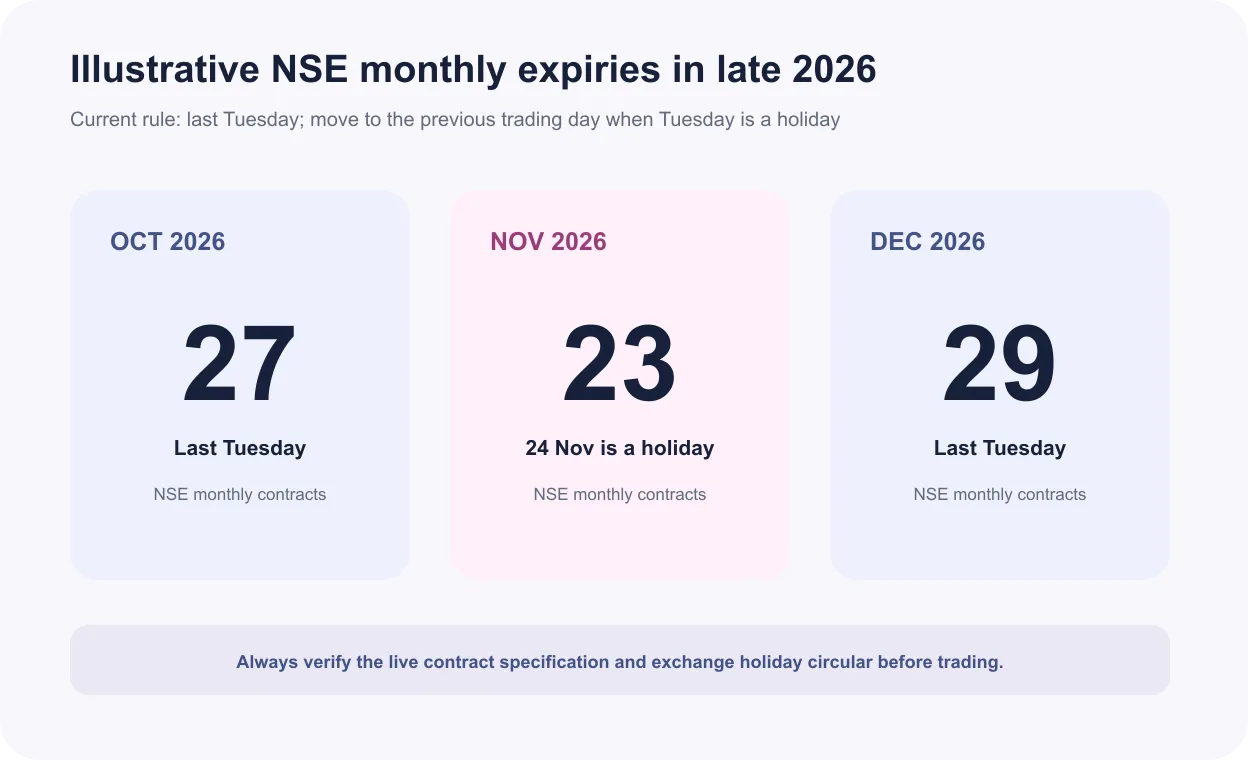
As of October 2026, NSE’s equity-derivatives specifications state Tuesday as the expiry day. Monthly index and individual-security contracts expire on the last Tuesday. If that Tuesday is a trading holiday, the f&o expiry date moves to the previous trading day.
That holiday rule matters in November 2026: NSE’s published holiday calendar lists Tuesday, 24 November as a market holiday, so the rule points to Monday, 23 November for the monthly series, subject to final exchange notices.
Never infer the scheduled expiry from another exchange or an old calendar. Read the date encoded in the contract and check the exchange circular. Corporate actions, product changes or exceptional market arrangements can require additional attention.
Settlement Process on Expiry Day
F&O settlement begins with the exchange-defined final settlement price. NSE states that the final price for index derivatives uses the closing value of the relevant underlying index, while individual-security derivatives use the closing price of the underlying security under the specified calculation method.
Futures are marked to market each day. At expiry, the remaining difference between the latest settlement basis and final settlement price produces the final profit or loss. Open futures positions then cease to exist as contracts.
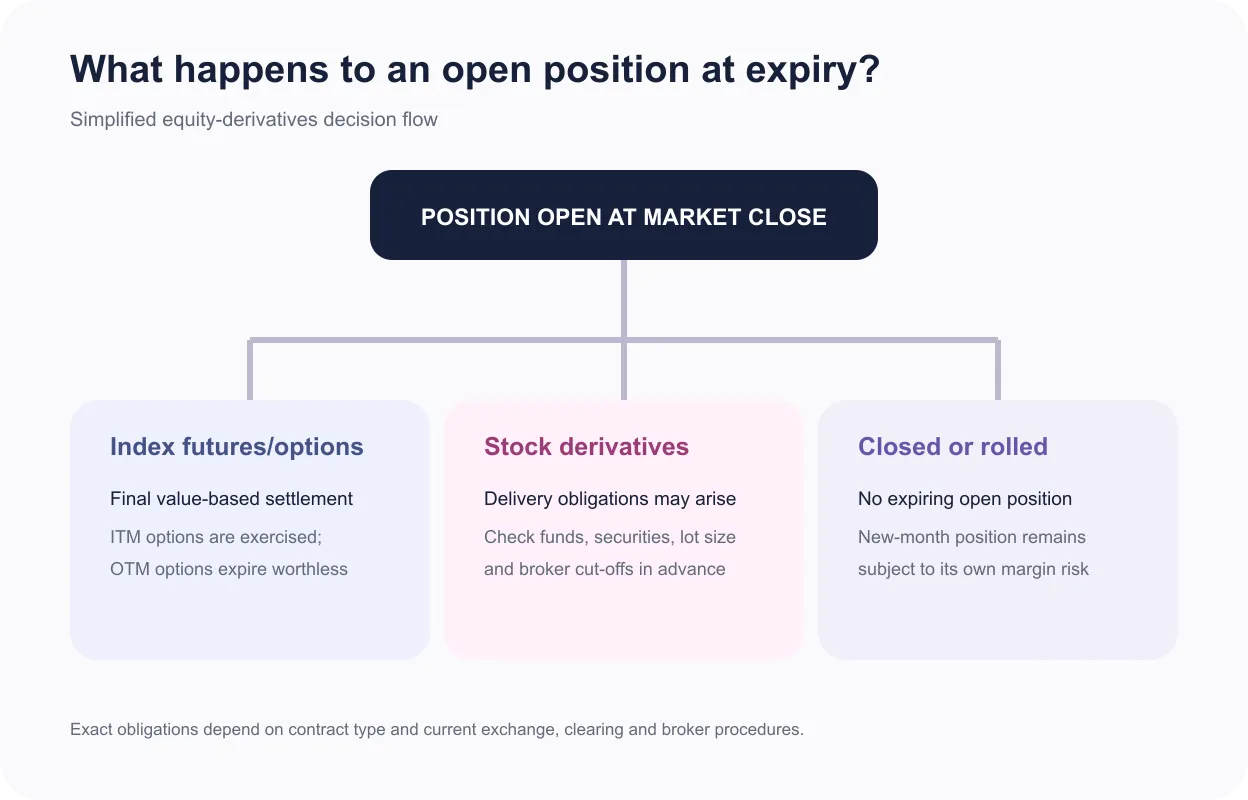
For index derivatives, F&O settlement is value based because an index cannot be delivered. For individual-stock derivatives, current Indian rules can result in physical-delivery obligations. Long and short positions may require securities or funds in the required quantity.
Broker cut-offs can be earlier than exchange close. Brokers may increase margins, restrict fresh positions or close positions when delivery risk is not funded. Check the broker policy well before the f&o expiry date and time rather than relying on the final minutes.
What Happens to ITM and OTM Options at Expiry?
At expiry, an ITM option has positive intrinsic value. A call is ITM when the final underlying value is above its strike, while a put is ITM when the final value is below its strike. NSE describes final exercise as automatic for ITM positions.
An OTM option has no intrinsic value and expires worthless. The buyer loses the premium already paid, while the seller retains the premium subject to prior mark-to-market, costs and any offsetting positions.
Index-option exercise produces a cash obligation or receipt based on intrinsic value and lot size. Stock-option exercise can produce physical-delivery consequences. A small move around the strike near monthly expiration can therefore materially change the position’s settlement category.
Do not confuse ITM with profit. A call bought for ₹12 and finishing ₹8 ITM still loses ₹4 per unit before costs. Exercise-related taxes and charges can also differ from an ordinary closing trade, so calculate the complete outcome before the f&o trading expiry date.
Get research like this in your inbox
The week’s research that mattered, in five minutes. Joined by 2L+ investors.
F&O Monthly vs Weekly Expiry
The f&o monthly expiry occurs once per contract month and applies broadly to eligible monthly futures and options. Weekly expiry provides shorter-dated exposure, currently on one benchmark index-options product per exchange under SEBI’s framework.
| Feature | Monthly expiry | Weekly expiry |
|---|---|---|
| Frequency | Once in the expiry month | Weekly for the permitted benchmark product |
| Products | Index and stock futures/options as listed | Benchmark index options under current limits |
| Time to expiry | Generally longer when introduced | Shorter |
| Time decay near expiry | Accelerates close to month-end | Can become acute within days |
| Holiday adjustment | Previous trading day under the stated rule | Previous trading day under the stated rule |
| Main check | Contract month and delivery risk | Exact weekly series and rapid gamma/theta risk |
The distinction does not make one contract safer. Short time to expiry can amplify percentage changes in option premium. Monthly contracts may offer more time but can still face sharp volatility and basis movement near month-end expiry.
Common Mistakes Traders Make Near Expiry
A common mistake is remembering an outdated weekday instead of checking the current f&o monthly expiry date. Another is overlooking a holiday adjustment or confusing a weekly option with the monthly series.
Traders may also assume every open position is cash settled. That can leave a stock-derivative trader without enough securities or funds for delivery. Verify the exact F&O settlement method, lot size and broker requirement for each contract.
Late rolling is another risk. Bid-ask spreads may widen, liquidity can migrate to the next series and execution costs can rise. A roll is two transactions, and the price difference between months is a real component of the trade.
Finally, traders sometimes ignore the f&o expiry date and time or wait for a broker to act. Forced square-off may occur at an unfavourable price and is not guaranteed. Responsibility for the open position remains with the trader.
Tips for Trading Around F&O Expiry
Start with a position inventory three to five sessions before expiry. Record the underlying, contract type, strike, lot size, quantity, contract expiry date and intended action: close, roll or settle.
Use limit orders where liquidity allows, and avoid assuming the displayed last price is executable. Monitor bid-ask spread, open interest and depth in both the expiring and next-month series.
For stock derivatives, confirm funds and deliverable shares with the broker. For option positions, model outcomes just below and above the strike, including premium, tax and charges. This makes F&O settlement exposure visible before the closing session.
Readers learning through f&o monthly expiry concepts should first understand futures MTM, option exercise and maximum loss. Traders following the changing f&o expiry date and time framework should verify the exchange page on every contract cycle.
A final checklist is simple: verify the f&o monthly expiry date, read broker cut-offs, decide the position action, fund obligations and keep a buffer for volatility. Expiry preparation should be completed before market pressure peaks.
Know your risk profile in 2 minutes
A short quiz that maps how much drawdown you can actually live with.
FAQ
What is F&O monthly expiry?
It is the final trading day for a monthly futures or options contract. Any position still open at the close is handled under the contract’s final settlement or exercise rules.
How is F&O expiry date decided?
The exchange sets the expiry day under its approved contract specifications. On NSE, current equity-derivatives specifications use Tuesday, with monthly contracts expiring on the last Tuesday or previous trading day if that Tuesday is a holiday.
What happens if I don't square off my F&O position before expiry?
The position enters final settlement. Index contracts are value settled, while stock derivatives can create delivery obligations. ITM options are exercised automatically under applicable rules and OTM options expire worthless.
What is the difference between monthly and weekly expiry?
Monthly contracts expire once each month and are available across eligible futures and options. Weekly contracts have shorter tenors and, under the current framework, are limited to one benchmark index-options product per exchange.
What time does F&O expire on expiry day?
The contract stops trading at the exchange’s applicable market close on its expiry date. Traders should verify the current session timetable and their broker’s earlier risk-management cut-offs.
How is settlement done for F&O contracts?
Futures are marked to the final settlement price. ITM options are exercised and OTM options lapse. The resulting cash or securities obligations depend on whether the contract is an index or individual-security derivative.


