


Nuclear energy stocks in India are gaining investor attention as India targets 100 GW of atomic capacity by 2047. Key players include NTPC, BHEL, L&T, and ancillaries benefiting from nuclear expansion. While direct nuclear power stocks India remain limited due to NPCIL's unlisted status, exposure exists through infrastructure stocks, green energy shares, and the top 10 energy sector stocks in India.
Nuclear Energy Stocks in India: Why the Sector Is Gaining Attention
Every serious investor tracking India's energy transition has a blind spot, and it is glowing faintly in the background while everyone obsesses over solar and wind.
Nuclear power. For years, it sat at the margins of investment conversations. Too complex, too regulated, too slow. But something has shifted. India's government has moved nuclear energy from a policy footnote to a central pillar of its Viksit Bharat 2047 energy strategy. Capacity targets have been tripled. New reactor designs are on the table. And a handful of listed companies, some obvious and many overlooked, are quietly positioning themselves to benefit from what could be one of India's most consequential infrastructure buildouts of the decade.
This blog breaks down what the nuclear push means for investors, which companies carry real exposure, how nuclear fits alongside green energy stocks and renewable plays in a portfolio, and what risks you need to understand before taking a position. Whether you are evaluating the top 10 energy sector stocks in India or building a thematic portfolio around India's power future, this is the context you need.
See what markets are pricing in
Live indices, sector moves and market breadth — the backdrop to every story we publish.
Nuclear Power Sector Stocks in India: The 100 GW Target by 2047
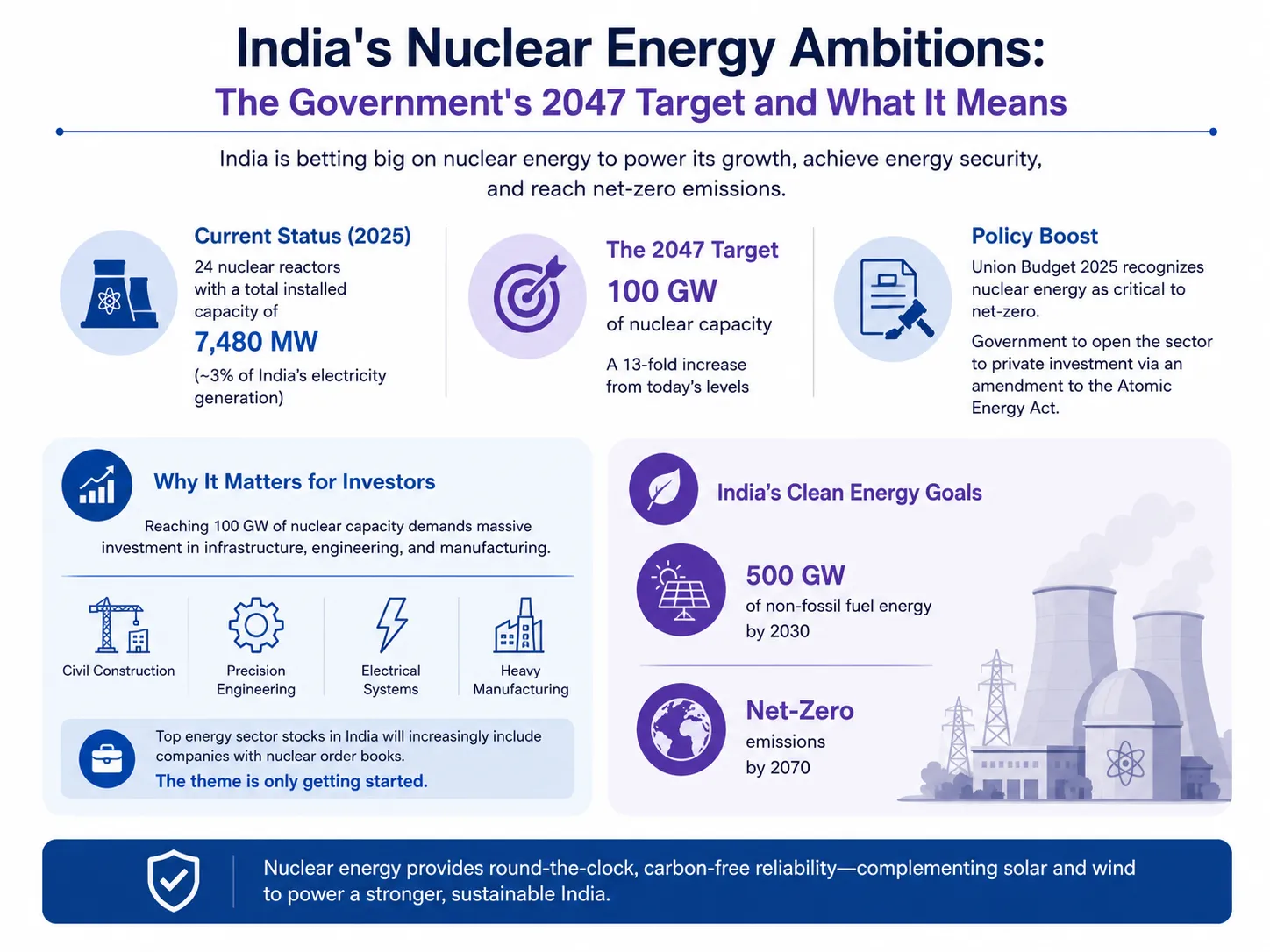
Nuclear energy stocks in India are a proxy for one of the government's most ambitious long-term infrastructure bets. India has 24 operating reactors with a total installed capacity of 8.78 GW (PIB, August 2026), contributing around 3% of the country's electricity generation. That number looks modest. The plan ahead, however, is not.
The Indian government has announced a target of reaching 100 GW of nuclear capacity by 2047, an increase of about 11 times from 8.78 GW today. Budget 2025-26 announced a ₹20,000 crore Nuclear Energy Mission for small modular reactors. The SHANTI Act 2025, which has received presidential assent, opens nuclear power generation to private participation; draft SHANTI Rules 2026 were issued on 14 August 2026.
Other 2026 developments: the Prototype Fast Breeder Reactor (PFBR) reached first criticality in April 2026, and Adani Power incorporated Adani Atomic Energy Ltd on 11 February 2026.
Why does this matter for investors? Because 100 GW of nuclear capacity requires a staggering volume of civil construction, precision engineering, electrical systems, and heavy manufacturing, much of which will be executed by listed companies.
India's stated goal is to achieve 500 GW of non-fossil fuel energy by 2030 and net-zero emissions by 2070. Nuclear, being a firm, baseload, carbon-free source of power, plays a role that intermittent green energy stocks simply cannot, providing round-the-clock reliability even when the sun does not shine, and the wind does not blow.
Small Modular Reactors (SMRs) in India: What Investors Should Know
India plans to operationalise at least five indigenous SMRs by 2033 under a ₹20,000 crore Nuclear Energy Mission. The two main designs are BARC’s 220 MWe BSMR-200 and the 55 MWe SMR-55, both pressurised water reactors with lead units planned at Tarapur, Maharashtra. Both target captive power for heavy industries such as steel, aluminium and cement. The SHANTI Act 2025 now allows private companies to build and operate these reactors.
For investors: Listed suppliers could gain new long-term orders. These include L&T for reactor vessels and forgings, MTAR for precision components, BHEL for turbines and HCC for civil works. The risks are long timelines (5–6 years to build after approval), small early order sizes, untested costs and valuations that may already price in the story.
How Nuclear Power Generation Works for Investors
You do not need a physics degree to invest in this theme. Here is what matters for an investor's understanding.
A nuclear reactor generates electricity by splitting uranium atoms in a controlled reaction, a process called fission. This generates intense heat, which converts water into steam, which spins turbines, which produce electricity. The reactors in India are primarily Pressurised Heavy Water Reactors (PHWRs), designed and operated by the Nuclear Power Corporation of India Limited (NPCIL).
What makes nuclear uniquely valuable as an asset class story is its capacity factor. Coal plants typically run at 60-70% capacity. Solar at 20-25%. A nuclear plant runs at 85-90% capacity factor, meaning it produces near-full output almost continuously. For a country like India, where power demand is growing at over 6% annually, that reliability premium is significant.
From an investment lens, the nuclear supply chain has several layers. There are plant operators (currently just NPCIL), civil contractors, and heavy engineering firms that construct facilities, equipment manufacturers supplying turbines, pumps, valves, and electrical components, and fuel cycle entities managing uranium procurement and processing. Each layer offers a different risk-return profile for investors looking at nuclear power stocks India.
Top Nuclear Energy Stocks in India: Listed Companies and Nuclear Exposure
Here is where the conversation gets practical. NPCIL, the primary entity that operates India's nuclear plants, is not listed on Indian exchanges. So, direct equity exposure to the operator is not currently available. But the listed universe around it is meaningful and growing.
Company |
Stock |
Nature of Nuclear Exposure |
Listed |
NTPC Ltd |
NSE: NTPC |
Nuclear capacity addition through NTPC Parmanu Urja Nigam (wholly owned) and ASHVINI (JV with NPCIL) |
Yes |
BHEL |
NSE: BHEL |
Turbine islands, steam generators for nuclear plants |
Yes |
Larsen & Toubro |
NSE: LT |
Civil construction and heavy engineering for nuclear facilities |
Yes |
Tata Consulting Engineers |
Unlisted |
Design and engineering for nuclear projects |
No |
HCC Ltd |
NSE: HCC |
Civil works for nuclear plants (historical exposure) |
Yes |
NSE: MIDHANI |
Specialty alloys and materials for nuclear reactors |
Yes |
|
Thermax |
NSE: THERMAX |
Heat exchange equipment, nuclear-grade components |
Yes |
Among the listed companies with nuclear exposure, NTPC has the most direct, through its wholly owned subsidiary NTPC Parmanu Urja Nigam and ASHVINI, its JV with NPCIL. BHEL has decades of experience supplying turbines to NPCIL plants.
These companies simultaneously qualify as infrastructure stocks and green energy sector stocks , making them candidates for multiple thematic portfolio strategies, not just a pure nuclear play.
Compare Nuclear Energy Stocks by Market Cap, Valuation and Returns
| Company | Nuclear exposure | Market cap (₹ cr) | P/E | 6M return | 1Y return |
|---|---|---|---|---|---|
| Larsen & Toubro (LT) | Makes reactor pressure vessels, steam generators and other core components; forging JV with NPCIL at Hazira | 5,77,953 | 32.6 | +7.2% | +4.3% |
| BHEL | Supplied turbine generators to 14 of India’s 24 reactors; won turbine island packages for 6 new 700 MW PHWRs | 1,50,774 | 52.9 | +6.1% | +52.0% |
| MTAR Technologies | Precision reactor parts: core components, fuel machining heads, coolant channel assemblies | 17,255 | 91.9 | −30.5% | +108.2% |
| Hindustan Construction Co. (HCC) | Civil contractor for nuclear projects (Tarapur, Kakrapar, Narora, Kudankulam) | 4,309 | 30.2 | −21.1% | −19.9% |
Market data as of 23 November 2026, from Wright Research stock pages. Past returns do not indicate future performance.
Get research like this in your inbox
The week’s research that mattered, in five minutes. Joined by 2L+ investors.
NTPC Nuclear and NPCIL: Who Can Participate in Nuclear Power Stocks India
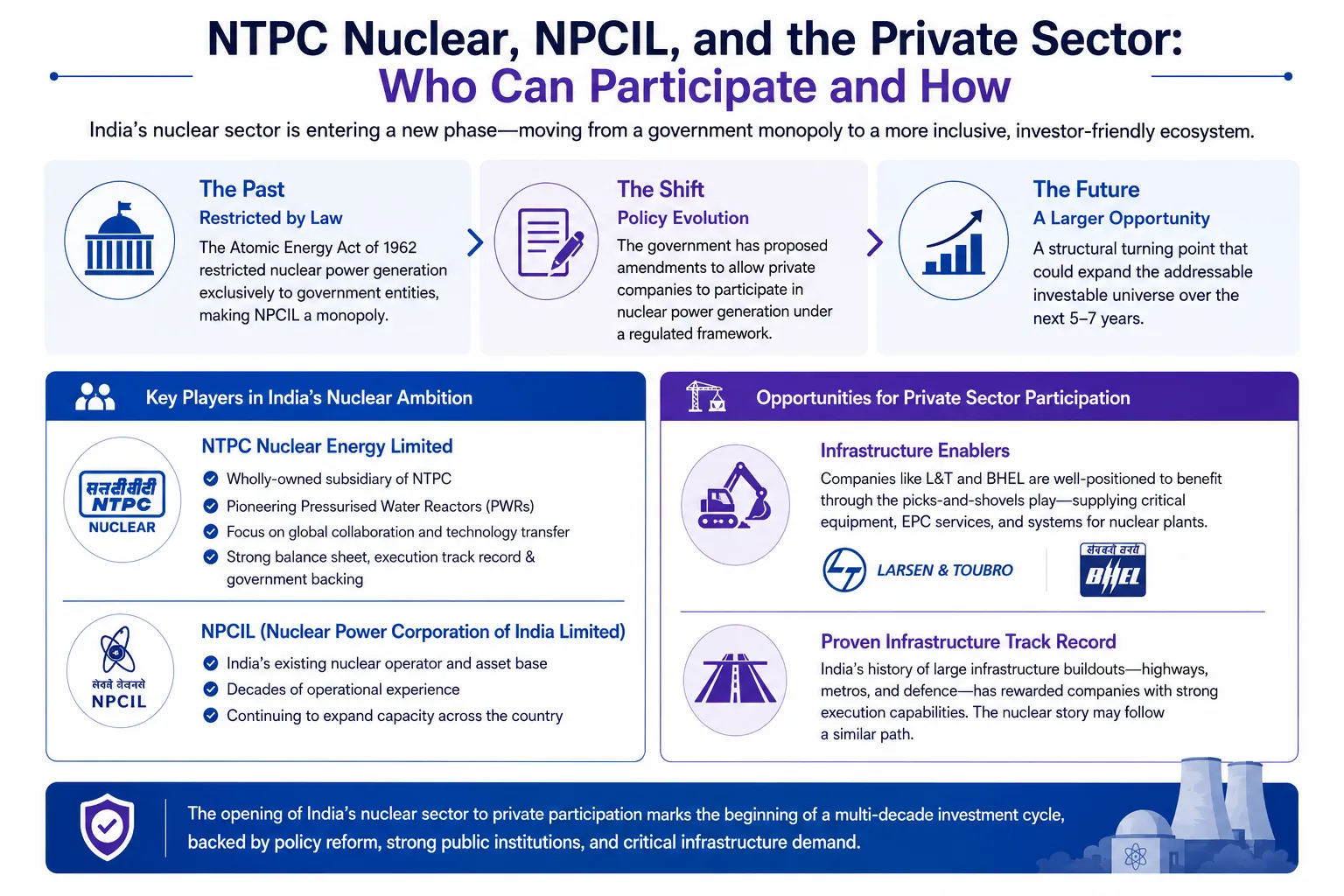
Until 2025, the Atomic Energy Act of 1962 restricted nuclear power generation to government entities, making NPCIL the only operator. The SHANTI Act 2025 replaces that framework and allows private participation under a regulated framework; its rules were issued in draft on 14 August 2026.
This is a structural change. For nuclear energy stocks in India, it means the listed universe with nuclear exposure could expand over time.
NTPC's nuclear push is underway. NTPC Parmanu Urja Nigam, a wholly owned subsidiary, is working toward setting up reactors, and ASHVINI is the NPCIL–NTPC joint venture. NTPC's project execution record and government backing make it one of the closest listed proxies for India's nuclear plans.
L&T and BHEL supply materials and systems regardless of which entity ultimately operates the plant.
Uranium Supply Chain: Why Fuel Security Matters for Investors
Nuclear plants run on uranium, and India's domestic uranium reserves are limited. This is a critical variable that often goes under-discussed in investor conversations about nuclear energy stocks in India.
India imports uranium primarily from Russia, Kazakhstan, Canada, and Australia. The Uranium Corporation of India Limited (UCIL) handles domestic mining, but supply is insufficient to fuel planned expansion. As reactor capacity grows about 11-fold, securing long-term uranium supply contracts becomes a strategic imperative and a risk that can meaningfully impact project timelines.
Investors should also be aware of thorium. India holds about 13% of the world's thorium reserves, and NPCIL's long-term three-stage nuclear programme envisions transitioning to thorium-based reactors as the final stage. While this is a decades-long horizon, it gives India's nuclear programme a domestic fuel security angle that most countries lack.
For the purposes of portfolio positioning, the uranium supply chain itself is not accessible through domestic listed stocks, but the exposure to uranium price dynamics is an indirect risk factor for companies like NTPC that will operate nuclear plants. This is worth monitoring, especially as global uranium prices have been on an upward trend since 2021.
Nuclear vs Green Energy Stocks: How They Fit in India Energy Mix
Nuclear and renewables are often framed as competitors. They are more accurately partners.
Green energy stocks, particularly solar and wind, have attracted large amounts of capital over the last decade. India's non-fossil capacity is above 300 GW, against a 500 GW target for 2030.
But renewables have a fundamental limitation: intermittency. Solar generates power only during daylight hours. Wind is dependent on weather patterns. For India to run a 24x7 economy on clean power, it needs firm baseload capacity, and nuclear is the only clean source that can reliably provide this at scale.
Parameter |
Solar/Wind (Green Energy) |
Nuclear Energy |
Capacity Factor |
20-30% |
85-90% |
Carbon Emissions |
Near Zero |
Near Zero |
Land Requirement |
High |
Low |
Power Reliability |
Intermittent |
Baseload / Continuous |
Gestation Period |
12-24 months |
7-15 years |
Cost Trend |
Declining rapidly |
Stable/Increasing |
Listed Stock Availability |
Abundant |
Limited (indirect) |
Nuclear is generally seen as complementary to renewables rather than a replacement, since it supplies firm baseload power.
Key Risks in Nuclear Energy Stocks India
Nuclear projects are long-duration. These are the main risks.
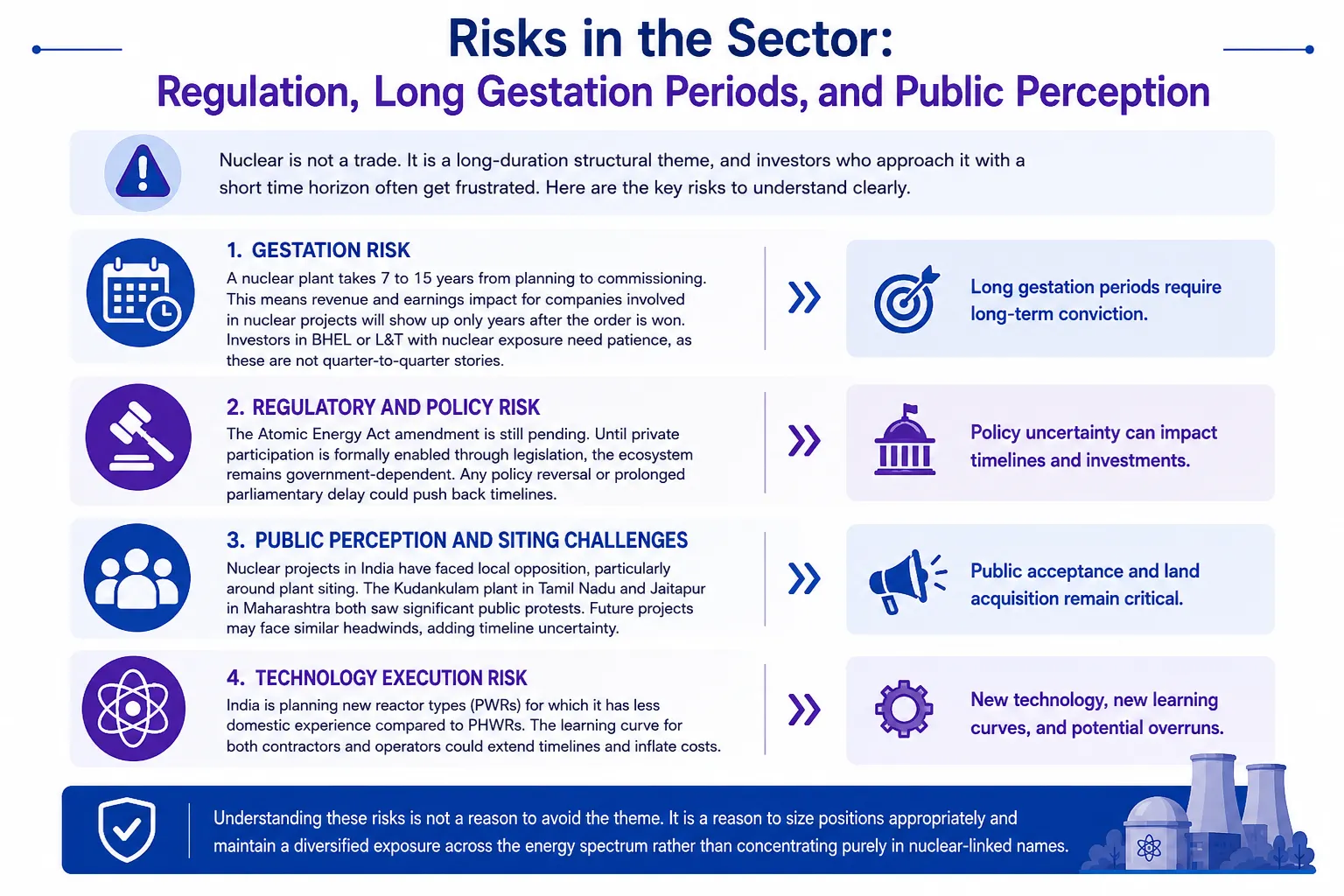
Gestation Risk. A nuclear plant takes 7 to 15 years from planning to commissioning. This means revenue and earnings impact for companies involved in nuclear projects will show up only years after the order is won.
Regulatory and Policy Risk. The SHANTI Act 2025 is in force, but its rules were issued only in draft on 14 August 2026. Until the rules are final, how private participation will work in practice remains uncertain, and policy delays could push back timelines.
Public Perception and Siting Challenges. Nuclear projects in India have faced local opposition, particularly around plant siting. The Kudankulam plant in Tamil Nadu and Jaitapur in Maharashtra both saw significant public protests. Future projects may face similar headwinds, adding timeline uncertainty.
Technology Execution Risk. India is planning new reactor types (PWRs) for which it has less domestic experience compared to PHWRs. The learning curve for both contractors and operators could extend timelines and inflate costs.
How Nuclear Exposure Appears in Listed Equities
Listed exposure to nuclear power comes through a few routes.
Diversified energy companies. NTPC and BHEL combine nuclear-related activity with other businesses.
Infrastructure companies with nuclear order books. L&T and BHEL have nuclear orders; nuclear is one part of each business.
NPCIL. NPCIL, the operator of India's reactors, remains unlisted.
Conclusion
India's nuclear build-out is one of the most significant infrastructure stories of the next two decades, and understanding which listed companies carry real exposure is half the battle.
Follow this sector’s live moves
Sector-level performance across Indian markets, updated through the day.
FAQs
Are there any listed nuclear energy stocks in India?
Directly listed nuclear energy stocks in India are limited because NPCIL, the primary nuclear operator, is a government entity and not publicly traded. However, investors can access the theme indirectly through listed companies like NTPC (via its nuclear JV), BHEL (turbine and equipment supplier), L&T (civil construction), MIDHANI (specialty alloys), and HCC. These qualify as nuclear power stocks India through their order books and project pipelines.
How long do nuclear projects take to affect earnings?
The government's target is 100 GW of nuclear capacity by 2047. Nuclear plants take 7–15 years from planning to commissioning, so the earnings impact of nuclear projects appears gradually, and regulations are still being finalised.
How does the government's nuclear expansion plan affect energy stocks?
The 100 GW nuclear target creates a multi-decade order pipeline for engineering, construction, and equipment companies. This directly benefits the top 10 energy sector stocks in India, like BHEL and NTPC, while also lifting broader infrastructure stocks with nuclear project exposure. The SHANTI Act 2025, which allows private participation, could further expand the investable universe.
What is the difference between nuclear energy stocks and renewable energy stocks?
Nuclear energy stocks in India are linked to baseload power generation that runs continuously at high capacity (85–90% capacity factor), with long project gestation and high capital expenditure. Green energy stocks and green energy shares are typically tied to solar and wind assets, faster to build, lower upfront capex, but intermittent in output. Both serve India's clean energy goals. Green energy and nuclear are generally seen as complementary rather than competing.
Which Indian companies benefit most from nuclear power expansion?
NTPC has the most direct exposure through its nuclear subsidiary and its ASHVINI JV with NPCIL. BHEL has supplied turbine islands and steam generators to nuclear plants. L&T supplies reactor components and civil construction. MIDHANI supplies specialty materials. These are the most direct listed names with nuclear exposure on NSE/BSE today.
What Factors Affect Nuclear Power Stock Prices?
Nuclear power stocks move on policy changes, such as the SHANTI Act and its rules, and on project approvals, such as the 10 new 700 MW PHWRs. Order wins also matter, like BHEL’s turbine island contracts. Valuation counts too, since stocks with very high P/E ratios, like MTAR, can fall sharply when projects are delayed, and diversified companies like L&T and BHEL often follow their non-nuclear business more than nuclear news.


