

Silver is both a precious metal and an industrial input. That combination can make its price respond to inflation expectations, currency moves, manufacturing demand, mine supply and investor sentiment. For Indian investors who want exposure without buying bars or coins, exchange-traded silver funds provide a practical route.
A silver ETF India product holds eligible silver exposure inside a mutual fund structure and issues units that trade on a recognised stock exchange. It simplifies custody and purity, but it does not remove price volatility, tracking difference or liquidity risk. Understanding the structure matters before treating it as a substitute for physical metal.
What Are Silver ETFs?
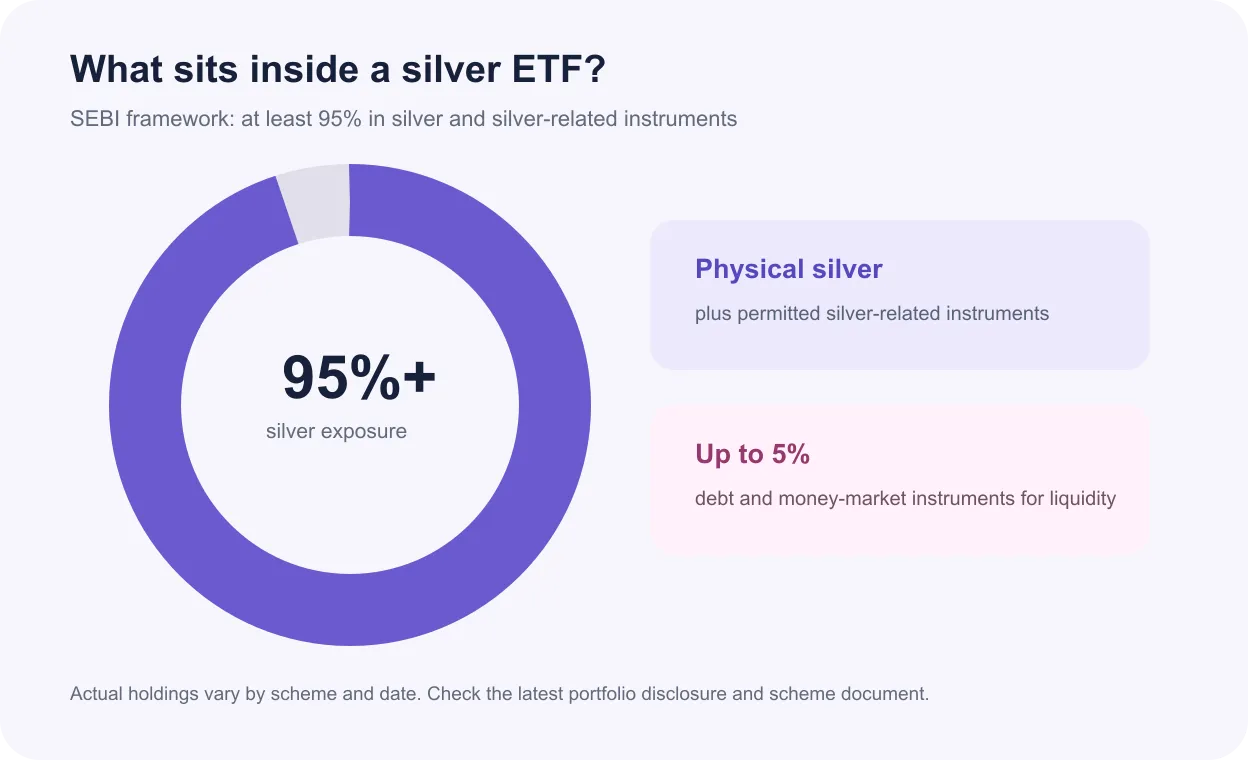
Silver ETFs are open-ended mutual fund schemes designed to track the domestic price of silver, subject to expenses and tracking error. Their portfolios are predominantly invested in physical silver and permitted silver-related instruments, with a small liquidity allocation allowed under the regulatory framework.
Each unit represents a proportional interest in the scheme rather than ownership of a specific numbered bar. The asset management company selects custodians, values the portfolio, publishes NAV and manages creation or redemption with authorised participants and market makers.
A silver ETF India scheme is regulated as a mutual fund, but it is not an equity-oriented fund. Its return primarily reflects the rupee value of silver after costs. It does not earn business profits, dividends or contractual interest from the metal itself.
Run the numbers on your next investment
Project returns on a lumpsum or SIP with our free calculators.
How Silver ETFs Work in India
To understand how silver ETFs work, separate the primary and secondary markets. Most retail investors buy or sell units on an exchange through a broker and demat account. Large investors and authorised participants can transact in creation-unit sizes directly with the fund under the scheme’s rules.
Market makers help connect the trading price with NAV. If units trade materially above the value of the underlying portfolio, creation activity can add supply; if they trade below, redemption or buying activity can narrow the gap. This arbitrage mechanism is useful, but it is not a guarantee of a perfect match at every moment.
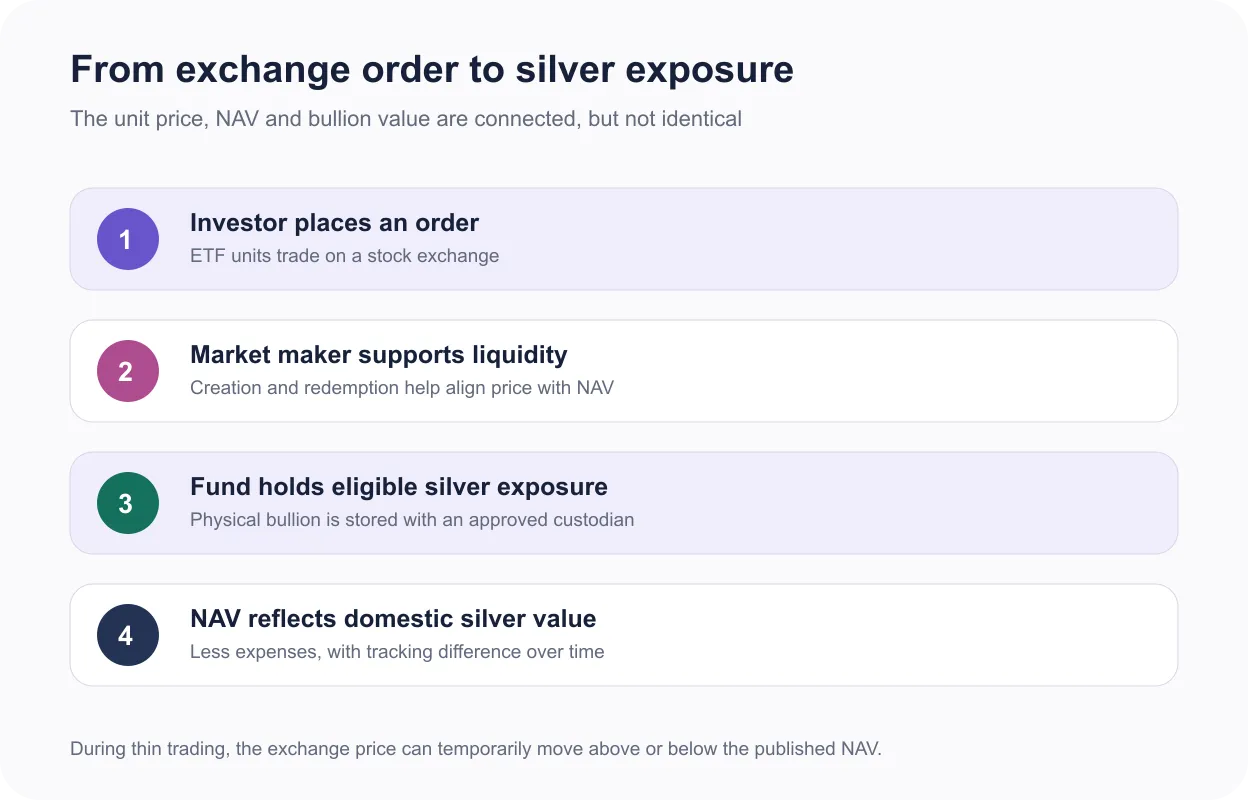
From April 2026, SEBI’s updated valuation framework uses polled spot prices published by recognised stock exchanges for physical gold and silver held by mutual fund schemes. The policy is intended to reflect domestic market conditions consistently. Scheme expenses, cash holdings and operational timing still create tracking difference.
Knowing how the structure works also means checking three prices: the exchange quote, the latest NAV and the underlying domestic silver reference. A limit order can help an investor avoid paying an unusually wide premium during volatile or illiquid trading.
Benefits of Investing in Silver ETFs
The main silver ETF benefits are convenience and standardisation. Investors do not need to evaluate purity, arrange a locker or negotiate with a bullion dealer. Units sit in demat form and can normally be traded during exchange hours.
A second benefit is portfolio access. Silver has different economic drivers from shares and conventional debt, so a measured allocation may diversify some portfolios. Industrial uses in electronics, solar equipment and other manufacturing can also influence demand, although this makes silver sensitive to the economic cycle.
Transparent NAV disclosure, audited holdings and regulated custody are further silver ETF benefits. The unit size can permit gradual allocation, while exchange trading provides observable prices. These features improve access; they do not promise a positive return.
For investors comparing a strategic allocation with other assets, Wright Research’s portfolio solutions provide a broader allocation context. A silver ETF India holding should have a defined role rather than being added only after a sharp price rally.
Silver ETF vs Physical Silver
The silver ETF vs physical silver choice begins with purpose. Physical coins or bars offer possession and may suit a non-financial use. An ETF is generally more practical for portfolio exposure because the fund handles storage, insurance, purity standards and institutional custody.
| Factor | Silver ETF | Physical silver |
|---|---|---|
| Ownership | Demat units in a regulated scheme | Direct possession of bars, coins or articles |
| Purchase cost | Market spread, brokerage and fund expenses | GST, dealer spread and possible making charges |
| Purity and storage | Managed by scheme and custodian | Investor verifies purity and arranges safekeeping |
| Liquidity | Exchange liquidity during market hours | Depends on dealer and form of silver |
| Tracking | May differ from silver because of costs and cash | Resale value may differ from quoted spot price |
In a silver ETF vs physical silver comparison, taxes and transaction costs should be assessed together. Physical bullion generally attracts GST at purchase, while exchange units have brokerage and statutory charges. A physical buyer may also face a larger resale discount, especially for jewellery or non-standard products.
Neither route guarantees liquidity at the expected price. During stress, a silver ETF India unit can trade away from NAV, while a dealer may quote a wide buyback spread for bullion.
Silver ETF vs Silver Mutual Funds
A silver ETF trades on an exchange and normally requires a demat and brokerage account. A silver mutual fund, often structured as a fund of funds, buys units of an underlying ETF and lets investors transact with the AMC at applicable NAV. The fund-of-funds route may support SIPs without demat.
The convenience creates another layer. A fund of funds bears its own expenses in addition to the underlying ETF’s cost, and its cash flows can add tracking difference. Redemption occurs through the mutual fund process rather than an intraday exchange order.
Tax holding periods can also differ because listed and unlisted units are classified differently under current rules. Investors can review available routes through Wright Research’s mutual fund platform , then compare total expense, liquidity, tracking and tax treatment for their own holding period.
Get research like this in your inbox
The week’s research that mattered, in five minutes. Joined by 2L+ investors.
Risks of Investing in Silver ETFs
Silver prices can be highly volatile. Industrial demand can weaken in a slowdown, while investor demand, the US dollar, real interest rates, mine supply and recycling can move prices in other directions. A commodity allocation can fall sharply even when the long-term narrative sounds persuasive.
Tracking risk is the possibility that scheme returns differ from the domestic silver benchmark. Expense ratio, transaction costs, cash, valuation timing and portfolio implementation all contribute. Compare tracking difference over multiple periods, not only the headline expense ratio.
Exchange liquidity creates another risk. Low volume and wide bid-ask spreads can make the traded price less attractive than NAV. Limit orders and avoiding disorderly market periods may help, but cannot eliminate the issue.
These schemes also carry custody, operational and regulatory risks disclosed in the scheme document. Institutional storage reduces the investor’s personal handling burden, yet no system is risk-free. Concentration is a separate concern: silver is one commodity, not a diversified portfolio.
Taxation of Silver ETFs in India
Silver ETF taxation India changed after the Finance (No. 2) Act, 2024 narrowed the definition of a “specified mutual fund” from assessment year 2026-27. Under the current FY 2026-27 treatment for a resident individual, listed silver ETF units held for 12 months or less generally produce short-term capital gains taxed at the applicable slab rate.
For listed units held for more than 12 months, gains are generally long-term and taxed at 12.5% without indexation, plus applicable surcharge and cess. The equity-fund exemption threshold under section 112A does not ordinarily apply because a silver scheme is not an equity-oriented fund.
| Investment route | Short-term holding | Long-term holding |
|---|---|---|
| Listed silver ETF | 12 months or less: slab rate | More than 12 months: 12.5% without indexation |
| Unlisted silver fund-of-funds units | 24 months or less: slab rate | More than 24 months: 12.5% without indexation |
This silver ETF taxation India summary is educational, not personal tax advice. Acquisition date, transfer date, investor status, set-off rules and future amendments can change the result. Check the latest scheme tax note and consult a tax professional before acting.
How to Invest in Silver ETFs
Start with the portfolio decision, not the ticker. Decide why silver belongs in the allocation, what maximum weight is acceptable and how it will be rebalanced. Then compare schemes using assets under management, expense ratio, tracking difference, bid-ask spread, trading volume and fund disclosures.
Open or use an existing broking and demat account, search for the exchange symbol, review the quote against indicative NAV where available, and place a suitably sized limit order. The practical minimum is usually one unit plus transaction charges, though the rupee value varies by scheme.
After purchase, monitor tracking, liquidity and the share of total wealth committed to commodities. Avoid assuming that a lower unit price means cheaper silver. Unit denomination changes how many units you receive, not the valuation of the underlying exposure.
Who Should Consider Silver ETFs?
These funds may suit investors who want a modest, transparent commodity allocation, can tolerate substantial price swings and already have a suitable core portfolio. They can also suit investors who prefer demat ownership to storing and verifying bullion.
They may be unsuitable for near-term goals, emergency money or investors seeking stable income. Silver produces no coupon or dividend, and returns depend on price movement after costs. Someone who wants metal for gifting, fabrication or personal possession may prefer physical silver despite its frictions.
The decision should reflect total allocation. A silver ETF India position can complement other assets, but it should not be treated as automatically defensive in every market environment.
See what markets are pricing in
Live indices, sector moves and market breadth — the backdrop to every story we publish.
FAQ
How do silver ETFs work in India?
They pool investor money into physical silver and permitted silver-related instruments, then issue exchange-listed units. Investors trade those units through a demat account while the fund manages bullion valuation, custody and tracking.
Are Silver ETFs a good investment option?
They can be useful for investors seeking a liquid, dematerialised allocation to silver without storing bullion. Suitability depends on portfolio need, risk tolerance, time horizon, expense ratio, liquidity and tracking difference.
What is the taxation on silver ETFs?
Under the current FY 2026-27 framework for resident individuals, gains on listed units held for 12 months or less are generally taxed at the applicable slab rate. Gains after more than 12 months are generally long-term and taxed at 12.5% without indexation, plus applicable surcharge and cess.
What is the difference between Silver ETFs and physical silver?
An ETF provides exchange-traded units backed mainly by eligible silver exposure, while physical silver gives direct possession. ETFs avoid personal storage and purity checks; bullion provides possession but may involve GST, making charges, storage and resale spreads.
Are silver ETFs safe to invest in?
They avoid some storage and purity problems, but they are not risk-free. Silver-price volatility, tracking difference, exchange liquidity, market-price premiums or discounts, custody and regulatory risks still apply.
What is the minimum investment in silver ETF?
For an exchange purchase, the practical minimum is usually one tradable unit plus brokerage and statutory charges. The rupee amount varies with the market price and the scheme’s unit denomination.


