
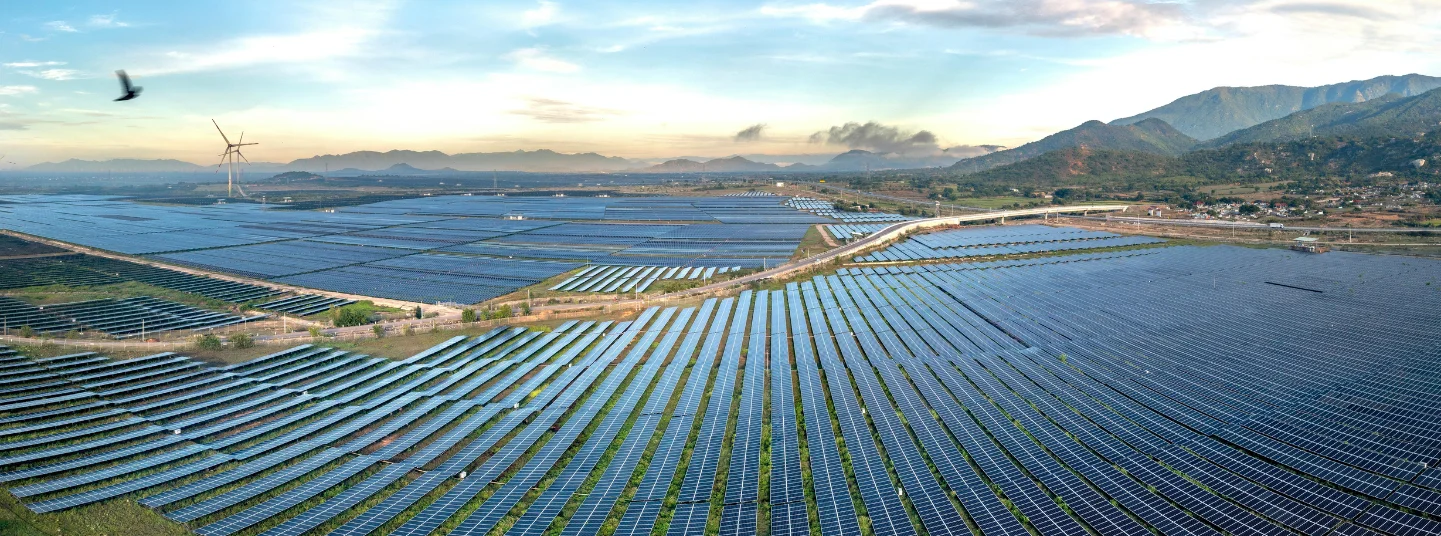
India's solar manufacturing sector has grown quickly under a mix of production incentives, mandatory domestic-sourcing lists and demand programmes. This article explains each policy tool and gives the latest data verified as at 23 November 2026, with sources and dates.
The policy toolkit
Production Linked Incentive (PLI) scheme
The Ministry of New and Renewable Energy (MNRE) launched the PLI scheme for high-efficiency solar PV modules in 2021 with an initial outlay of Rs 4,500 crore, later expanded by Rs 19,500 crore in a second tranche, for a total of Rs 24,000 crore. Incentives are paid on actual sales of modules over five years after a unit starts production, with higher support for more efficient modules and for locally made upstream components. The scheme aims at integrated capacity across polysilicon, ingot-wafer, cell and module stages.
Reported progress: MNRE data as at 30 June 2026 put capacity set up under the scheme at about 42 GW of modules, 11.5 to 12 GW of cells and about 2 GW of ingot-wafer, with investment of about Rs 73,400 crore (reported by trade press; the cell figure differs between outlets).
Approved List of Models and Manufacturers (ALMM)
ALMM is a registry maintained by MNRE. Projects that are government-backed, net-metered or sold through certain schemes must buy from listed manufacturers, which have to meet Bureau of Indian Standards specifications and have their factories inspected.
- List-I (modules): in force since 2019 in its original form. As reported by Mercom (September 2026), listed module capacity stood at about 225.5 GW.
- List-II (cells): MNRE said on 25 May 2026 that it would not extend the deadline beyond 1 June 2026. Government-backed, net-metered and open-access solar projects commissioned from 1 June 2026 must use domestically made cells. Listed cell capacity was close to 35.5 GW at the time of the Mercom report.
- List-III (wafers): an MNRE office memorandum dated 17 March 2026 creates a list for wafers, effective 1 June 2028. It will be issued only when at least three independently owned units together reach 15 GW a year, and from that date List-I will admit only modules made from listed cells and wafers.
The sequence shows the intent: the mandate moves one step up the value chain at a time, from modules to cells to wafers.
Customs duties and quality control
Import duties on solar cells and modules, together with exemptions for manufacturing machinery, are the third lever; the rates were adjusted in the Union Budget 2025-26 and are set by the Finance Ministry, so the current notification should be checked for exact rates. Mandatory BIS quality-control orders cover modules and some other equipment.
Demand-side schemes
Manufacturing needs buyers. PM Surya Ghar: Muft Bijli Yojana provides a central subsidy for rooftop solar at homes: Rs 30,000 per kW for the first 2 kW and Rs 18,000 for the third kW, capped at Rs 78,000 for systems of 3 kW and above. PIB reported 26.2 lakh installations and Rs 17,967 crore of central assistance disbursed as at 19 March 2026, and over 40 lakh households in June 2026, against a target of one crore households by 2026-27. PM-KUSUM supports solar pumps and farm-level solar plants.
See what markets are pricing in
Live indices, sector moves and market breadth — the backdrop to every story we publish.
Capacity data
| Item | Figure | Source and date |
|---|---|---|
| Cumulative module capacity | 261.7 GW | Mercom, as of June 2026 |
| Cumulative cell capacity | 36.6 GW | Mercom, as of June 2026 |
| Module capacity added in 1H 2026 | 50.6 GW | Mercom, 25 Sep 2026 |
| Cell capacity added in 1H 2026 | 9.7 GW | Mercom, 25 Sep 2026 |
| ALMM-listed module capacity by technology | TOPCon 80%, Mono PERC/TOPCon 11%, Mono PERC 4%, HJT 3%, thin-film 2% | Mercom, as of June 2026 |
| Module capacity by state | Gujarat about 45%; Rajasthan 26.1 GW; Tamil Nadu 23.4 GW | Mercom, June 2026 |
| Cell capacity by state | Gujarat 37%; Tamil Nadu 4.3 GW; Telangana 4.2 GW | Mercom, June 2026 |
Capacity is not production: new lines take months to reach stable output.
Get research like this in your inbox
The week’s research that mattered, in five minutes. Joined by 2L+ investors.
Trade: imports and exports
In the first half of 2026, imports rose 18% from the same period of 2025, with cells making up 81% of the import value and modules 19%. That mix reflects the gap in upstream capacity. On exports, the United States took 92% of India's solar exports in the same half-year (Mercom). US tariff and trade-remedy decisions therefore have a large bearing on export volumes, since the concentration on a single market is high.
Structural issues discussed by industry and analysts
- Cell shortfall: module capacity (261.7 GW) is far larger than cell capacity (36.6 GW). With List-II in force, modules made with imported cells cannot be used in covered projects, and industry commentary has raised concern for standalone module makers.
- Upstream dependence: polysilicon and wafers are still largely imported, and MNRE was reported in August 2026 to be considering a polysilicon-focused incentive (secondary report, details not disclosed).
- Overcapacity: installed module capacity is well above annual domestic installations, so utilisation depends on exports and on demand growth. MNRE has cautioned lenders against financing capacity additions without a technology or cost case.
- Technology: the market has moved towards TOPCon; newer designs such as HJT have a small listed share so far.
- Transmission: generation needs grid capacity; transmission and storage investment is part of the 500 GW non-fossil capacity target for 2030.
Follow this sector’s live moves
Sector-level performance across Indian markets, updated through the day.
Listed companies in the sector
Several listed companies operate in module and cell manufacturing, among them Waaree Energies, Premier Energies, Vikram Solar and Saatvik Green Energy. Their order books, capacity and results are published in quarterly filings on NSE and BSE. They are named only as examples of the sector, with no figures quoted here; inclusion is not a recommendation.
This article is for educational purposes only and is not investment advice.


