


Buying a share on Monday and selling it on Tuesday can create two delivery obligations even if you hold the position for only one night. Your broker may let you sell while the purchase is still settling, but the shares must still be available when the sale settles. That timing gap is what distinguishes BTST trading from selling shares already in your demat account.
Here is how to read that gap, what can happen when an incoming delivery fails, and how to judge whether a small overnight price move can cover two orders’ worth of costs. The examples assume the regular Indian cash-equity T+1 cycle and no intervening holidays.
What Is BTST Trading?
The BTST meaning is “Buy Today, Sell Tomorrow.” In Indian cash equities, it commonly refers to buying shares for delivery and selling them on the next trading day while the purchase is still shown as unsettled or awaiting demat credit. If the shares have already been credited when you sell, the sale is funded by settled holdings, even though the actual holding period may still be one day.
T denotes the trade date. Under T+1 settlement, the regular pay-in and pay-out are scheduled for the next working settlement day. The sale starts its own T+1 clock. For terminology such as pay-in, pay-out and settlement, see Wright Research’s quant glossary. The practical BTST meaning is about when shares become available, not a separate exchange order type or a promise of profit by tomorrow.
See what markets are pricing in
Live indices, sector moves and market breadth — the backdrop to every story we publish.
How BTST Works From Buy to Sell
The simplest way to see how BTST works is to follow the purchase and sale separately:
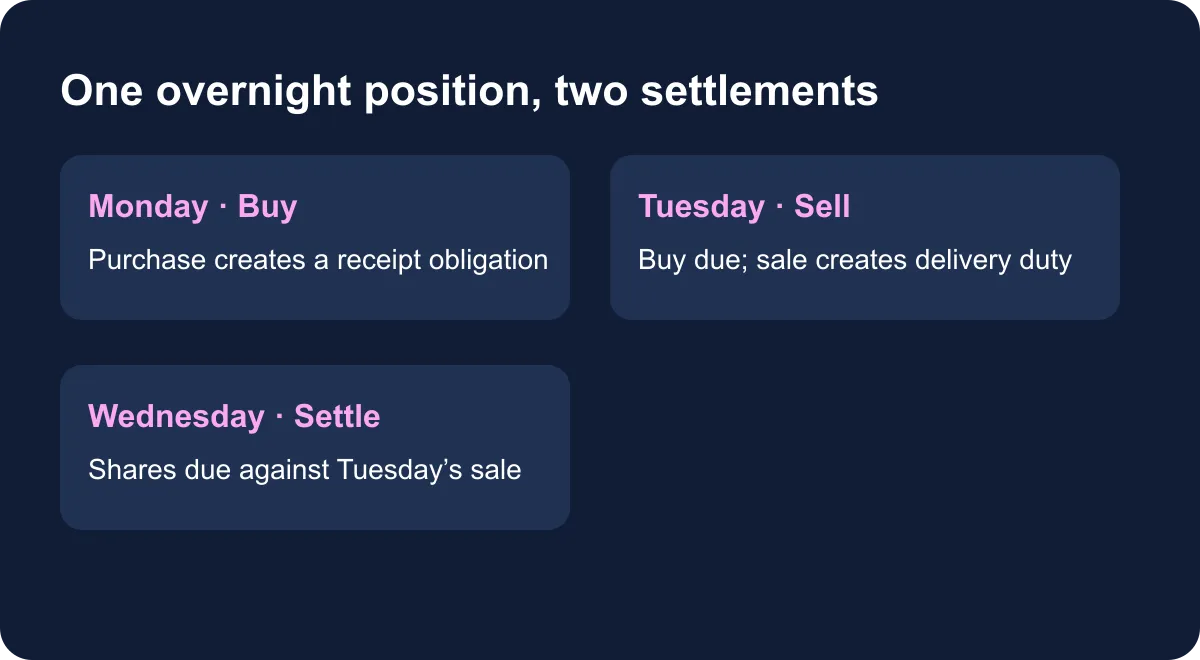
- Monday, T for the buy: You place a delivery buy order. A fill creates a payment obligation and an expected receipt of shares. Check the executed quantity, not the quantity originally entered.
- Tuesday, T+1 for the buy: The purchase is due to settle. If your broker permits an early sale, it may show the position under T1 holdings and let you sell before the incoming shares appear as settled. A filled sale creates a new obligation to deliver shares.
- Wednesday, T+1 for the sale: The outgoing shares are due for delivery and the sale settles under normal conditions. In one documented broker workflow, incoming shares are credited to the investor’s demat account and earmarked for the subsequent pay-in.
This sequence assumes both trades clear normally. If a settlement holiday intervenes, the scheduled dates can change. If the buy fills but the sell order does not, you still own the market exposure. If the sell fills but the buy later has a delivery shortage, the outgoing settlement obligation does not disappear.
Do not confuse order status with settlement status. An executed trade confirms the exchange match, the contract note records the transaction, and the demat statement shows actual securities movement. A temporary label in the trading app is useful for monitoring but is not a substitute for those records.
BTST vs Intraday vs Delivery Trading
The practical difference in BTST vs intraday comparisons is overnight exposure. A same-day cash-equity position that is fully squared off normally does not require delivery, whereas an overnight buy followed by an early sale relies on shares arriving for pay-in. Selling settled delivery holdings avoids dependence on that particular incoming purchase.
| Feature | Next-day sale before demat credit | Intraday square-off | Sale of settled delivery holdings |
|---|---|---|---|
| Typical exit | Next trading day, if permitted | Same trading session | After shares are credited; no fixed holding period |
| Overnight exposure | Yes | Normally no when fully closed | Yes if held overnight |
| Securities needed for the sale | Depends on incoming delivery or other eligible holdings | Usually no delivery for a fully offset normal-segment position | Shares are already available, subject to authorisation |
| Main execution constraint | Broker eligibility, incoming settlement and liquidity | Intraday product rules and square-off deadline | Available quantity, authorisation and liquidity |
In trade-for-trade securities, delivery obligations arise on each trade. Do not use the normal-segment intraday assumption for those securities. A broker may also impose tighter restrictions than the exchange’s trading eligibility.
Why Traders Use BTST
Some traders want to hold a position after the close because they expect a move to continue into the next session. Others establish an overnight position and reassess it when new information arrives. A BTST trading strategy can express a short-lived view without committing to a multi-day holding period. But it still requires two executable orders and enough cash for the purchase.
The time horizon alone is not a reason to trade. A trader should be able to state what would invalidate the position, how much could be lost if the open is worse than expected and whether there is enough liquidity to exit the planned quantity. For example, a quoted last price is not proof that several hundred shares can be sold at that price. Compare bid depth and the spread when evaluating listed stocks.
Potential Benefits of BTST
The main benefit of BTST trading is flexibility. When a broker permits it, you can respond during the next trading session rather than waiting for the purchase credit to appear in settled holdings. That can matter if there is new information before market open or if the price has already reached the level at which you wanted to exit.
The approach can also make a trading hypothesis easier to measure: compare the actual closing-session entry and next-day fill against the planned prices and costs. If testing a BTST trading strategy with algorithmic trading research , account for opening spreads, unfilled orders and restrictions on particular securities. A backtest that always buys at the previous closing price and sells at the next opening print may assume fills the strategy could not obtain.
Get research like this in your inbox
The week’s research that mattered, in five minutes. Joined by 2L+ investors.
Risks: Short Delivery, Volatility and Charges
Short delivery: The seller on your purchase may fail to deliver some or all of the shares. If you have already sold and lack other eligible shares to cover the outgoing obligation, your sale can also fall short. NSE Clearing’s securities settlement guidance explains that normal-segment shortages on T+1 can trigger a buy-in auction that day, with auction settlement on T+2. Some settlement types use direct close-out instead. An auction or cash adjustment on the purchase side does not necessarily cover the sale side in time.
Overnight gaps: Results, policy news or a global market move can put the stock’s first executable price well below your intended exit. A stop can specify when an order should trigger, but it cannot guarantee a fill or a price. A halt or a one-sided order book can make even a marketable order impossible to fill.
Costs: Brokerage where applicable, taxes, exchange fees and a demat debit can reduce a narrow price advantage. Slippage compounds the effect. In BTST trading, a small positive change from one day’s last price to the next day’s last price can still translate into a net loss at actual fills.
Operational errors: Check whether you need to authorise the debit and whether you are selling the right quantity. Pay particular attention if you already hold the same stock: the broker’s treatment of eligible settled holdings can change which shares are delivered and how your ledger looks.
BTST Settlement and Margin Considerations
A holding marked T1 is an expected receipt, not the same thing as freely available shares in your demat account. Verify that your broker permits a sale against it for the particular security and segment. Confirm upfront funds and applicable margin before entering the buy. Do not assume an intraday leverage product can be carried overnight or automatically converted to delivery.
Trading balance, settlement credit and withdrawable cash are different. For example, Zerodha’s explanation of T1 sale proceeds says the credit cannot be used on the same day. Check your own broker’s treatment before relying on an early sale to fund another purchase. Leave a cash buffer so that a funding delay does not turn one trade into a problem for another.
BTST trading can also be affected by changes to settlement cycles. The optional NSE Clearing T+0 framework operates alongside regular T+1, rather than changing every cash-equity trade to same-day settlement. Confirm which order window and settlement cycle apply when the example differs from your actual order.
BTST Charges and Tax Treatment
Estimate the full round-trip cost before placing an order. BTST charges can include brokerage, exchange transaction charges, securities transaction tax (STT), SEBI turnover fees, GST on applicable services and stamp duty on the purchase. A depository participant (DP) charge may apply when shares are debited. For example, Zerodha states that DP charges apply to its BTST demat credit-and-debit workflow. Zero delivery brokerage does not mean a zero-cost trade.
Use the broker’s tariff and contract note for exchange and trade charges, and inspect the ledger for any separately posted DP charge. Treat slippage as the difference between your assumed price and the price actually obtained, not as a separate charge if you have already used actual fills. Keep any auction debit or close-out credit separate when reconciling the outcome.
The holding period makes a next-day sale short term if the shares are capital assets. For a qualifying transfer subject to STT, the Income Tax Department’s guidance under the Income-tax Act, 2025 lists a 20% rate under Section 196, before any applicable surcharge and cess. If shares are held as stock-in-trade, the result is generally treated as business income instead. The trading label does not determine the tax head or taxable profit; consult a tax professional about your classification and which costs are deductible.
A Simple BTST Example
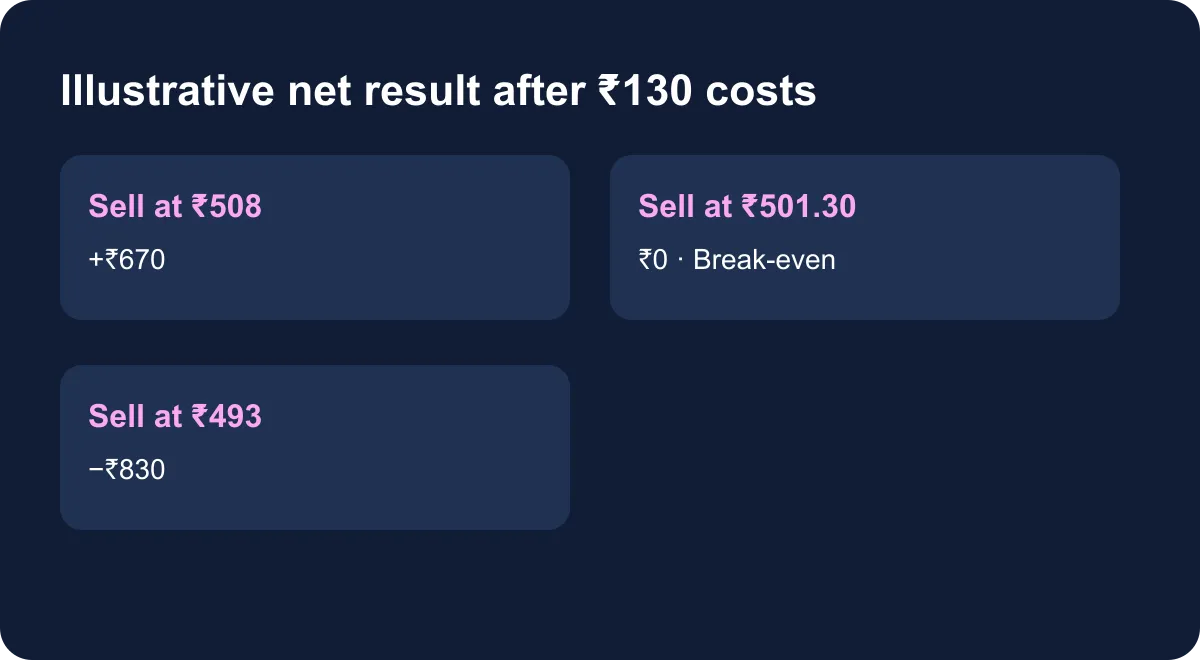
Assume you buy 100 shares of a hypothetical stock at ₹500 on Monday and place a next-day sale before the purchase settles. On Tuesday the sale fills at ₹508. The purchase settles on Tuesday and the sale settles on Wednesday. For this illustration, assume total round-trip charges of ₹130 in every scenario. This is not a broker quote and does not include income tax or a shortage adjustment.
| Tuesday sale price | Gross result on 100 shares | Illustrative result after ₹130 charges |
|---|---|---|
| ₹508.00 | +₹800 | +₹670 |
| ₹501.30 | +₹130 | ₹0 |
| ₹493.00 | −₹700 | −₹830 |
The break-even price is ₹501.30 because the illustrative cost is ₹1.30 per share. That figure moves with quantity, price and actual costs. If Tuesday’s first available bid is ₹493, the position can open below the planned exit; overnight losses are not bounded by the prior close.
Now suppose only 80 of the 100 incoming shares arrive. Unless other eligible holdings cover the gap, the outgoing sale may be short 20 shares. The price table does not capture what happens next. NSE Clearing’s shortage rules determine the applicable processing, and the broker’s settlement statement shows the resulting entries. A profitable screen price therefore does not establish the final result of BTST trading.
Is your portfolio built for what’s coming?
Get a free AI-powered review of your holdings — risk, overlap and quality in minutes.
FAQ
What happens if BTST shares are short delivered?
The clearing corporation may use an auction or a direct close-out, depending on the segment and circumstances. If you already sold and cannot deliver from other eligible holdings, the outgoing sale can also fall short. Ask the broker to identify which leg was affected and reconcile the securities credit or cash adjustment before calculating the final result.
Do all listed stocks support BTST trades?
No. Permissions depend on the broker, instrument, segment and any applicable surveillance or settlement restrictions. Check whether the broker accepts a sale from unsettled holdings for the specific stock. If the order is blocked, do not assume an intraday order is a substitute for delivering the shares.
How can a dividend or stock split affect a BTST position?
The exchange’s ex-date and the issuer’s record date determine the relevant entitlement process. A purchase on or after the ex-date generally does not carry the announced entitlement. Splits also change the basis for quoting prices and quantities. Check the corporate-action notice and ask the broker how it handles pending credits or shortages around the record date.
Can a trading halt or price band affect a BTST order?
Yes. A halt can prevent execution, and a price band can leave a stock with sellers but no matching buyers. A stop order may trigger without filling. Until the sale executes, the position remains exposed to further price movement.


