


India’s exchanges will hold their 2026 Diwali special session on Sunday, 8 November. The equity pre-open begins at 2:05 PM IST, and continuous trading starts at 2:20 PM. Non-CAS securities close at 3:30 PM, while stocks covered by the closing auction follow a different transition.
The session has cultural significance, but it remains a real market. Every order faces price, liquidity and execution risk, and every completed trade creates settlement obligations. The official muharat trading time should therefore be treated as an operating schedule, not a promise of favourable returns.
This guide covers the confirmed date, Samvat 2083, order windows and risk controls for diwali muhurat trading. It also separates tradition from evidence so investors can participate without abandoning their normal research process.
What Is Muhurat Trading?
Muhurat Trading is a special live session conducted by Indian exchanges around Diwali Laxmi Pujan. “Muhurat” refers to an auspicious period. Many participants use the session to make a symbolic first investment or mark the beginning of a new financial year in the traditional calendar.
In practical terms, the muhurat trading stock market session uses exchange systems, order matching and surveillance. It is shorter than a normal day, but trades are genuine. Participants need an active trading and demat account and must follow their broker’s operational rules.
The workbook keyword “muharat trading” reflects a common search spelling. In this article, muharat trading refers to the same exchange session officially described as Muhurat Trading. The cultural label does not change security valuation or expected return.
See what markets are pricing in
Live indices, sector moves and market breadth — the backdrop to every story we publish.
Muhurat Trading 2026 Date, Timings and Samvat 2083
The confirmed muhurat trading date is Sunday, 8 November 2026. NSE circular NSE/CMTR/76941 schedules the equity pre-open from 2:05 PM, continuous trading from 2:20 PM, and the non-CAS market close at 3:30 PM. All times are IST.
The main diwali trading time is therefore 2:20 PM to 3:30 PM for non-CAS equity securities. CAS securities stop continuous trading at 3:15 PM and move through the closing auction process. Equity F&O runs until 3:40 PM under its separate circular.
What Is Samvat 2083? Significance for Investors
Samvat 2083 is the Vikram Samvat year associated with Diwali 2026. Trading communities traditionally treat the festival as a new beginning, which gives diwali muhurat trading its symbolic role. Samvat is a cultural calendar reference, not an investment-performance measure.
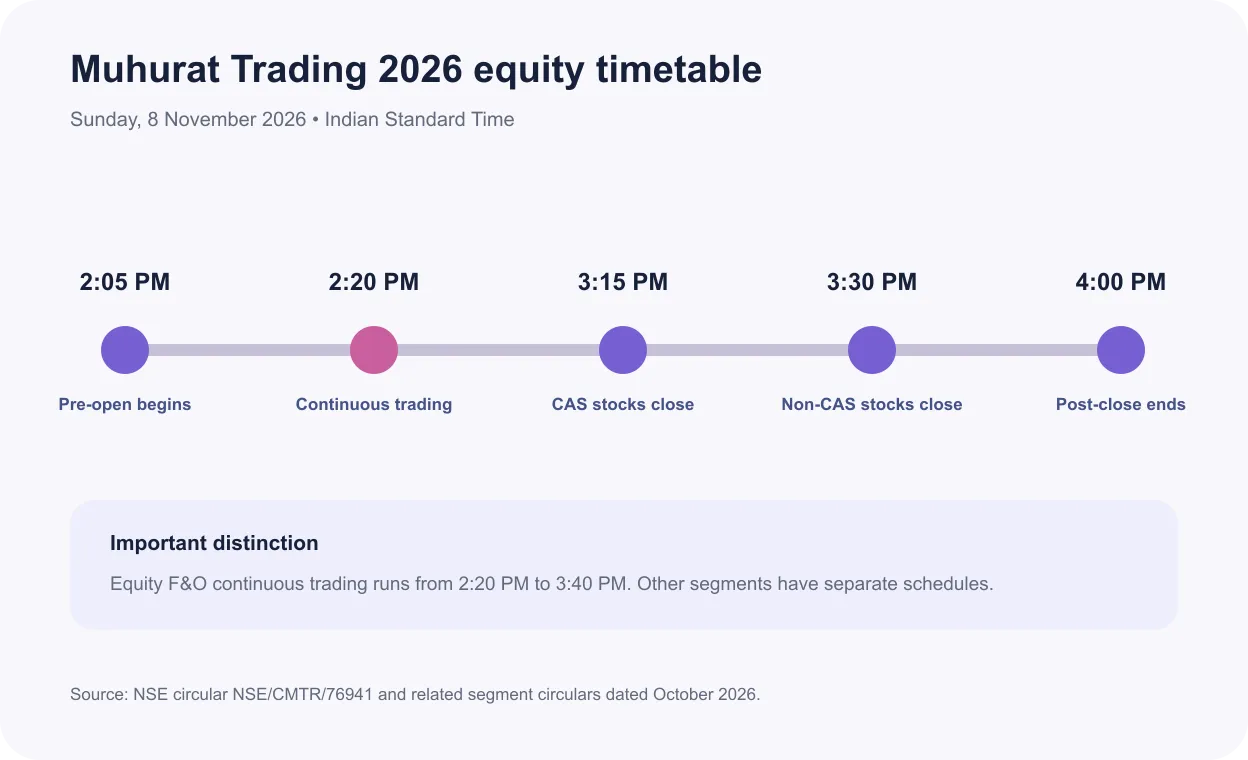
NSE/BSE Special Session: Timetable and Order Types
The special session contains more than one window. The table focuses on the main equity-market timetable and shows why investors should not reduce the muharat trading time to a single opening and closing number.
| Session | Start | End | Purpose |
|---|---|---|---|
| Block deal | 1:50 PM | 2:05 PM | Eligible negotiated block orders |
| Pre-open order entry | 2:05 PM | 2:15 PM* | Order entry, modification and cancellation under staged rules |
| Matching and buffer | 2:15 PM | 2:20 PM | Price discovery and transition |
| Continuous trading | 2:20 PM | 3:15/3:30 PM | CAS securities close earlier than non-CAS securities |
| Closing auction | 3:20 PM | 3:35 PM | Closing-price discovery for CAS securities |
| Post-close | 3:50 PM | 4:00 PM | Post-closing window |
*The exchange applies system-driven random closure during specified order-entry periods. Limit and market orders have different modification rules in the pre-open stage. Check the current broker interface before trading on diwali day.
How to Prepare for Muhurat Trading
Begin by confirming the muhurat trading date and segment. Then update KYC or account issues early, transfer only the required funds, and build a watchlist from research completed before the session.
Decide whether the order is symbolic or part of a planned portfolio change. For a symbolic purchase, keep the size modest. For an investment, review earnings, balance-sheet quality, valuation and portfolio fit exactly as you would on an ordinary day.
Verify the diwali trading time and the broker’s own order, intraday square-off and margin cut-offs. Use live bid and ask prices rather than the last traded price alone. Thin depth can make execution differ from expectation.
Get research like this in your inbox
The week’s research that mattered, in five minutes. Joined by 2L+ investors.
Should You Buy Stocks During Muhurat Trading?
Buying solely because the session is considered auspicious is not an investment thesis. A strong business can be overpriced, and a weak business does not improve because it is purchased during diwali muhurat trading.
The session may suit an investor who already has a researched purchase and accepts the available price. Readers exploring the muharat trading tradition can also use a very small order to mark the occasion without changing long-term asset allocation.
Use the muhurat trading stock market screen as a tool, not a recommendation list. If spreads are wide or the price exceeds your limit, skipping the trade is a valid outcome.
Risk Management for the Special Session
Set a maximum rupee exposure and use limit prices. Short sessions can concentrate orders and emotion. Avoid leverage unless it already fits a tested process, and do not assume a broker can close every position at the displayed price.
All completed orders carry ordinary settlement and tax consequences. Confirm product type, quantity and order status before the session ends. A mistaken intraday or delivery selection can create an unintended obligation.
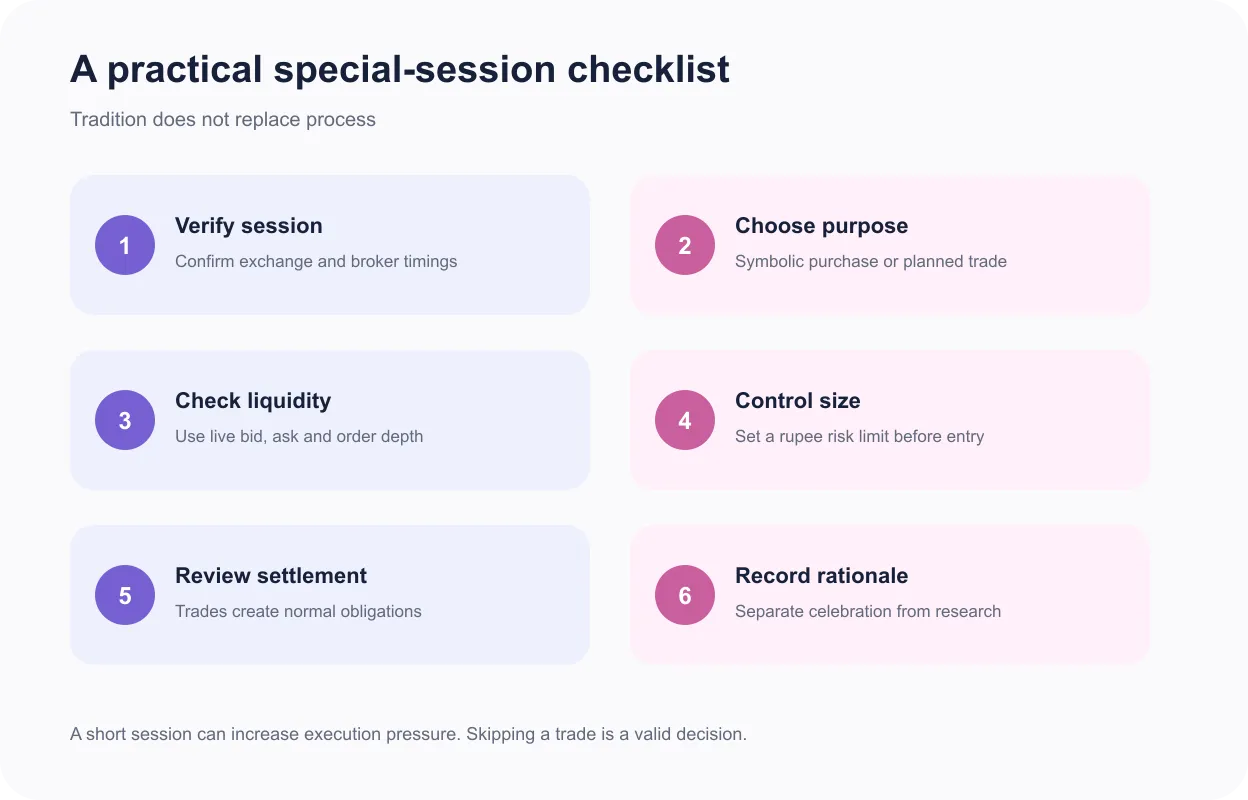
The second muharat trading time check should happen on the broker’s notice page because platform cut-offs can precede exchange closing. Record the reason for the trade and the exit or holding rule before placing it.
Past Performance: What It Can and Cannot Tell Investors
A positive close in a previous special session describes only that short window. It cannot establish that the next session, Samvat year or chosen stock will rise. The sample contains one brief event per year and is strongly affected by the surrounding market trend.
Historical diwali trading time returns can be reported as facts, but averaging them does not create a dependable forecast. A 70-minute move is not comparable with a full-year return, and headline indices may not reflect an individual security’s outcome.
Use past sessions to understand liquidity, volatility and operational behaviour. Do not use them as the sole reason for trading on diwali day. The final muharat trading decision should rest on valuation, diversification, horizon and risk capacity.
Is your portfolio built for what’s coming?
Get a free AI-powered review of your holdings — risk, overlap and quality in minutes.
FAQ
Why is Muhurat Trading held around Diwali?
It is a market tradition associated with Diwali Laxmi Pujan, prosperity, new beginnings and the opening of a new Samvat year for many trading and business communities.
Are all market segments open during the Muhurat Trading session?
No single timetable applies to every segment. Equity, equity derivatives, currency, commodities and debt-related platforms can have different windows, so investors must check the relevant exchange circular.
Do trades during Muhurat Trading receive any special tax treatment?
No. Trades create ordinary settlement, tax and charge consequences under the rules applicable to the security and transaction. The cultural significance does not create a separate tax category.
Who announces the official Muhurat Trading date and timings each year?
The recognised stock exchanges publish the official date and detailed segment schedules through holiday calendars, notices and circulars. Brokers may also publish operational cut-offs.


